QIMR Berghofer Medical Research Institute, Brisbane, Australia.
Melbourne School of Population and Global Health, University of Melbourne, Melbourne, Australia.
J Allergy Clin Immunol. 2014 Jun;133(6):1564-71. doi: 10.1016/j.jaci.2013.10.030. Epub 2013 Dec 31.
To date, no genome-wide association study (GWAS) has considered the combined phenotype of asthma with hay fever. Previous analyses of family data from the Tasmanian Longitudinal Health Study provide evidence that this phenotype has a stronger genetic cause than asthma without hay fever.
We sought to perform a GWAS of asthma with hay fever to identify variants associated with having both diseases.
We performed a meta-analysis of GWASs comparing persons with both physician-diagnosed asthma and hay fever (n = 6,685) with persons with neither disease (n = 14,091).
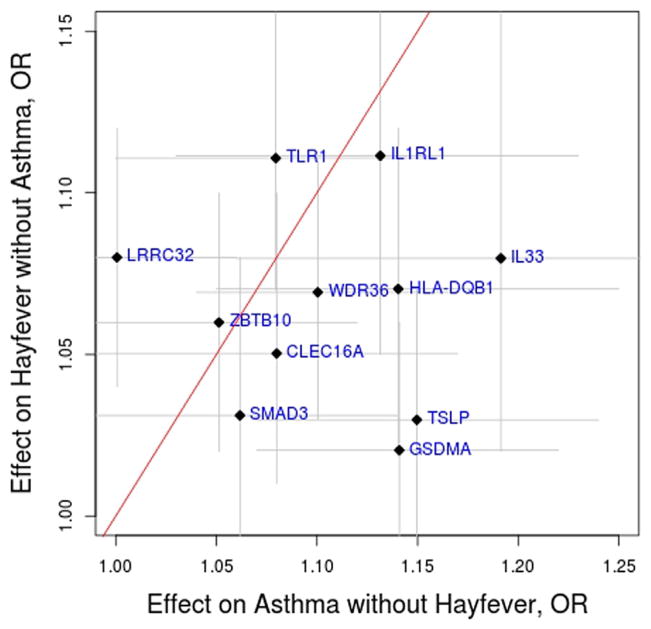
At genome-wide significance, we identified 11 independent variants associated with the risk of having asthma with hay fever, including 2 associations reaching this level of significance with allergic disease for the first time: ZBTB10 (rs7009110; odds ratio [OR], 1.14; P = 4 × 10(-9)) and CLEC16A (rs62026376; OR, 1.17; P = 1 × 10(-8)). The rs62026376:C allele associated with increased asthma with hay fever risk has been found to be associated also with decreased expression of the nearby DEXI gene in monocytes. The 11 variants were associated with the risk of asthma and hay fever separately, but the estimated associations with the individual phenotypes were weaker than with the combined asthma with hay fever phenotype. A variant near LRRC32 was a stronger risk factor for hay fever than for asthma, whereas the reverse was observed for variants in/near GSDMA and TSLP. Single nucleotide polymorphisms with suggestive evidence for association with asthma with hay fever risk included rs41295115 near IL2RA (OR, 1.28; P = 5 × 10(-7)) and rs76043829 in TNS1 (OR, 1.23; P = 2 × 10(-6)).
By focusing on the combined phenotype of asthma with hay fever, variants associated with the risk of allergic disease can be identified with greater efficiency.
迄今为止,尚无全基因组关联研究(GWAS)同时考虑哮喘和花粉热的综合表型。塔斯马尼亚纵向健康研究的家族数据分析先前提供的证据表明,这种表型的遗传原因比没有花粉热的哮喘更强。
我们试图对哮喘合并花粉热进行 GWAS,以确定与同时患有这两种疾病相关的变异。
我们对比较同时患有医生诊断的哮喘和花粉热(n=6685)和既无疾病(n=14091)的 GWAS 进行了荟萃分析。
在全基因组显著水平上,我们确定了 11 个与患有哮喘合并花粉热的风险相关的独立变异,其中 2 个与过敏疾病首次达到这一显著水平的关联:ZBTB10(rs7009110;比值比[OR],1.14;P=4×10(-9))和 CLEC16A(rs62026376;OR,1.17;P=1×10(-8))。与哮喘合并花粉热风险增加相关的 rs62026376:C 等位基因已被发现也与单核细胞中附近的 DEXI 基因表达降低相关。这 11 个变异与哮喘和花粉热的风险分别相关,但与综合哮喘合并花粉热表型的估计关联较弱。LRRC32 附近的一个变体是花粉热的更强危险因素,而 GSDMA 和 TSLP 附近的变体则相反。与哮喘合并花粉热风险具有提示性关联的单核苷酸多态性包括 IL2RA 附近的 rs41295115(OR,1.28;P=5×10(-7))和 TNS1 中的 rs76043829(OR,1.23;P=2×10(-6))。
通过关注哮喘合并花粉热的综合表型,可以更有效地识别与过敏疾病风险相关的变异。