Genetics and Computational Biology, QIMR Berghofer Medical Research Institute, Brisbane, Australia.
University of Groningen, University Medical Center Groningen, Epidemiology, Groningen Research Institute for Asthma and COPD, Groningen, the Netherlands.
PLoS Genet. 2020 Jun 30;16(6):e1008725. doi: 10.1371/journal.pgen.1008725. eCollection 2020 Jun.
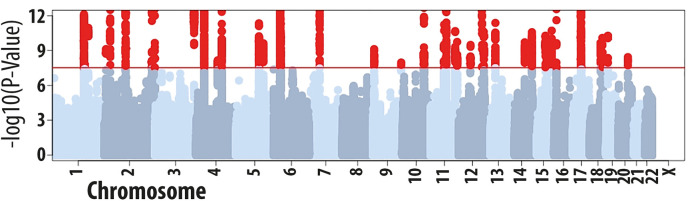
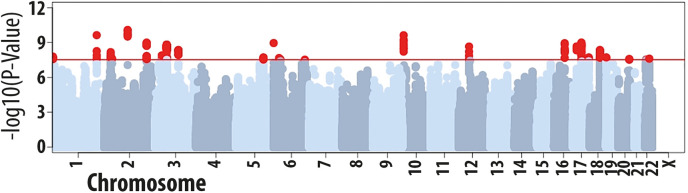
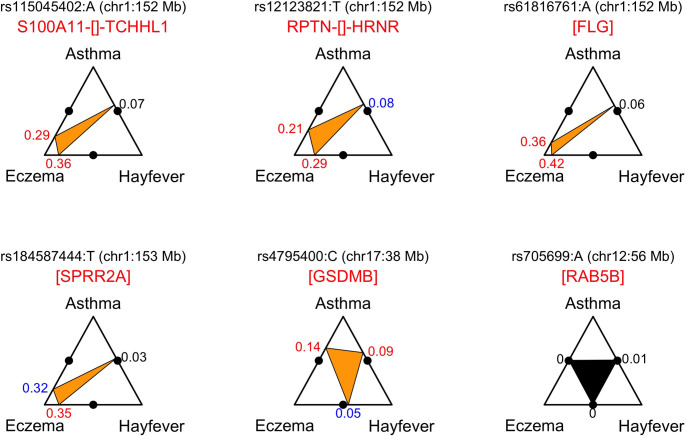
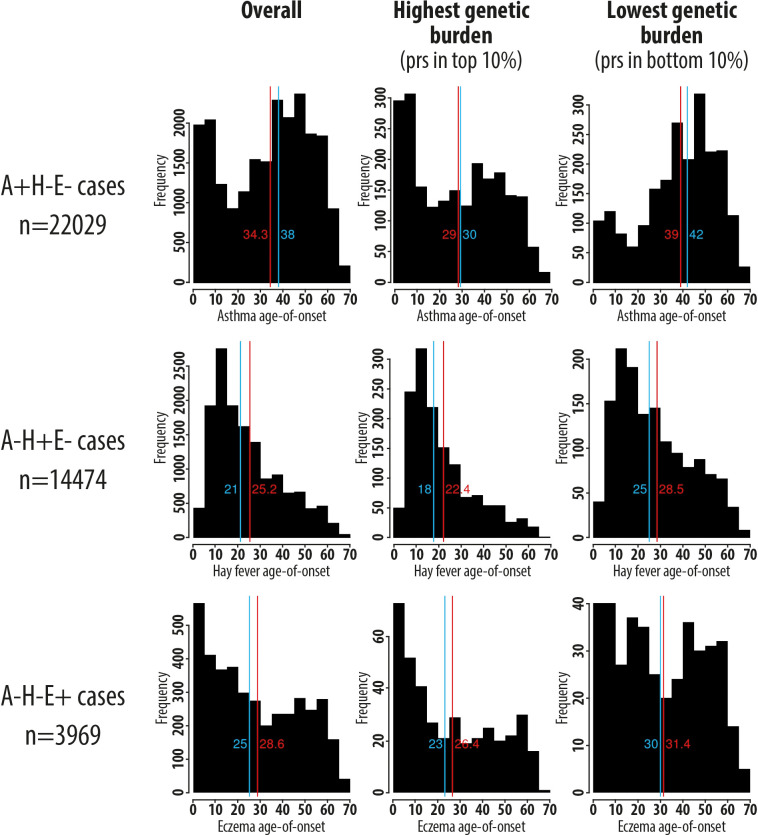
Risk factors that contribute to inter-individual differences in the age-of-onset of allergic diseases are poorly understood. The aim of this study was to identify genetic risk variants associated with the age at which symptoms of allergic disease first develop, considering information from asthma, hay fever and eczema. Self-reported age-of-onset information was available for 117,130 genotyped individuals of European ancestry from the UK Biobank study. For each individual, we identified the earliest age at which asthma, hay fever and/or eczema was first diagnosed and performed a genome-wide association study (GWAS) of this combined age-of-onset phenotype. We identified 50 variants with a significant independent association (P<3x10⁻⁸) with age-of-onset. Forty-five variants had comparable effects on the onset of the three individual diseases and 38 were also associated with allergic disease case-control status in an independent study (n = 222,484). We observed a strong negative genetic correlation between age-of-onset and case-control status of allergic disease (rg = -0.63, P = 4.5x10-61), indicating that cases with early disease onset have a greater burden of allergy risk alleles than those with late disease onset. Subsequently, a multivariate GWAS of age-of-onset and case-control status identified a further 26 associations that were missed by the univariate analyses of age-of-onset or case-control status only. Collectively, of the 76 variants identified, 18 represent novel associations for allergic disease. We identified 81 likely target genes of the 76 associated variants based on information from expression quantitative trait loci (eQTL) and non-synonymous variants, of which we highlight ADAM15, FOSL2, TRIM8, BMPR2, CD200R1, PRKCQ, NOD2, SMAD4, ABCA7 and UBE2L3. Our results support the notion that early and late onset allergic disease have partly distinct genetic architectures, potentially explaining known differences in pathophysiology between individuals.
导致过敏性疾病发病年龄个体差异的风险因素尚未完全阐明。本研究旨在鉴定与过敏症状首次出现相关的遗传风险变异,同时考虑哮喘、花粉热和湿疹的信息。英国生物库研究中的 117130 名欧洲血统个体提供了自我报告的发病年龄信息。对于每个个体,我们确定了首次诊断出哮喘、花粉热和/或湿疹的最早年龄,并对该综合发病年龄表型进行了全基因组关联研究(GWAS)。我们鉴定了 50 个具有显著独立关联(P<3x10⁻⁸)的变异与发病年龄有关。45 个变异对三种个体疾病的发病有类似的影响,38 个变异在一项独立研究(n = 222484)中与过敏疾病病例对照状态也有关联。我们观察到发病年龄与过敏疾病病例对照状态之间存在强烈的负遗传相关性(rg = -0.63,P = 4.5x10-61),表明发病年龄早的病例比发病年龄晚的病例携带更多的过敏风险等位基因。随后,对发病年龄和病例对照状态的多变量 GWAS 鉴定出了进一步的 26 个关联,这些关联在仅对发病年龄或病例对照状态进行单变量分析时被遗漏。在鉴定出的 76 个变异中,18 个代表过敏疾病的新关联。我们根据表达数量性状基因座(eQTL)和非同义变异的信息,确定了 76 个相关变异中的 81 个可能的靶基因,其中我们重点介绍了 ADAM15、FOSL2、TRIM8、BMPR2、CD200R1、PRKCQ、NOD2、SMAD4、ABCA7 和 UBE2L3。我们的研究结果支持这样一种观点,即早发性和晚发性过敏疾病具有部分不同的遗传结构,这可能解释了个体间病理生理学已知的差异。