Genetics and Computational Biology, QIMR Berghofer Medical Research Institute, Brisbane, Australia.
Epidemiology, University of Groningen, University Medical Center Groningen, Groningen Research Institute for Asthma and COPD, Groningen, The Netherlands.
J Allergy Clin Immunol. 2019 Feb;143(2):691-699. doi: 10.1016/j.jaci.2018.03.012. Epub 2018 Apr 19.
A recent genome-wide association study (GWAS) identified 99 loci that contain genetic risk variants shared between asthma, hay fever, and eczema. Many more risk loci shared between these common allergic diseases remain to be discovered, which could point to new therapeutic opportunities.
We sought to identify novel risk loci shared between asthma, hay fever, and eczema by applying a gene-based test of association to results from a published GWAS that included data from 360,838 subjects.
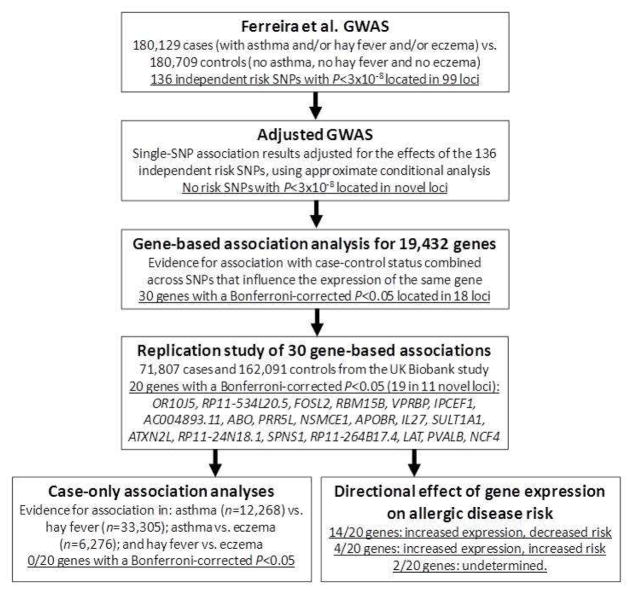
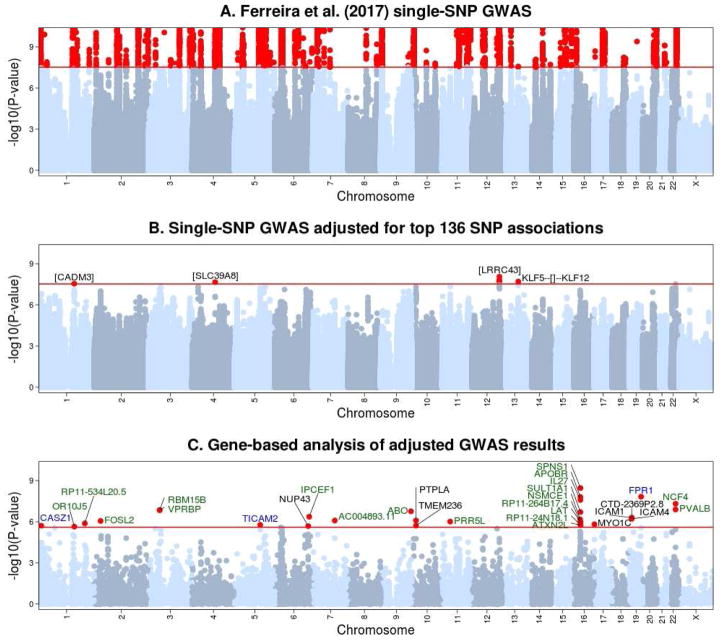
We used approximate conditional analysis to adjust the results from the published GWAS for the effects of the top risk variants identified in that study. We then analyzed the adjusted GWAS results with the EUGENE gene-based approach, which combines evidence for association with disease risk across regulatory variants identified in different tissues. Novel gene-based associations were followed up in an independent sample of 233,898 subjects from the UK Biobank study.
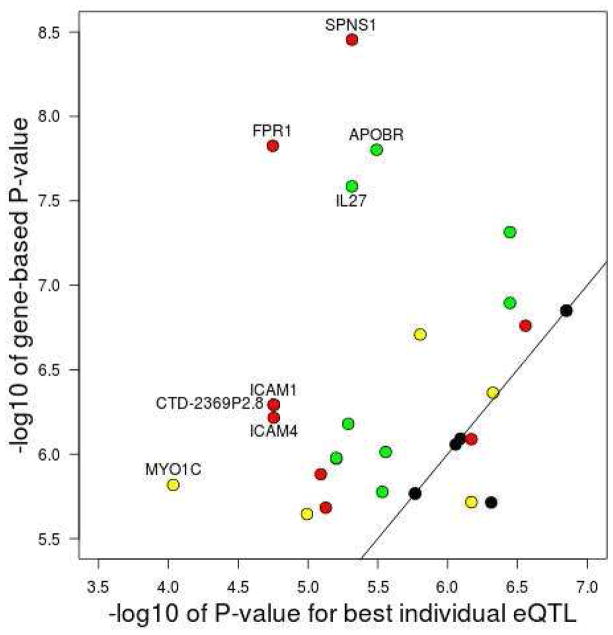
Of the 19,432 genes tested, 30 had a significant gene-based association at a Bonferroni-corrected P value of 2.5 × 10. Of these, 20 were also significantly associated (P < .05/30 = .0016) with disease risk in the replication sample, including 19 that were located in 11 loci not reported to contain allergy risk variants in previous GWASs. Among these were 9 genes with a known function that is directly relevant to allergic disease: FOSL2, VPRBP, IPCEF1, PRR5L, NCF4, APOBR, IL27, ATXN2L, and LAT. For 4 genes (eg, ATXN2L), a genetically determined decrease in gene expression was associated with decreased allergy risk, and therefore drugs that inhibit gene expression or function are predicted to ameliorate disease symptoms. The opposite directional effect was observed for 14 genes, including IL27, a cytokine known to suppress T2 responses.
Using a gene-based approach, we identified 11 risk loci for allergic disease that were not reported in previous GWASs. Functional studies that investigate the contribution of the 19 associated genes to the pathophysiology of allergic disease and assess their therapeutic potential are warranted.
最近的全基因组关联研究(GWAS)确定了 99 个包含哮喘、花粉热和湿疹遗传风险变异的基因座。这些常见过敏性疾病之间仍有许多风险基因座有待发现,这可能指向新的治疗机会。
我们通过对包含 360838 名受试者数据的已发表 GWAS 结果进行基于基因的关联检验,旨在鉴定哮喘、花粉热和湿疹之间的新风险基因座。
我们使用近似条件分析调整了该研究中确定的顶级风险变异的影响后的已发表 GWAS 结果。然后,我们使用 EUGENE 基于基因的方法分析了调整后的 GWAS 结果,该方法结合了不同组织中鉴定的与疾病风险相关的调节变异的关联证据。在英国生物库研究的 233898 名独立样本中对新的基于基因的关联进行了随访。
在测试的 19432 个基因中,有 30 个基因在经过 Bonferroni 校正的 P 值<2.5×10时具有显著的基于基因的关联。其中,20 个基因在复制样本中与疾病风险显著相关(P<0.05/30=0.0016),包括 19 个位于以前的 GWAS 未报告含有过敏风险变异的 11 个基因座中。其中包括 9 个具有直接与过敏疾病相关的已知功能的基因:FOSL2、VPRBP、IPCEF1、PRR5L、NCF4、APOB、IL27、ATXN2L 和 LAT。对于 4 个基因(例如 ATXN2L),基因表达的遗传决定降低与过敏风险降低相关,因此抑制基因表达或功能的药物预计可以改善疾病症状。相反的效果在 14 个基因中观察到,包括已知抑制 T2 反应的细胞因子 IL27。
使用基于基因的方法,我们鉴定了 11 个以前的 GWAS 未报告的过敏疾病风险基因座。有必要进行功能研究,以研究 19 个相关基因对过敏疾病病理生理学的贡献,并评估它们的治疗潜力。