Townsend Kristy L, Tseng Yu-Hua
Joslin Diabetes Center and Harvard Medical School, One Joslin Place, Boston, MA 02215, USA.
Joslin Diabetes Center and Harvard Medical School, One Joslin Place, Boston, MA 02215, USA; Harvard Stem Cell Institute, Harvard University, Cambridge, MA, USA.
Trends Endocrinol Metab. 2014 Apr;25(4):168-77. doi: 10.1016/j.tem.2013.12.004. Epub 2014 Jan 2.
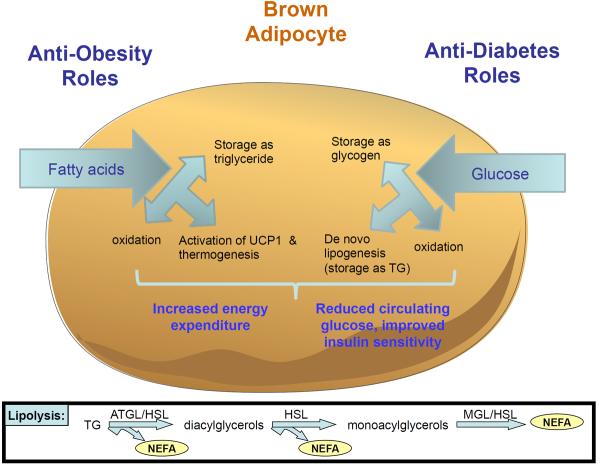
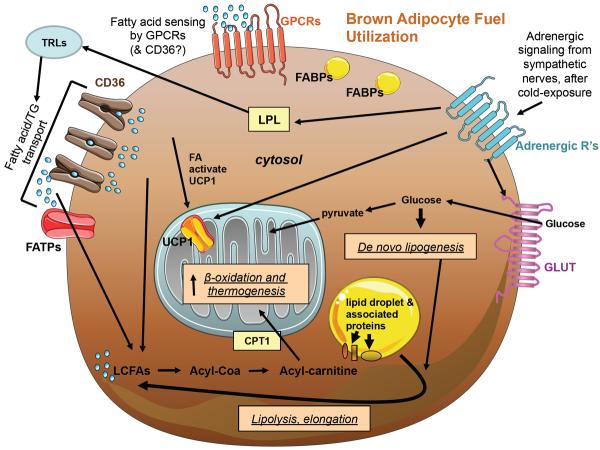
Brown adipose tissue (BAT) dissipates energy as heat to maintain optimal thermogenesis and to contribute to energy expenditure in rodents and possibly humans. The energetic processes executed by BAT require a readily-available fuel supply, which includes glucose and fatty acids (FAs). FAs become available by cellular uptake, de novo lipogenesis, and multilocular lipid droplets in brown adipocytes. BAT also possesses a great capacity for glucose uptake and metabolism, and an ability to regulate insulin sensitivity. These properties make BAT an appealing target for the treatment of obesity, diabetes, and other metabolic disorders. Recent research has provided a better understanding of the processes of fuel utilization carried out by brown adipocytes, which is the focus of the current review.
棕色脂肪组织(BAT)以热量形式消耗能量,以维持最佳的产热作用,并有助于啮齿动物以及可能在人类中消耗能量。BAT执行的能量过程需要随时可用的燃料供应,其中包括葡萄糖和脂肪酸(FAs)。脂肪酸通过细胞摄取、从头脂肪生成以及棕色脂肪细胞中的多泡脂质滴来提供。BAT还具有很强的葡萄糖摄取和代谢能力,以及调节胰岛素敏感性的能力。这些特性使BAT成为治疗肥胖症、糖尿病和其他代谢紊乱的有吸引力的靶点。最近的研究使人们对棕色脂肪细胞进行的燃料利用过程有了更好的理解,这也是本综述的重点。