Doglioni C, Dell'Orto P, Coggi G, Iuzzolino P, Bontempini L, Viale G
Am J Pathol. 1987 Jun;127(3):519-29.
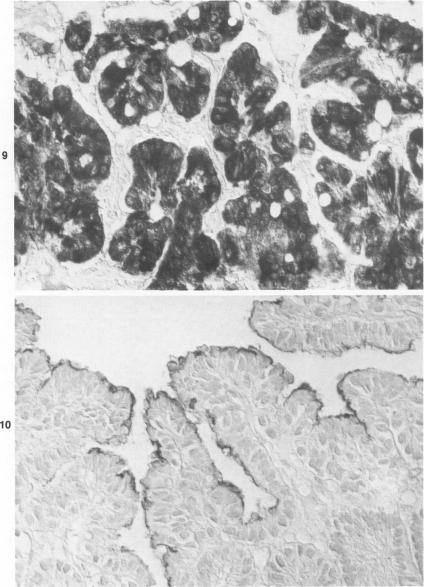
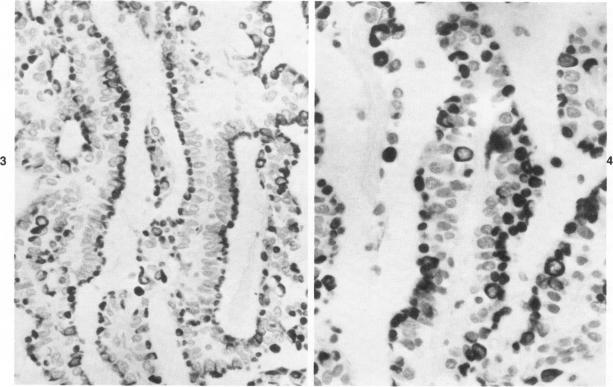
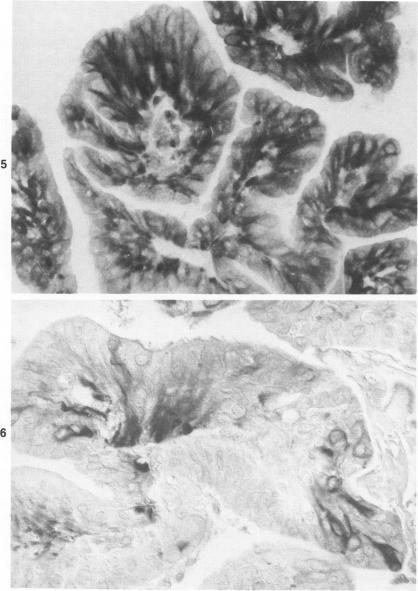
Sixteen choroid plexus tumors (CPTs) have been investigated for the localization of different immunocytochemical markers of epithelial and nonepithelial nature, namely, simple epithelial-type cytokeratins, vimentin, glial fibrillary acidic protein (GFAP), a panepithelial antigen defined by the lu-5 monoclonal antibody (lu-5 antigen), S-100 protein, and epithelial membrane antigen (EMA). Intermediate filament proteins have been identified in paraffin sections of 14 of 16 cases (87.5%). In all these tumors, cytokeratins and vimentin were constantly coexpressed by the neoplastic cells, in a manner similar to that of the cells lining normal choroid plexus. In 7 of these 14 cases, in addition to cytokeratins and vimentin, the neoplastic cells were shown to coexpress GFAP, which is not synthesized by their normal cell counterpart. The appearance of GFAP immunoreactivity in CPTs might be related to an ependymal differentiation of the neoplastic cells, because normal ependyma and ependymomas constantly coexpress GFAP and vimentin. The simultaneous expression of three distinct intermediate filament proteins by the same neoplastic cells is an exceedingly rare phenomenon, which has never been reported by double labeling technique in neoplasms of the central nervous system. Despite the complex antigenic profile of the CPT, which includes immunoreactivity for lu-5 antigen, S-100 protein, and EMA in most of the cases, positivity for three different epithelial markers indicates that these tumors have an epithelial nature. Moreover, the immunocytochemical typing of CPT with the panel of antibodies used in the current investigation allows differentiation from other primary and metastatic central nervous system tumors.
对16例脉络丛肿瘤(CPT)进行了研究,以定位具有上皮和非上皮性质的不同免疫细胞化学标志物,即简单上皮型细胞角蛋白、波形蛋白、胶质纤维酸性蛋白(GFAP)、由lu-5单克隆抗体定义的全上皮抗原(lu-5抗原)、S-100蛋白和上皮膜抗原(EMA)。16例中有14例(87.5%)的石蜡切片中鉴定出中间丝蛋白。在所有这些肿瘤中,肿瘤细胞持续共表达细胞角蛋白和波形蛋白,其方式类似于正常脉络丛内衬细胞。在这14例中的7例中,除细胞角蛋白和波形蛋白外,肿瘤细胞还共表达GFAP,而其正常细胞对应物不合成GFAP。CPT中GFAP免疫反应性的出现可能与肿瘤细胞的室管膜分化有关,因为正常室管膜和室管膜瘤持续共表达GFAP和波形蛋白。同一肿瘤细胞同时表达三种不同的中间丝蛋白是一种极其罕见的现象,在中枢神经系统肿瘤中从未通过双重标记技术报道过。尽管CPT具有复杂的抗原谱,在大多数病例中包括对lu-5抗原、S-100蛋白和EMA的免疫反应性,但三种不同上皮标志物呈阳性表明这些肿瘤具有上皮性质。此外,使用本研究中所用抗体组对CPT进行免疫细胞化学分型可与其他原发性和转移性中枢神经系统肿瘤相鉴别。