Institute of Orthopaedic Research and Biomechanics, Center of Musculoskeletal Research, University of Ulm, Ulm, Germany.
Department of Osteology and Biomechanics, University Medical Center Hamburg-Eppendorf, Hamburg, Germany.
PLoS One. 2013 Dec 31;8(12):e84232. doi: 10.1371/journal.pone.0084232. eCollection 2013.
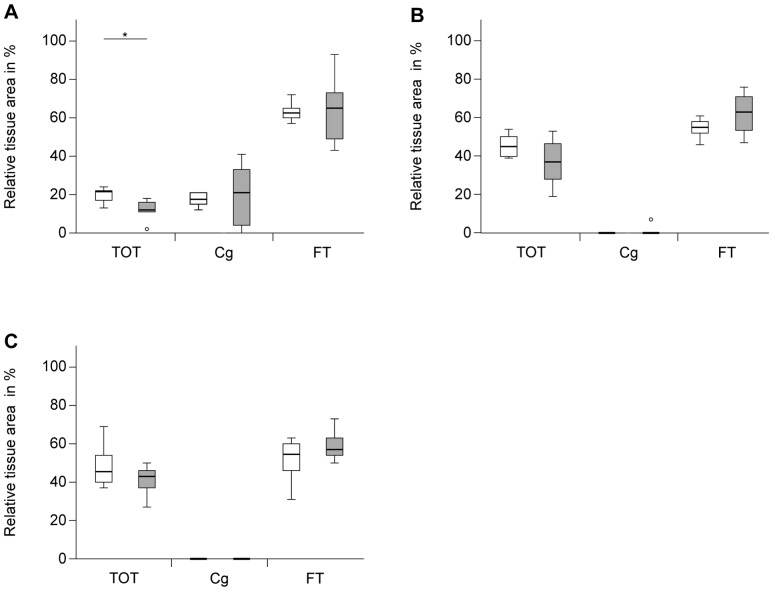
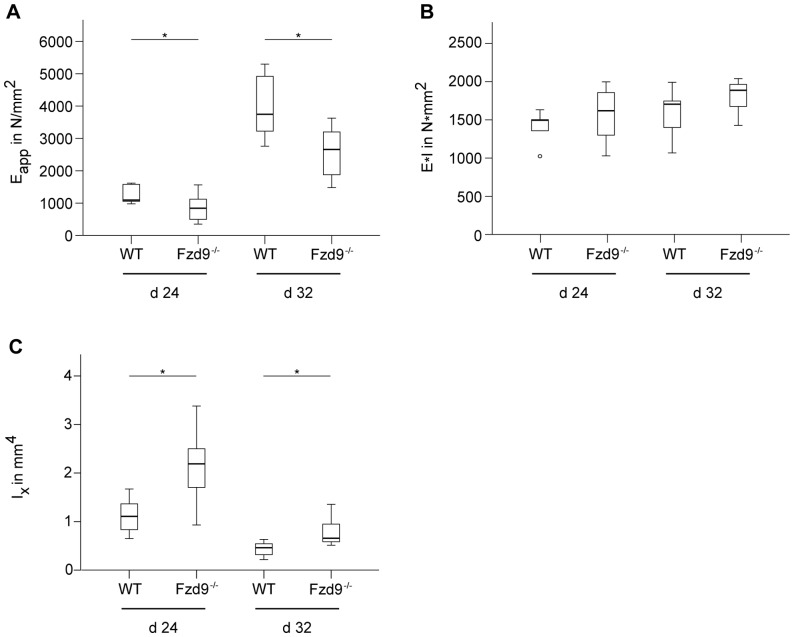
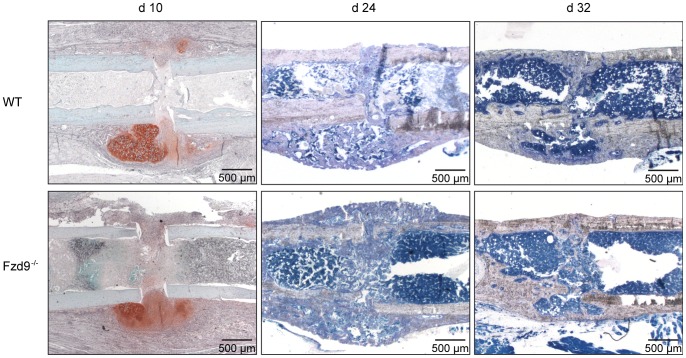
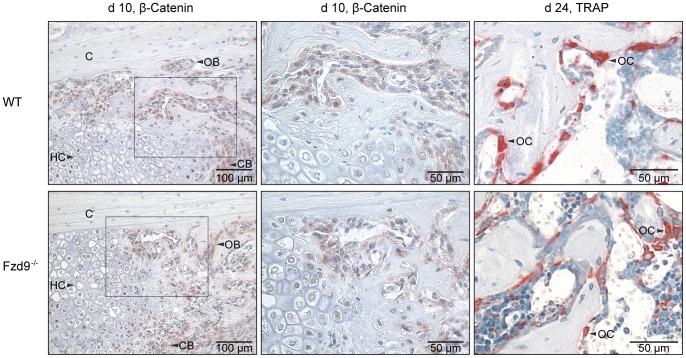
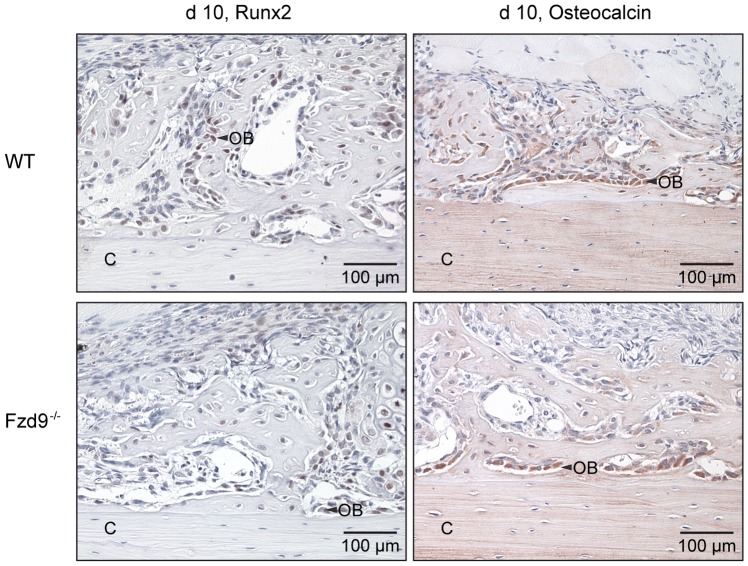
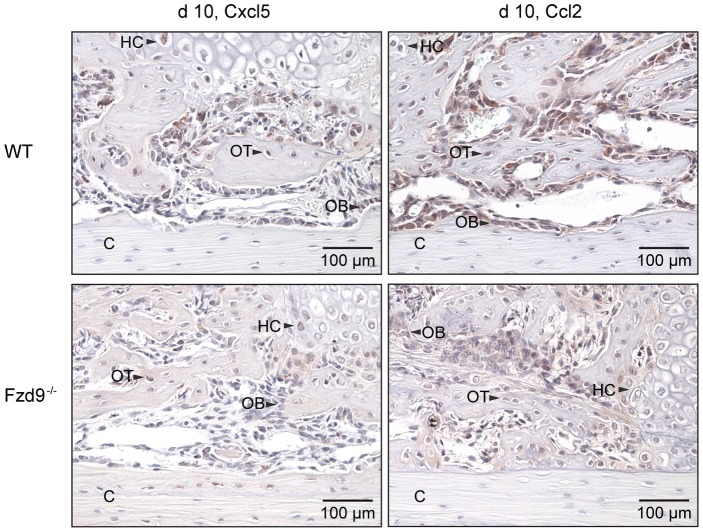
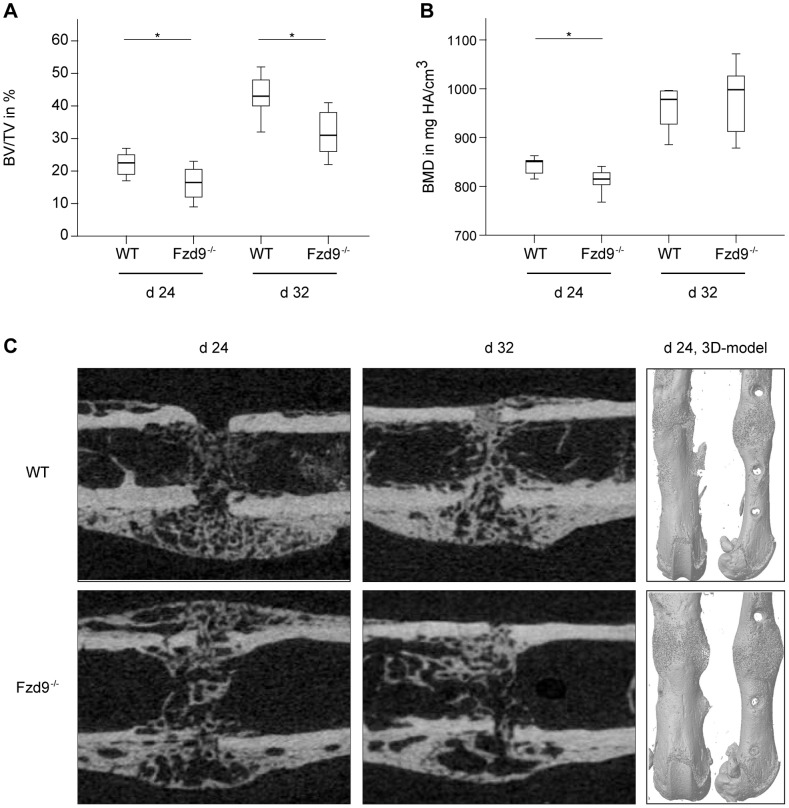
Wnt signaling is a key regulator of bone metabolism and fracture healing. The canonical Wnt/β-catenin pathway is regarded as the dominant mechanism, and targeting this pathway has emerged as a promising strategy for the treatment of osteoporosis and poorly healing fractures. In contrast, little is known about the role of non-canonical Wnt signaling in bone. Recently, it was demonstrated that the serpentine receptor Fzd9, a Wnt receptor of the Frizzled family, is essential for osteoblast function and positively regulates bone remodeling via the non-canonical Wnt pathway without involving β-catenin-dependent signaling. Here we investigated whether the Fzd9 receptor is essential for fracture healing using a femur osteotomy model in Fzd9(-/-) mice. After 10, 24 and 32 days the fracture calli were analyzed using biomechanical testing, histomorphometry, immunohistochemistry, and micro-computed tomography. Our results demonstrated significantly reduced amounts of newly formed bone at all investigated healing time points in the absence of Fzd9 and, accordingly, a decreased mechanical competence of the callus tissue in the late phase of fracture healing. In contrast, cartilage formation and numbers of osteoclasts degrading mineralized matrix were unaltered. β-Catenin immunolocalization showed that canonical Wnt-signaling was not affected in the absence of Fzd9 in osteoblasts as well as in proliferating and mature chondrocytes within the fracture callus. The expression of established differentiation markers was not altered in the absence of Fzd9, whereas chemokines Ccl2 and Cxcl5 seemed to be reduced. Collectively, our results suggest that non-canonical signaling via the Fzd9 receptor positively regulates intramembranous and endochondral bone formation during fracture healing, whereas it does not participate in the formation of cartilage or in the osteoclastic degradation of mineralized matrix. The finding that Fzd9, in addition to its role in physiological bone remodeling, regulates bone repair may have implications for the development of treatments for poorly or non-healing fractures.
Wnt 信号通路是骨代谢和骨折愈合的关键调节因子。经典的 Wnt/β-catenin 信号通路被认为是主要机制,针对该通路已成为治疗骨质疏松症和愈合不良骨折的有前途的策略。相比之下,人们对非经典 Wnt 信号通路在骨中的作用知之甚少。最近,研究表明卷曲受体 Fzd9(卷曲受体家族的 Wnt 受体)是成骨细胞功能所必需的,它通过非经典 Wnt 通路正向调节骨重塑,而不涉及β-catenin 依赖性信号转导。在这里,我们使用 Fzd9(-/-) 小鼠的股骨切开模型研究了 Fzd9 受体是否对骨折愈合至关重要。在 10、24 和 32 天时,通过生物力学测试、组织形态计量学、免疫组织化学和微计算机断层扫描分析骨折愈合。我们的研究结果表明,在缺乏 Fzd9 的情况下,所有研究的愈合时间点的新形成骨量明显减少,并且相应地,在骨折愈合的晚期,骨痂组织的机械性能降低。相比之下,软骨形成和降解矿化基质的破骨细胞数量没有改变。β-catenin 免疫定位显示,在缺乏 Fzd9 的情况下,经典 Wnt 信号通路在成骨细胞以及骨折愈合过程中增殖和成熟的软骨细胞中不受影响。在缺乏 Fzd9 的情况下,已建立的分化标志物的表达没有改变,而趋化因子 Ccl2 和 Cxcl5 似乎减少。总的来说,我们的研究结果表明,Fzd9 受体的非经典信号通过正调节骨折愈合过程中的膜内和软骨内骨形成,而不参与软骨形成或矿化基质的破骨细胞降解。除了在生理骨重塑中的作用外,Fzd9 调节骨修复的发现可能对治疗愈合不良或不愈合的骨折的治疗方法的发展具有重要意义。