Yanagisawa Rie, Koike Eiko, Win-Shwe Tin-Tin, Yamamoto Megumi, Takano Hirohisa
Center for Environmental Health Sciences, National Institute for Environmental Studies, Tsukuba, Japan.
Environ Health Perspect. 2014 Mar;122(3):277-83. doi: 10.1289/ehp.1307421. Epub 2014 Jan 7.
Hexabromocyclododecane (HBCD) is an additive flame retardant used in the textile industry and in polystyrene foam manufacturing. Because of its lipophilicity and persistency, HBCD accumulates in adipose tissue and thus has the potential of causing metabolic disorders through disruption of lipid and glucose homeostasis. However, the association between HBCD and obesity remains unclear.
We investigated whether exposure to HBCD contributes to initiation and progression of obesity and related metabolic dysfunction in mice fed a normal diet (ND) or a high-fat diet (HFD).
Male C57BL/6J mice were fed a HFD (62.2 kcal% fat) or a ND and treated orally with HBCD (0, 1.75, 35, or 700 μg/kg body weight) weekly from 6 to 20 weeks of age. We examined body weight, liver weight, blood biochemistry, histopathological changes, and gene expression profiles in the liver and adipose tissue.
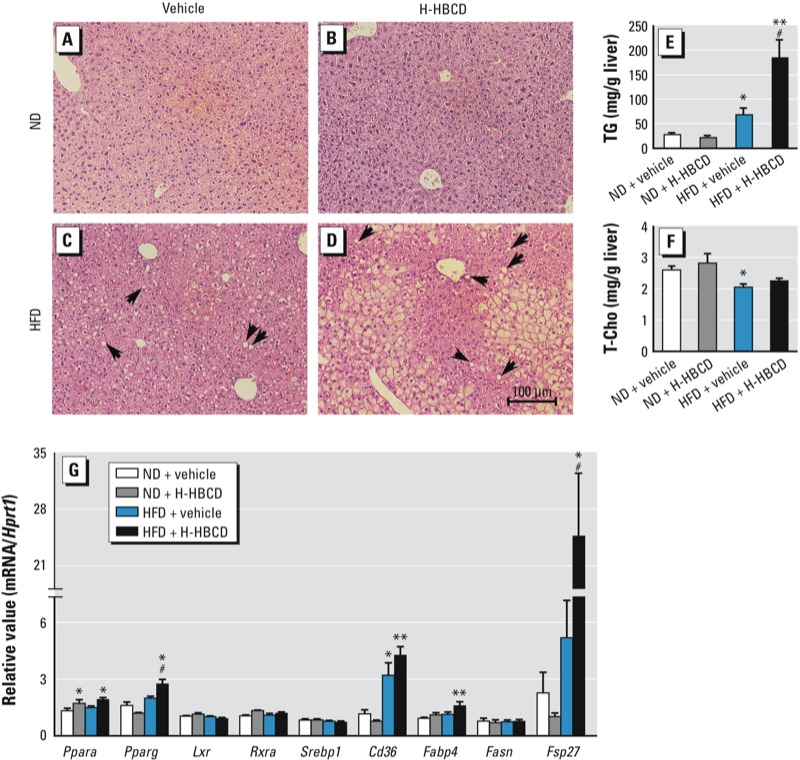
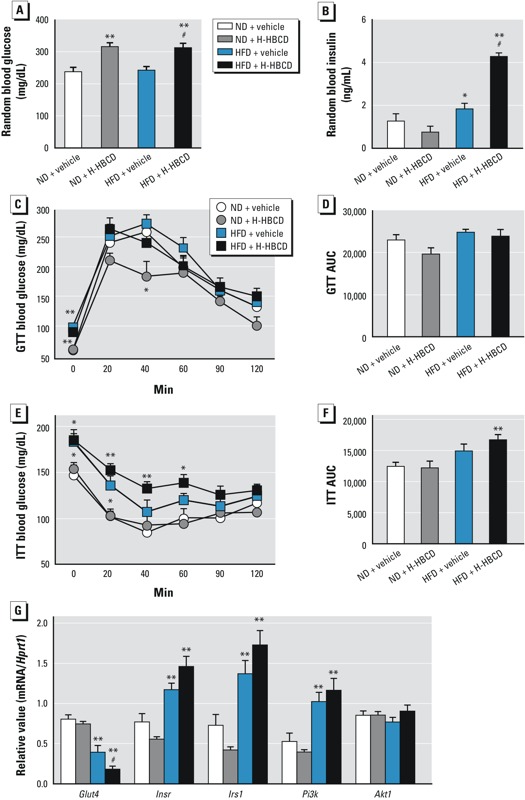
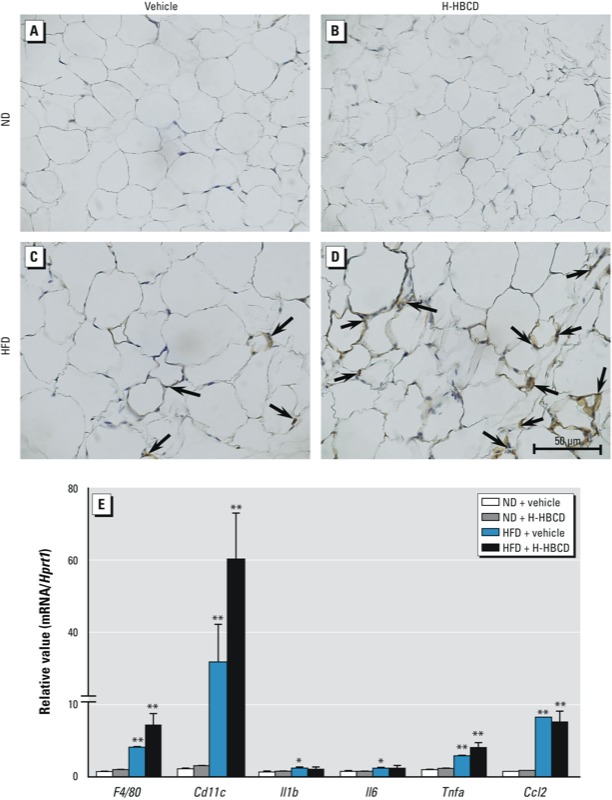
In HFD-fed mice, body and liver weight were markedly increased in mice treated with the high (700 μg/kg) and medium (35 μg/kg) doses of HBCD compared with vehicle. This effect was more prominent in the high-dose group. These increases were paralleled by increases in random blood glucose and insulin levels and enhancement of microvesicular steatosis and macrophage accumulation in adipose tissue. HBCD-treated HFD-fed mice also had increased mRNA levels of Pparg (peroxisome proliferator-activated receptor-γ) in the liver and decreased mRNA levels of Glut4 (glucose transporter 4) in adipose tissue compared with vehicle-treated HFD-fed mice.
Our findings suggest that HBCD may contribute to enhancement of diet-induced body weight gain and metabolic dysfunction through disruption of lipid and glucose homeostasis, resulting in accelerated progression of obesity.
Yanagisawa R, Koike E, Win-Shwe TT, Yamamoto M, Takano H. 2014. Impaired lipid and glucose homeostasis in hexabromocyclododecane-exposed mice fed a high-fat diet. Environ Health Perspect 122:277-283; http://dx.doi.org/10.1289/ehp.1307421.
六溴环十二烷(HBCD)是一种添加型阻燃剂,用于纺织工业和聚苯乙烯泡沫塑料制造。由于其亲脂性和持久性,HBCD会在脂肪组织中蓄积,因此有可能通过破坏脂质和葡萄糖稳态引发代谢紊乱。然而,HBCD与肥胖之间的关联仍不明确。
我们研究了在喂食正常饮食(ND)或高脂饮食(HFD)的小鼠中,接触HBCD是否会导致肥胖的起始和进展以及相关的代谢功能障碍。
雄性C57BL/6J小鼠从6周龄到20周龄每周喂食高脂饮食(脂肪含量62.2千卡%)或正常饮食,并经口给予HBCD(0、1.75、35或700微克/千克体重)。我们检测了体重、肝脏重量、血液生化指标、组织病理学变化以及肝脏和脂肪组织中的基因表达谱。
在喂食高脂饮食的小鼠中,与溶剂对照组相比,高剂量(700微克/千克)和中剂量(35微克/千克)HBCD处理的小鼠体重和肝脏重量显著增加。这种效应在高剂量组中更为明显。体重和肝脏重量的增加伴随着随机血糖和胰岛素水平的升高以及脂肪组织中微泡性脂肪变性和巨噬细胞蓄积的增强。与溶剂处理的喂食高脂饮食小鼠相比,HBCD处理的喂食高脂饮食小鼠肝脏中过氧化物酶体增殖物激活受体γ(Pparg)的mRNA水平升高,脂肪组织中葡萄糖转运蛋白4(Glut4)的mRNA水平降低。
我们的研究结果表明,HBCD可能通过破坏脂质和葡萄糖稳态,促进饮食诱导的体重增加和代谢功能障碍,从而导致肥胖加速进展。
柳泽R,小池E,温-施韦TT,山本M,高野H。2014年。喂食高脂饮食的六溴环十二烷暴露小鼠的脂质和葡萄糖稳态受损。《环境健康展望》122:277 - 283;http://dx.doi.org/10.1289/ehp.1307421 。