Oregon Research Institute, Eugene, Oregon, United States.
Department of Exercise Science, Willamette University, Salem, Oregon, United States.
Arch Gerontol Geriatr. 2014 May-Jun;58(3):434-9. doi: 10.1016/j.archger.2013.12.003. Epub 2013 Dec 22.
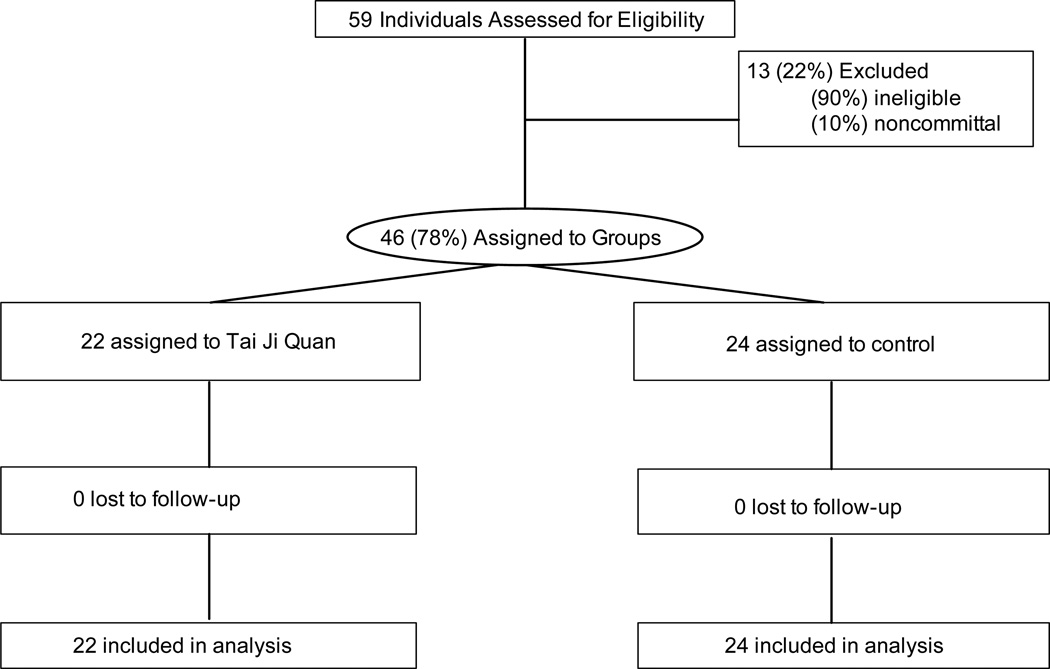
This study evaluated whether Tai Ji Quan: Moving for Better Balance (TJQMBB) could improve global cognitive function in older adults with cognitive impairment. Using a nonrandomized control group pretest-posttest design, participants aged ≥65 years who scored between 20 and 25 on the Mini-Mental State Examination (MMSE) were allocated into either a 14-week TJQMBB program (n=22) or a control group (n=24). The primary outcome was MMSE as a measure of global cognitive function with secondary outcomes of 50-ft speed walk, Timed Up&Go, and Activities-Specific Balance Confidence (ABC) scale. At 14 weeks, Tai Ji Quan participants showed significant improvement on MMSE (mean=2.26, p<0.001) compared to controls (mean=0.63, p=0.08). Similarly, Tai Ji Quan participants performed significantly better compared to the controls in both physical performance and balance efficacy measures (p<0.05). Improvement in cognition as measured by MMSE was related to improved physical performance and balance efficacy. These results provide preliminary evidence of the utility of the TJQMBB program to promote cognitive function in older adults in addition to physical benefits.
动中求衡(TJQMBB)是否能改善认知障碍的老年人群的整体认知功能。采用非随机对照群组预测试-后测试设计,年龄≥65 岁、迷你精神状态检查(MMSE)得分在 20-25 分之间的参与者被分配到 14 周的 TJQMBB 项目(n=22)或对照组(n=24)。主要结果是 MMSE 作为整体认知功能的衡量标准,次要结果是 50 英尺快走速度、起身和行走计时测试以及活动特定平衡信心量表(ABC 量表)。14 周后,与对照组(mean=0.63,p=0.08)相比,太极拳组的 MMSE 评分有显著提高(mean=2.26,p<0.001)。同样,与对照组相比,太极拳组在身体表现和平衡效果测量方面也表现出显著的改善(p<0.05)。MMSE 衡量的认知改善与身体表现和平衡效果的改善有关。这些结果初步证明了 TJQMBB 项目除了对身体有益之外,还能促进老年人群的认知功能。