Park Jin-Sung, Koentjoro Brianada, Veivers David, Mackay-Sim Alan, Sue Carolyn M
Department of Neurogenetics, Kolling Institute of Medical Research, Royal North Shore Hospital and the University of Sydney, St Leonards, New South Wales 2065, Australia and.
Hum Mol Genet. 2014 Jun 1;23(11):2802-15. doi: 10.1093/hmg/ddt623. Epub 2014 Jan 7.
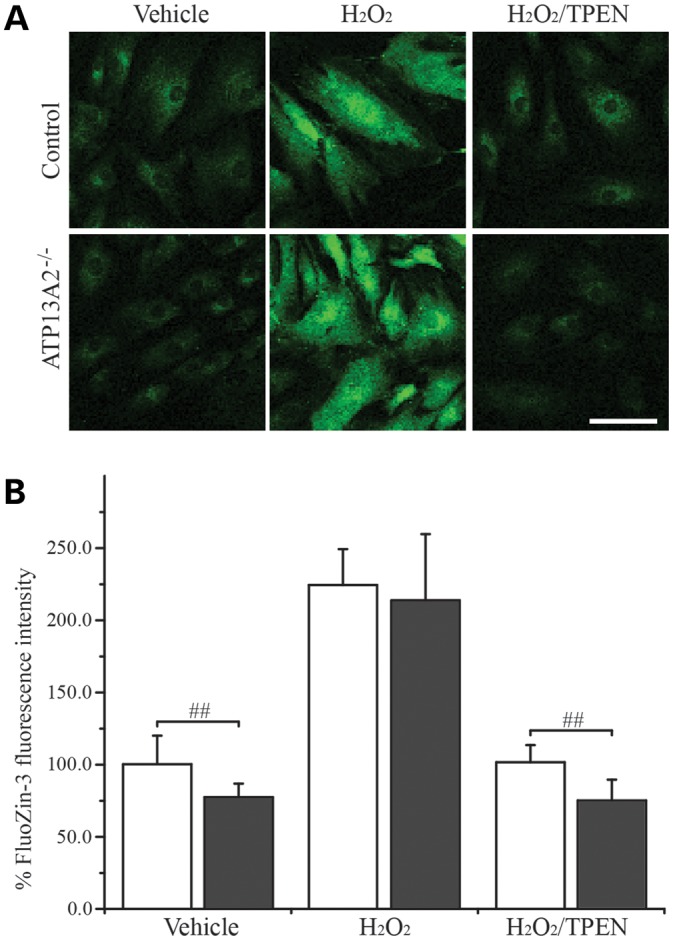
Human ATP13A2 (PARK9), a lysosomal type 5 P-type ATPase, has been associated with autosomal recessive early-onset Parkinson's disease (PD). ATP13A2 encodes a protein that is highly expressed in neurons and is predicted to function as a cation pump, although the substrate specificity remains unclear. Accumulation of zinc and mitochondrial dysfunction are established aetiological factors that contribute to PD; however, their underlying molecular mechanisms are largely unknown. Using patient-derived human olfactory neurosphere cultures, which harbour loss-of-function mutations in both alleles of ATP13A2, we identified a low intracellular free zinc ion concentration ([Zn(2+)]i), altered expression of zinc transporters and impaired sequestration of Zn(2+) into autophagy-lysosomal pathway-associated vesicles, indicating that zinc dyshomeostasis occurs in the setting of ATP13A2 deficiency. Pharmacological treatments that increased [Zn(2+)]i also induced the production of reactive oxygen species and aggravation of mitochondrial abnormalities that gave rise to mitochondrial depolarization, fragmentation and cell death due to ATP depletion. The toxic effect of Zn(2+) was blocked by ATP13A2 overexpression, Zn(2+) chelation, antioxidant treatment and promotion of mitochondrial fusion. Taken together, these results indicate that human ATP13A2 deficiency results in zinc dyshomeostasis and mitochondrial dysfunction. Our data provide insights into the molecular mechanisms of zinc dyshomeostasis in PD and its contribution to mitochondrial dysfunction with ATP13A2 as a molecular link between the two distinctive aetiological factors of PD.
人类ATP13A2(PARK9)是一种溶酶体5型P型ATP酶,与常染色体隐性早发性帕金森病(PD)相关。ATP13A2编码一种在神经元中高度表达的蛋白质,预计其功能为阳离子泵,尽管底物特异性仍不清楚。锌的积累和线粒体功能障碍是导致PD的既定病因;然而,其潜在的分子机制在很大程度上尚不清楚。利用来自患者的人类嗅觉神经球培养物(其ATP13A2的两个等位基因均存在功能丧失突变),我们发现细胞内游离锌离子浓度([Zn(2+)]i)较低、锌转运体表达改变以及Zn(2+)向自噬-溶酶体途径相关囊泡的隔离受损,这表明在ATP13A2缺乏的情况下会发生锌稳态失衡。增加[Zn(2+)]i的药物治疗还会诱导活性氧的产生,并加重线粒体异常,进而导致线粒体去极化、碎片化以及因ATP耗竭引起的细胞死亡。Zn(2+)的毒性作用可通过ATP13A2过表达、Zn(2+)螯合、抗氧化治疗以及促进线粒体融合来阻断。综上所述,这些结果表明人类ATP13A2缺乏会导致锌稳态失衡和线粒体功能障碍。我们的数据为PD中锌稳态失衡的分子机制及其对线粒体功能障碍的作用提供了见解,其中ATP13A2作为PD两个不同病因之间的分子联系。