The University of Queensland (School of Medicine), Brisbane, QLD, Australia ; Princess Alexandra Hospital, Brisbane, QLD, Australia.
The University of Queensland (School of Medicine), Brisbane, QLD, Australia.
Int J Chron Obstruct Pulmon Dis. 2014;9:51-6. doi: 10.2147/COPD.S53590. Epub 2013 Dec 24.
Individuals with chronic obstructive pulmonary disease (COPD) are at a high risk of developing significant complications from infection with the influenza virus. It is therefore vital to ensure that prophylaxis with the influenza vaccine is effective in COPD. The aim of this study was to assess the immunogenicity of the 2010 trivalent influenza vaccine in persons with COPD compared to healthy subjects without lung disease, and to examine clinical factors associated with the serological response to the vaccine.
In this observational study, 34 subjects (20 COPD, 14 healthy) received the 2010 influenza vaccine. Antibody titers at baseline and 28 days post-vaccination were measured using the hemagglutination inhibition assay (HAI) assay. Primary endpoints included seroconversion (≥4-fold increase in antibody titers from baseline) and the fold increase in antibody titer after vaccination.
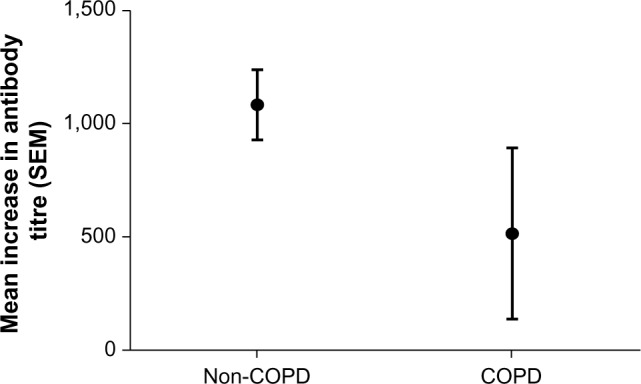
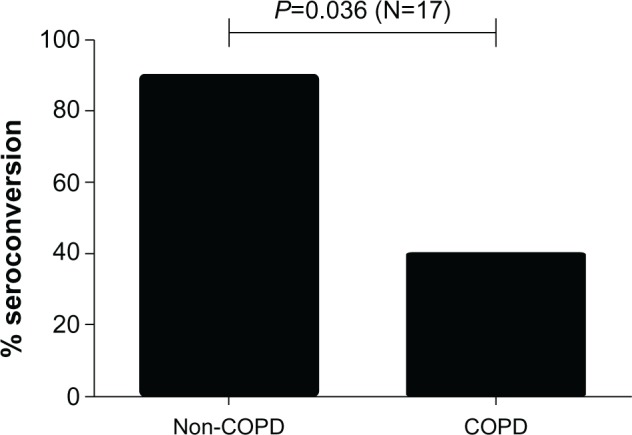
Persons with COPD mounted a significantly lower humoral immune response to the influenza vaccine compared to healthy participants. Seroconversion occurred in 90% of healthy participants, but only in 43% of COPD patients (P=0.036). Increasing age and previous influenza vaccination were associated with lower antibody responses. Antibody titers did not vary significantly with cigarette smoking, presence of other comorbid diseases, or COPD severity.
The humoral immune response to the 2010 influenza vaccine was lower in persons with COPD compared to non-COPD controls. The antibody response also declined with increasing age and in those with a history of prior vaccination.
患有慢性阻塞性肺疾病(COPD)的个体感染流感病毒后发生严重并发症的风险很高。因此,确保流感疫苗预防有效至关重要。本研究旨在评估 2010 年三价流感疫苗在 COPD 患者与无肺部疾病的健康受试者中的免疫原性,并研究与疫苗血清学反应相关的临床因素。
在这项观察性研究中,34 名受试者(20 名 COPD,14 名健康)接受了 2010 年流感疫苗。使用血凝抑制(HAI)测定法在基线和接种疫苗后 28 天测量抗体滴度。主要终点包括血清转化率(抗体滴度较基线增加≥4 倍)和接种疫苗后的抗体滴度增加倍数。
与健康参与者相比,COPD 患者对流感疫苗的体液免疫反应明显较低。90%的健康参与者发生血清转化率,而 COPD 患者中只有 43%发生血清转化率(P=0.036)。年龄增长和既往流感疫苗接种与较低的抗体反应相关。抗体滴度与吸烟、存在其他合并症或 COPD 严重程度无显著差异。
与非 COPD 对照组相比,COPD 患者对 2010 年流感疫苗的体液免疫反应较低。抗体反应也随年龄增长和既往接种疫苗而下降。