Department of Brain Environmental Research, KatoBrain Co., Ltd. Tokyo, Japan.
Department of Environment/Engineering, Tokyo Branch, Central Nippon Expressway Co., Ltd. Tokyo, Japan.
Front Hum Neurosci. 2013 Dec 25;7:895. doi: 10.3389/fnhum.2013.00895. eCollection 2013.
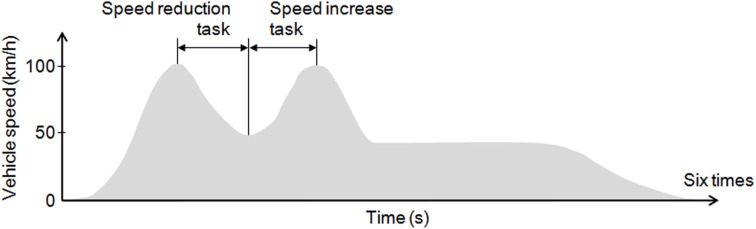
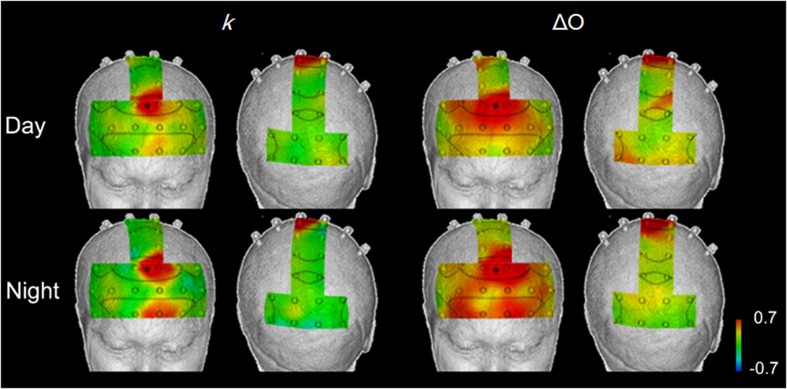
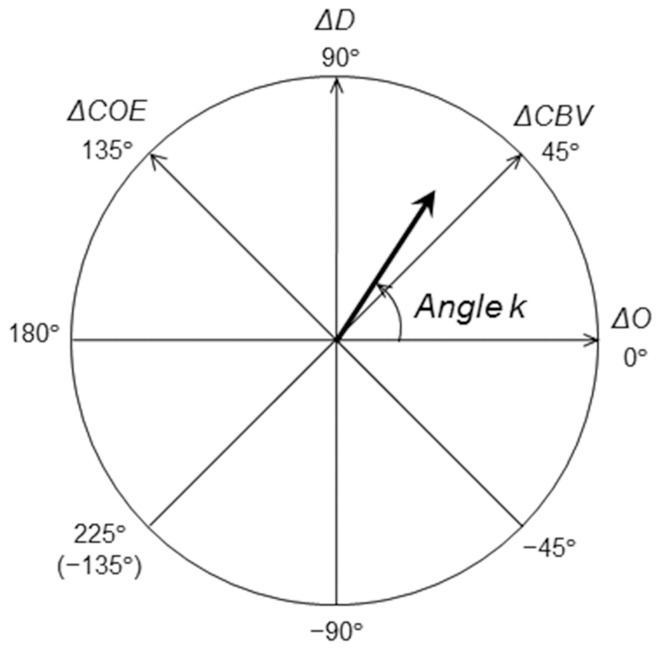
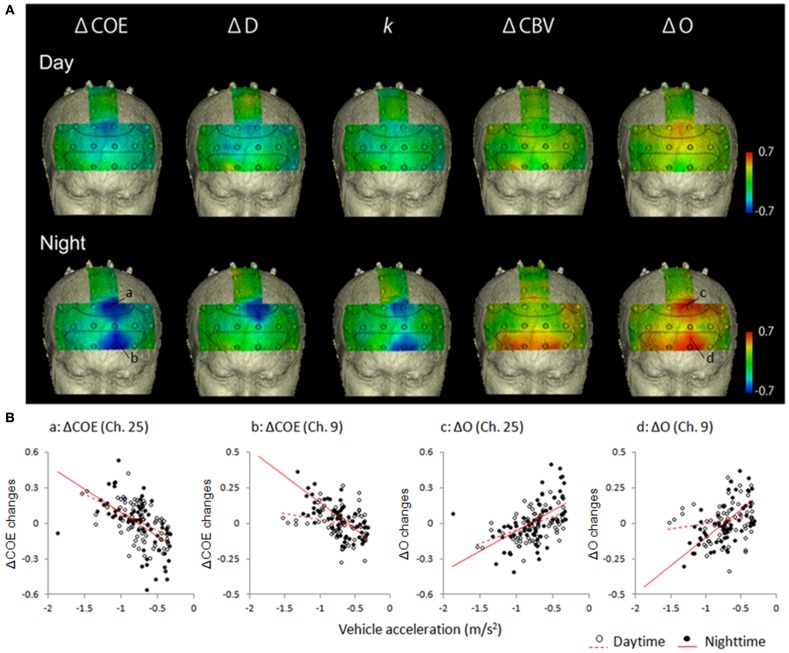
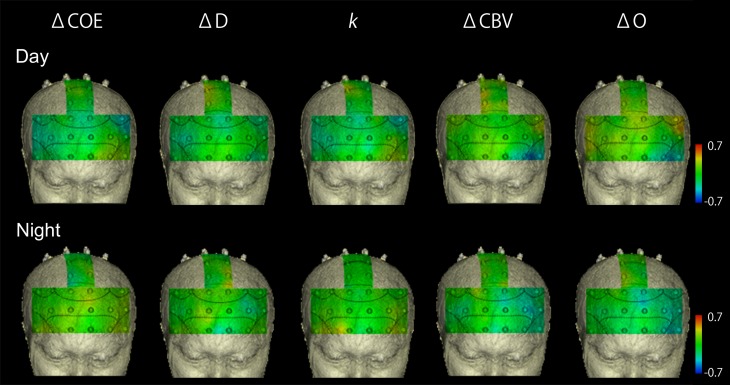
Traffic accidents occur more frequently during deceleration than during acceleration. However, little is known about the relationship between brain activation and vehicle acceleration because it has been difficult to measure the brain activation of drivers while they drive. In this study, we measured brain activation during actual driving using vector-based functional near-infrared spectroscopy. Subjects decelerated from 100 to 50 km/h (speed reduction task) and accelerated from 50 to 100 km/h (speed increase task) while driving on an expressway, in the daytime and at night. We examined correlations between average vehicle acceleration in each task and five hemodynamic indices: changes in oxygenated hemoglobin (ΔoxyHb), deoxygenated hemoglobin (ΔdeoxyHb), cerebral blood volume (ΔCBV), and cerebral oxygen exchange (ΔCOE); and the phase angle k (degrees) derived from the other hemoglobin (Hb) indices. ΔoxyHb and ΔCBV reflect changes in cerebral blood flow, whereas ΔdeoxyHb, ΔCOE, and k are related to variations in cerebral oxygen metabolism. Most of the resulting correlations with specific brain sites, for all the indices, appeared during deceleration rather than during acceleration. Faster deceleration resulted in greater increases in ΔdeoxyHb, ΔCOE, and k in the prefrontal cortex (r < -0.5, p < 0.01), in particular, in the frontal eye field, and at night, it also resulted in greater decreases in ΔoxyHb and ΔCBV in the prefrontal cortex and in the parietal lobe (r > 0.4, p < 0.01), suggesting oxygen metabolism associated with transient ischemic changes. Our results suggest that vehicle deceleration requires more brain activation, focused in the prefrontal cortex, than does acceleration. From the standpoint of the indices used, we found that simultaneous analysis of multiple hemodynamic indices was able to detect not only the blood flow components of hemodynamic responses, but also more localized frontal lobe activation involving oxygen metabolism.
在减速过程中发生的交通事故比在加速过程中更为频繁。然而,由于很难测量驾驶员在驾驶时的大脑激活情况,因此人们对大脑激活与车辆加速之间的关系知之甚少。在这项研究中,我们使用基于向量的功能性近红外光谱技术在实际驾驶过程中测量了大脑激活。受试者在高速公路上白天和夜间驾驶时,从 100 公里/小时减速到 50 公里/小时(减速任务)和从 50 公里/小时加速到 100 公里/小时(加速任务)。我们检查了在每个任务中平均车辆加速度与五个血液动力学指标之间的相关性:含氧血红蛋白(ΔoxyHb),去氧血红蛋白(ΔdeoxyHb),脑血容量(ΔCBV)和脑氧交换(ΔCOE)的变化;以及来自其他血红蛋白(Hb)指标的相位角 k(度)。ΔoxyHb 和 ΔCBV 反映了脑血流的变化,而 ΔdeoxyHb,ΔCOE 和 k 与脑氧代谢的变化有关。所有指标中,与特定大脑部位的大多数相关关系都出现在减速过程中,而不是加速过程中。更快的减速导致前额叶皮层中 ΔdeoxyHb,ΔCOE 和 k 的增加更大(r < -0.5,p < 0.01),尤其是在额眼区,而在夜间,它还导致前额叶皮层和顶叶中 ΔoxyHb 和 ΔCBV 的减少更大(r > 0.4,p < 0.01),这表明与短暂性缺血变化有关的氧代谢。我们的结果表明,与加速相比,车辆减速需要更多的大脑激活,主要集中在前额叶皮层。从使用的指标的角度来看,我们发现对多个血液动力学指标的同时分析不仅能够检测到血液动力学响应的血流成分,而且还能够检测到涉及氧代谢的更局部的额叶激活。