Oka Noriyuki, Yoshino Kayoko, Yamamoto Kouji, Takahashi Hideki, Li Shuguang, Sugimachi Toshiyuki, Nakano Kimihiko, Suda Yoshihiro, Kato Toshinori
Department of Brain Environmental Research, KatoBrain Co., Ltd., Tokyo, Japan.
Department of Environment/Engineering, Tokyo Branch, Central Nippon Expressway Co., Ltd, Tokyo, Japan.
PLoS One. 2015 May 19;10(5):e0127594. doi: 10.1371/journal.pone.0127594. eCollection 2015.
In the brain, the mechanisms of attention to the left and the right are known to be different. It is possible that brain activity when driving also differs with different horizontal road alignments (left or right curves), but little is known about this. We found driver brain activity to be different when driving on left and right curves, in an experiment using a large-scale driving simulator and functional near-infrared spectroscopy (fNIRS).
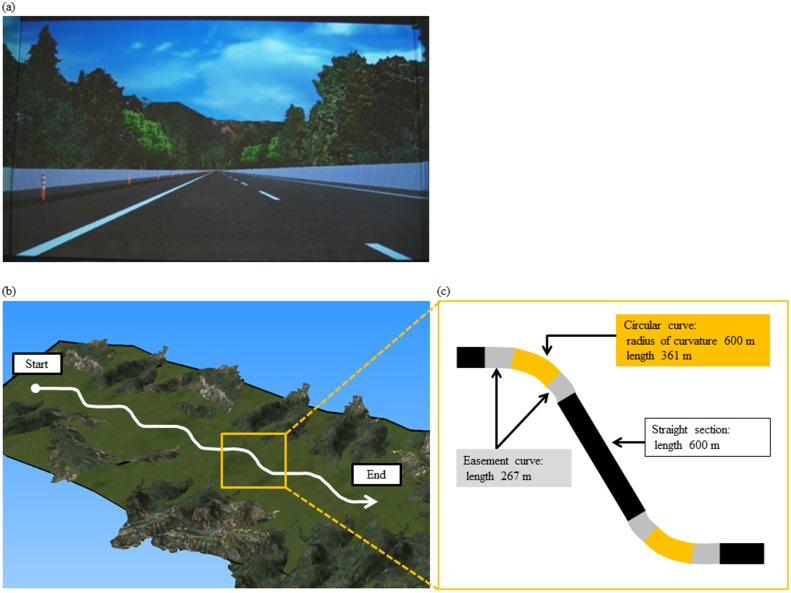
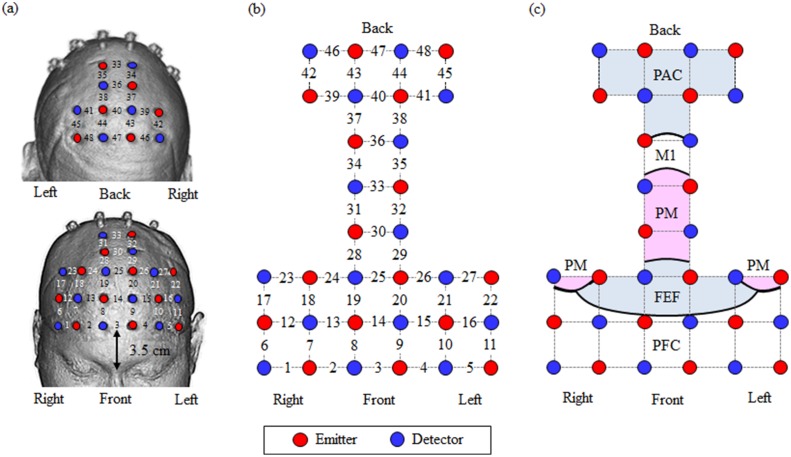
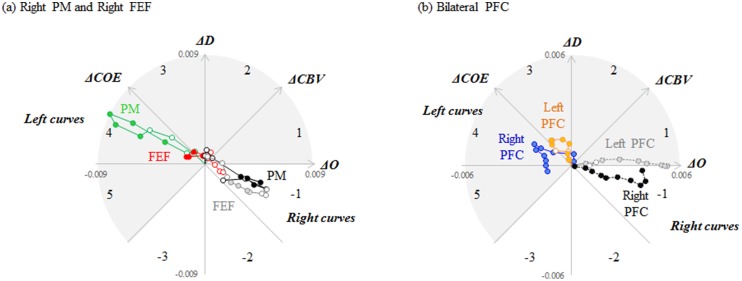
The participants were fifteen healthy adults. We created a course simulating an expressway, comprising straight line driving and gentle left and right curves, and monitored the participants under driving conditions, in which they drove at a constant speed of 100 km/h, and under non-driving conditions, in which they simply watched the screen (visual task). Changes in hemoglobin concentrations were monitored at 48 channels including the prefrontal cortex, the premotor cortex, the primary motor cortex and the parietal cortex. From orthogonal vectors of changes in deoxyhemoglobin and changes in oxyhemoglobin, we calculated changes in cerebral oxygen exchange, reflecting neural activity, and statistically compared the resulting values from the right and left curve sections.
Under driving conditions, there were no sites where cerebral oxygen exchange increased significantly more during right curves than during left curves (p > 0.05), but cerebral oxygen exchange increased significantly more during left curves (p < 0.05) in the right premotor cortex, the right frontal eye field and the bilateral prefrontal cortex. Under non-driving conditions, increases were significantly greater during left curves (p < 0.05) only in the right frontal eye field.
Left curve driving was thus found to require more brain activity at multiple sites, suggesting that left curve driving may require more visual attention than right curve driving. The right frontal eye field was activated under both driving and non-driving conditions.
已知大脑中对左侧和右侧的注意力机制有所不同。驾驶时大脑活动可能也会因不同的水平道路线形(左弯或右弯)而有所差异,但对此了解甚少。在一项使用大型驾驶模拟器和功能近红外光谱技术(fNIRS)的实验中,我们发现驾驶员在左弯和右弯行驶时大脑活动存在差异。
参与者为15名健康成年人。我们创建了一个模拟高速公路的路线,包括直线行驶以及平缓的左弯和右弯,并在驾驶条件下(参与者以100公里/小时的恒定速度驾驶)和非驾驶条件下(参与者只是观看屏幕,即视觉任务)对参与者进行监测。在包括前额叶皮质、运动前皮质、初级运动皮质和顶叶皮质在内的48个通道监测血红蛋白浓度的变化。从脱氧血红蛋白变化和氧合血红蛋白变化的正交向量中,我们计算反映神经活动的脑氧交换变化,并对左右弯道部分的结果值进行统计学比较。
在驾驶条件下,没有发现右弯时脑氧交换增加显著多于左弯的部位(p>0.05),但在右运动前皮质、右额叶眼区和双侧前额叶皮质中,左弯时脑氧交换增加显著更多(p<0.05)。在非驾驶条件下,仅在右额叶眼区左弯时增加显著更大(p<0.05)。
因此发现左弯驾驶在多个部位需要更多的大脑活动,这表明左弯驾驶可能比右弯驾驶需要更多的视觉注意力。右额叶眼区在驾驶和非驾驶条件下均被激活。