Division of Research, Kaiser Permanente Northern California, Oakland, California.
Cancer Med. 2013 Dec;2(6):881-8. doi: 10.1002/cam4.135. Epub 2013 Oct 2.
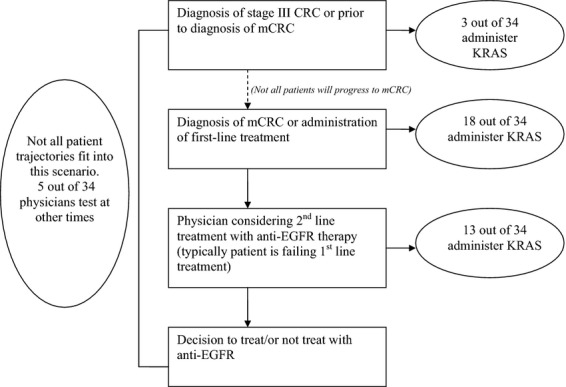
Recent discoveries promise increasingly to help oncologists individually tailor anticancer therapy to their patients' molecular tumor characteristics. One such promising molecular diagnostic is Kirsten ras (KRAS) tumor mutation testing for metastatic colorectal cancer (mCRC) patients. In the current study, we examined how and why physicians adopt KRAS testing and how they subsequently utilize the information when discussing treatment strategies with patients. We conducted 34 semi-structured in-person or telephone interviews with oncologists from seven different health plans. Each interview was audiotaped, transcribed, and coded using qualitative research methods. Information and salient themes relating to the research questions were summarized for each interview. All of the oncologists in this study reported using the KRAS test at the time of the interview. Most appeared to have adopted the test rapidly, within 6 months of the publication of National Clinical Guidelines. Oncologists chose to administer the test at various time points, although the majority ordered the test at the time their patient was diagnosed with mCRC. While oncologists expressed a range of opinions about the KRAS test, there was a general consensus that the test was useful and provided benefits to mCRC patients. The rapid adoption and enthusiasm for KRAS suggests that these types of tests may be filling an important informational need for oncologists when making treatment decisions. Future research should focus on the informational needs of patients around this test and whether patients feel informed or confident with their physicians' use of these tests to determine treatment access.
最近的发现越来越有希望帮助肿瘤学家根据患者的分子肿瘤特征为每位患者量身定制抗癌疗法。一种有前途的分子诊断是针对转移性结直肠癌 (mCRC) 患者的 Kirsten ras (KRAS) 肿瘤突变检测。在目前的研究中,我们研究了医生如何以及为何采用 KRAS 检测,以及他们随后在与患者讨论治疗策略时如何利用该信息。我们对来自七个不同健康计划的 34 名肿瘤学家进行了 34 次半结构化的现场或电话访谈。每次访谈都使用定性研究方法进行录音、转录和编码。为每次访谈总结了与研究问题相关的信息和突出主题。本研究中的所有肿瘤学家都报告说在接受采访时使用了 KRAS 测试。大多数人似乎在国家临床指南发布后的 6 个月内迅速采用了该测试。肿瘤学家选择在不同的时间点进行测试,尽管大多数人在患者被诊断为 mCRC 时就订购了该测试。虽然肿瘤学家对 KRAS 测试表达了一系列意见,但普遍认为该测试对 mCRC 患者有用且有益。KRAS 的快速采用和热情表明,当做出治疗决策时,这些类型的测试可能会满足肿瘤学家的重要信息需求。未来的研究应侧重于围绕该测试的患者的信息需求,以及患者是否对医生使用这些测试来确定治疗机会感到知情或有信心。