Department of Internal Medicine, Seoul National University College of Medicine, Seoul, Korea. ; Institute of Allergy and Clinical Immunology, Seoul National University Medical Research Center, Seoul, Korea. ; Department of Internal Medicine, Seoul National University Bundang Hospital, Seongnam, Korea.
Department of Internal Medicine, Seoul National University College of Medicine, Seoul, Korea. ; Institute of Allergy and Clinical Immunology, Seoul National University Medical Research Center, Seoul, Korea.
Allergy Asthma Immunol Res. 2014 Jan;6(1):39-46. doi: 10.4168/aair.2014.6.1.39. Epub 2013 Oct 30.
Sensitization to specific allergens may be important in the development of allergic airway inflammation and airway hyperresponsiveness (AHR). We evaluated the effect of specific aeroallergen sensitization on eosinophilic airway inflammation and AHR.
We reviewed retrospectively the clinical data of subjects who underwent skin prick tests to aeroallergens, induced sputum analysis, and methacholine bronchial provocation tests to evaluate lower airway symptoms as well as analyzed the associations between the pattern of aeroallergen sensitization and sputum eosinophilia or AHR.
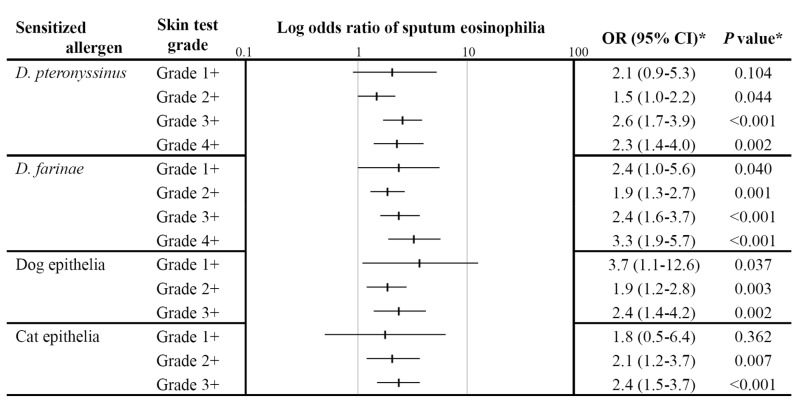
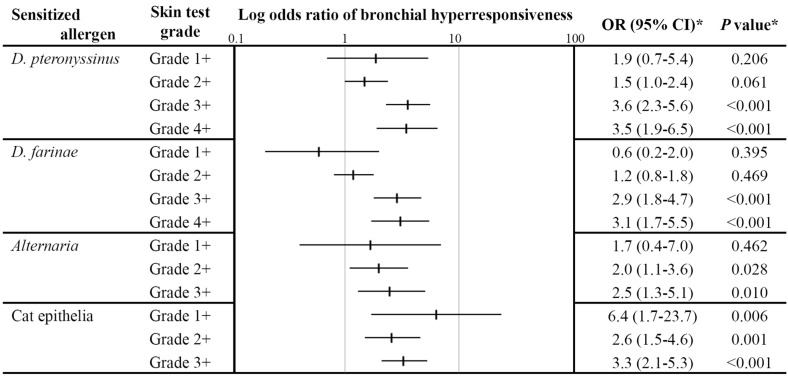
Of the 1,202 subjects be enrolled, 534 (44.4%) were sensitized to at least one aeroallergen in skin tests. AHR was demonstrated in 23.5% and sputum eosinophilia in 38.8%. Sputum eosinophilia was significantly associated with sensitization to perennial allergens (OR, 1.9; 95% CI, 1.4-2.5), house dust mite (OR, 1.7; 95% CI, 1.3-2.3), dog (OR, 1.9; 95% CI, 1.1-3.3), and cat (OR, 2.1; 95% CI, 1.4-3.4). AHR was associated with sensitization to perennial allergens (OR, 2.7; 95% CI, 2.0-3.7), house dust mite (OR, 2.2; 95% CI, 1.6 3.2), Alternaria (OR, 2.3; 95% CI, 1.2-4.7), and cat (OR, 2.7; 95% CI, 1.7-4.3). Sensitization to more perennial allergens increased the risk for sputum eosinophilia and AHR. There was no relationship with individual seasonal allergens.
The development of airway eosinophilic inflammation and AHR in an adult Korean population was associated with sensitization to perennial allergens rather than seasonal allergens.
特定过敏原的致敏可能在过敏性气道炎症和气道高反应性(AHR)的发展中起重要作用。我们评估了特定气传过敏原致敏对嗜酸性气道炎症和 AHR 的影响。
我们回顾性分析了接受气传过敏原皮肤点刺试验、诱导痰分析和乙酰甲胆碱支气管激发试验评估下气道症状的受试者的临床资料,并分析了气传过敏原致敏模式与痰嗜酸性粒细胞增多或 AHR 之间的关系。
在纳入的 1202 名受试者中,534 名(44.4%)在皮肤试验中至少对一种气传过敏原过敏。23.5%的患者存在 AHR,38.8%的患者存在痰嗜酸性粒细胞增多。痰嗜酸性粒细胞增多与对常年性过敏原(OR,1.9;95%CI,1.4-2.5)、屋尘螨(OR,1.7;95%CI,1.3-2.3)、狗(OR,1.9;95%CI,1.1-3.3)和猫(OR,2.1;95%CI,1.4-3.4)过敏有关。AHR 与对常年性过敏原(OR,2.7;95%CI,2.0-3.7)、屋尘螨(OR,2.2;95%CI,1.6-3.2)、交链孢霉(OR,2.3;95%CI,1.2-4.7)和猫(OR,2.7;95%CI,1.7-4.3)过敏有关。对更多常年性过敏原的致敏增加了痰嗜酸性粒细胞增多和 AHR 的风险。与个别季节性过敏原无关系。
在韩国成年人群中,气道嗜酸性粒细胞炎症和 AHR 的发展与对常年性过敏原而非季节性过敏原的致敏有关。