Division of Primary Care, University of Nottingham, University Park, Nottingham NG7 2RD, UK.
BMC Infect Dis. 2014 Jan 9;14:13. doi: 10.1186/1471-2334-14-13.
Greater use of antibiotics during the past 50 years has exerted selective pressure on susceptible bacteria and may have favoured the survival of resistant strains. Existing information on antibiotic resistance patterns from pathogens circulating among community-based patients is substantially less than from hospitalized patients on whom guidelines are often based. We therefore chose to assess the relationship between the antibiotic resistance pattern of bacteria circulating in the community and the consumption of antibiotics in the community.
Both gray literature and published scientific literature in English and other European languages was examined. Multiple regression analysis was used to analyse whether studies found a positive relationship between antibiotic consumption and resistance. A subsequent meta-analysis and meta-regression was conducted for studies for which a common effect size measure (odds ratio) could be calculated.
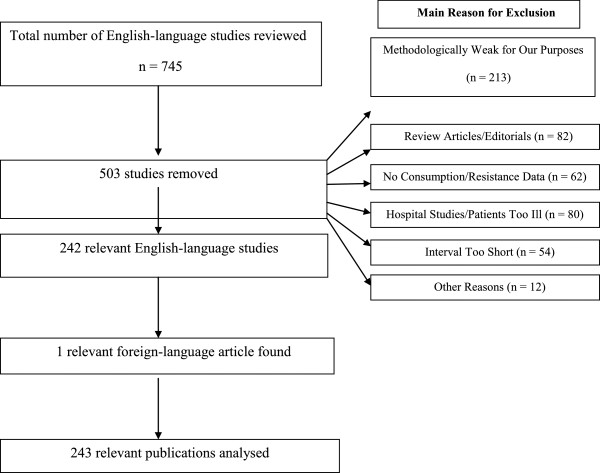
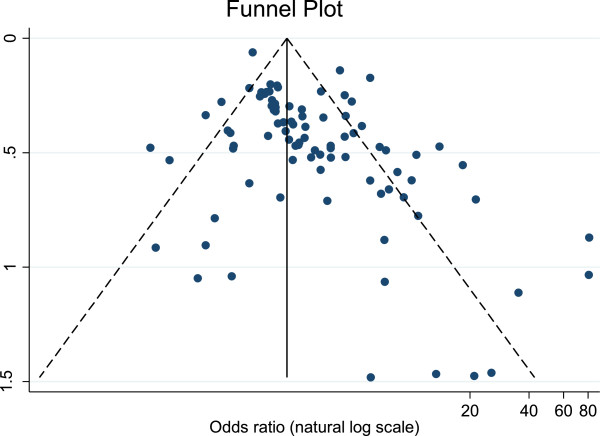
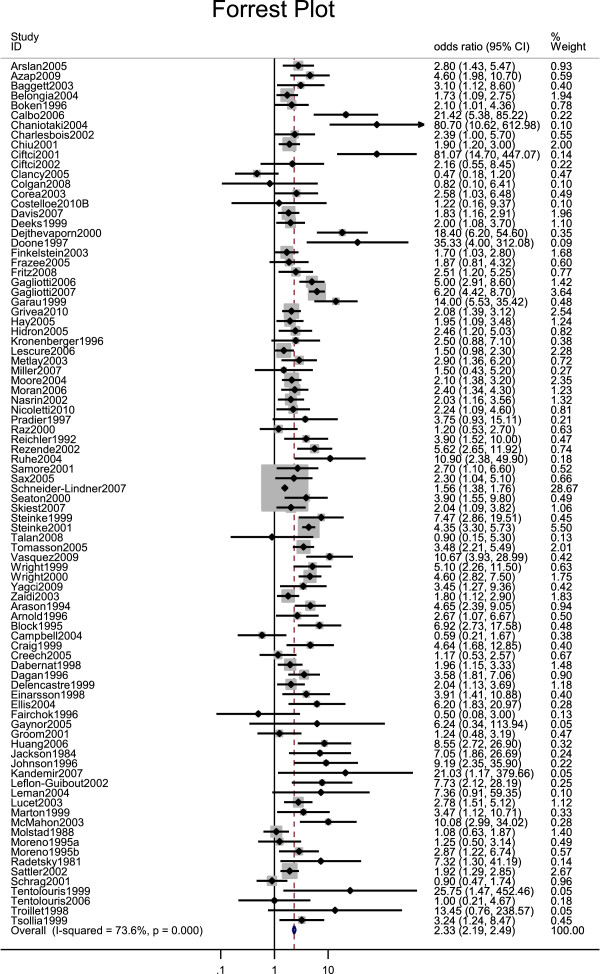
Electronic searches identified 974 studies but only 243 studies were considered eligible for inclusion by the two independent reviewers who extracted the data. A binomial test revealed a positive relationship between antibiotic consumption and resistance (p < .001) but multiple regression modelling did not produce any significant predictors of study outcome. The meta-analysis generated a significant pooled odds ratio of 2.3 (95% confidence interval 2.2 to 2.5) with a meta-regression producing several significant predictors (F(10,77) = 5.82, p < .01). Countries in southern Europe produced a stronger link between consumption and resistance than other regions.
Using a large set of studies we found that antibiotic consumption is associated with the development of antibiotic resistance. A subsequent meta-analysis, with a subsample of the studies, generated several significant predictors. Countries in southern Europe produced a stronger link between consumption and resistance than other regions so efforts at reducing antibiotic consumption may need to be strengthened in this area. Increased consumption of antibiotics may not only produce greater resistance at the individual patient level but may also produce greater resistance at the community, country, and regional levels, which can harm individual patients.
在过去的 50 年中,抗生素的广泛使用对敏感细菌施加了选择性压力,并且可能有利于耐药菌株的存活。与经常作为指南基础的住院患者相比,来自社区患者的病原体中抗生素耐药模式的现有信息要少得多。因此,我们选择评估在社区中循环的细菌的抗生素耐药模式与社区中抗生素的使用之间的关系。
检查了英文和其他欧洲语言的灰色文献和已发表的科学文献。多元回归分析用于分析研究是否发现抗生素消耗与耐药性之间存在正相关关系。对于可以计算共同效应大小(比值比)的研究,进行了随后的荟萃分析和荟萃回归。
电子检索确定了 974 项研究,但只有 243 项研究被两位独立的提取数据的审查员认为符合纳入标准。二项式检验显示抗生素消耗与耐药性之间存在正相关(p<0.001),但多元回归模型没有产生任何有意义的研究结果预测指标。荟萃分析产生了一个显著的合并比值比为 2.3(95%置信区间 2.2 至 2.5),并且荟萃回归产生了几个显著的预测指标(F(10,77)=5.82,p<0.01)。与其他地区相比,南欧国家的抗生素消耗与耐药性之间的联系更为紧密。
使用大量研究,我们发现抗生素消耗与抗生素耐药性的发展有关。随后的荟萃分析(使用研究的子样本)生成了几个显著的预测指标。与其他地区相比,南欧国家的抗生素消耗与耐药性之间的联系更为紧密,因此在该地区减少抗生素消耗的努力可能需要加强。抗生素消耗的增加不仅会在个体患者层面产生更大的耐药性,而且还会在社区、国家和地区层面产生更大的耐药性,从而损害个体患者。