Iskandar Heba N, Cassell Benjamin, Kanuri Navya, Gyawali C Prakash, Gutierrez Alexandra, Dassopoulos Themistocles, Ciorba Matthew A, Sayuk Gregory S
*Division of Gastroenterology ‡Department of Psychiatry, Washington University in St. Louis School of Medicine §John Cochran Veterans Affairs Medical Center, St. Louis, MO †Digestive Diseases, Emory University School of Medicine, Atlanta, GA.
J Clin Gastroenterol. 2014 May-Jun;48(5):423-9. doi: 10.1097/MCG.0000000000000049.
Tricyclic antidepressants (TCAs) have efficacy in treating irritable bowel syndrome (IBS). Some clinicians use TCAs to treat residual symptoms in inflammatory bowel disease (IBD) patients already on decisive IBD therapy or with quiescent inflammation, although this strategy has not been formally studied.
The aim of this study was to examine the efficacy of TCA therapy in IBD patients with residual symptoms, despite controlled inflammation, in a retrospective cohort study.
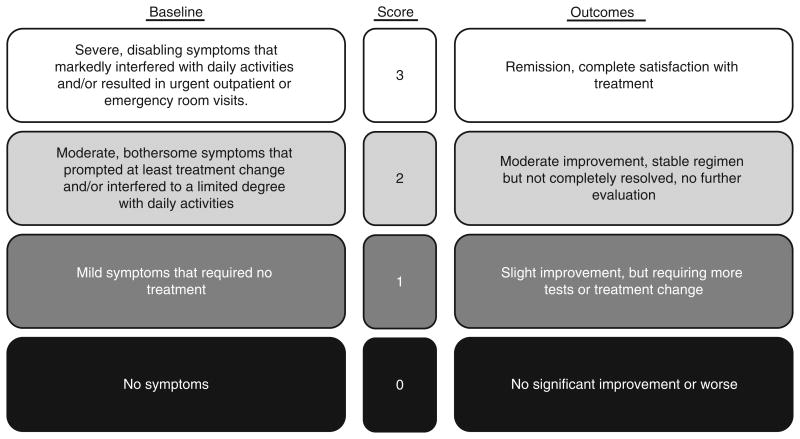
Inclusion required initiation of TCA for persistent gastrointestinal symptoms. IBD patients had inactive or mildly active disease with persistent symptoms despite adequate IBD therapy as determined by their physician. Symptom response was compared with IBS patients. Established Likert scales were used to score baseline symptom severity (0=no symptoms, 3=severe symptoms) and TCA response (0=no improvement; 3=complete satisfaction).
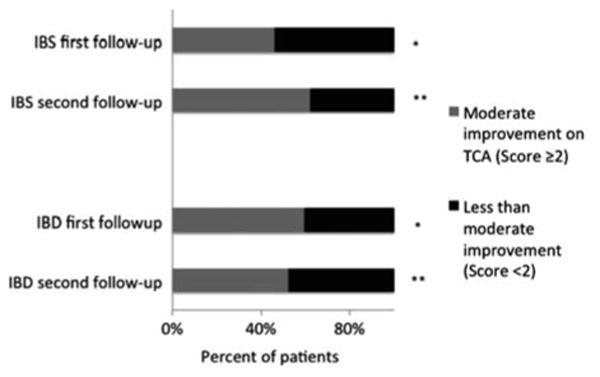
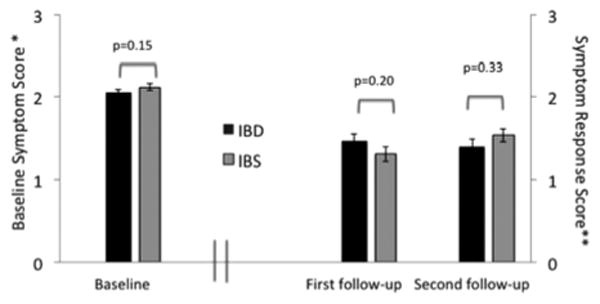
Eighty-one IBD [41.3±1.7 y, 56F; 58 Crohn's disease/23 ulcerative colitis (UC)] and 77 IBS (46.2±1.7 y, 60F) patients were initiated on a TCA therapy. Baseline symptom scores (IBD, 2.06±0.03; IBS, 2.12±0.04; P=0.15) and symptom response to TCA therapy (IBD, 1.46±0.09; IBS, 1.30±0.09; P=0.2) were similar in both the groups. At least moderate improvement (Likert score ≥2) on TCA was achieved by comparable proportions of patients (59.3% IBD vs. 46% IBS; P=0.09). Within IBD, response was better with UC than Crohn's disease (1.86±0.13 vs. 1.26±0.11, respectively, P=0.003).
In a clinical practice setting, TCA use led to moderate improvement of residual gastrointestinal symptoms in IBD patients for whom escalation of IBD therapy was not planned. UC patients demonstrated higher therapeutic success. IBD symptom responses were similar to IBS patients.
三环类抗抑郁药(TCA)在治疗肠易激综合征(IBS)方面具有疗效。一些临床医生使用TCA来治疗已经接受决定性炎症性肠病(IBD)治疗或炎症处于静止期的IBD患者的残留症状,尽管这一策略尚未得到正式研究。
本研究的目的是在一项回顾性队列研究中,检验TCA治疗对炎症得到控制但仍有残留症状的IBD患者的疗效。
纳入标准要求因持续性胃肠道症状开始使用TCA。IBD患者的疾病处于非活动期或轻度活动期,尽管经医生判断已接受充分的IBD治疗,但仍有持续性症状。将症状反应与IBS患者进行比较。使用既定的李克特量表对基线症状严重程度(0 = 无症状,3 = 严重症状)和TCA反应(0 = 无改善;3 = 完全满意)进行评分。
81例IBD患者[41.3±1.7岁,56例女性;58例克罗恩病/23例溃疡性结肠炎(UC)]和77例IBS患者(46.2±1.7岁,60例女性)开始接受TCA治疗。两组的基线症状评分(IBD,2.06±0.03;IBS,2.12±0.04;P = 0.15)和对TCA治疗的症状反应(IBD,1.46±0.09;IBS,1.30±0.09;P = 0.2)相似。相当比例的患者在TCA治疗后至少有中度改善(李克特评分≥2)(IBD患者为59.3%,IBS患者为46%;P = 0.09)。在IBD患者中,UC患者的反应优于克罗恩病患者(分别为1.86±0.13和1.26±0.11,P = 0.003)。
在临床实践中,对于未计划升级IBD治疗的IBD患者,使用TCA可使残留的胃肠道症状得到中度改善。UC患者的治疗成功率更高。IBD患者的症状反应与IBS患者相似。