Liu Dong, Rhebergen Anne Marie, Eisenbarth Stephanie C
Department of Laboratory Medicine, Yale University School of Medicine , New Haven, CT , USA ; Department of Immunobiology, Yale University School of Medicine , New Haven, CT , USA ; Department of Internal Medicine, Yale University School of Medicine , New Haven, CT , USA.
Front Immunol. 2013 Dec 27;4:486. doi: 10.3389/fimmu.2013.00486.
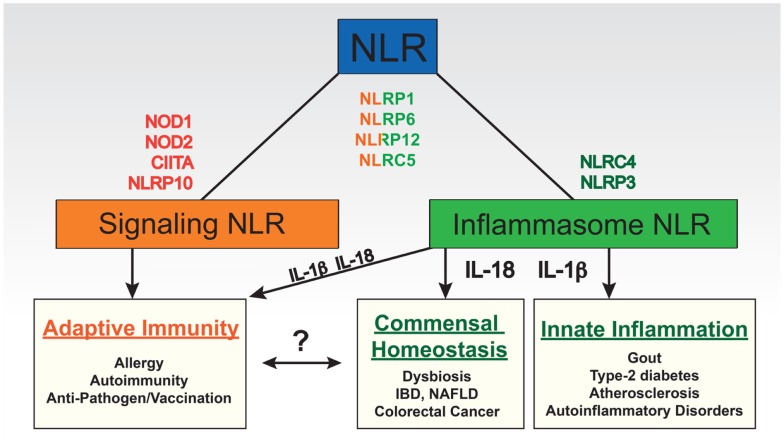
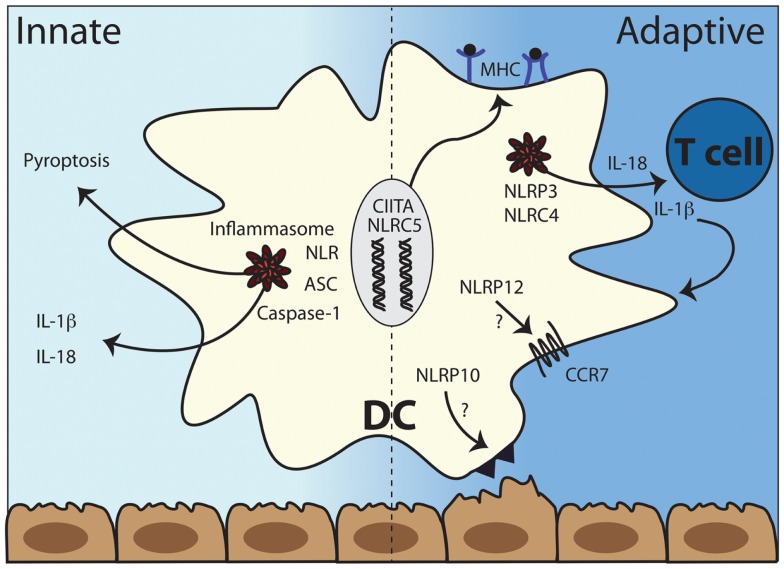
The innate immune system is composed of a diverse set of host defense molecules, physical barriers, and specialized leukocytes and is the primary form of immune defense against environmental insults. Another crucial role of innate immunity is to shape the long-lived adaptive immune response mediated by T and B lymphocytes. The activation of pattern recognition receptors (PRRs) from the Toll-like receptor family is now a classic example of innate immune molecules influencing adaptive immunity, resulting in effective antigen presentation to naïve T cells. More recent work suggests that the activation of another family of PRRs, the NOD-like receptors (NLRs), induces a different set of innate immune responses and accordingly, drives different aspects of adaptive immunity. Yet how this unusually diverse family of molecules (some without canonical PRR function) regulates immunity remains incompletely understood. In this review, we discuss the evidence for and against NLR activity orchestrating adaptive immune responses during infectious as well as non-infectious challenges.
先天免疫系统由多种宿主防御分子、物理屏障和特殊白细胞组成,是抵御环境侵害的主要免疫防御形式。先天免疫的另一个关键作用是塑造由T淋巴细胞和B淋巴细胞介导的长期适应性免疫反应。来自Toll样受体家族的模式识别受体(PRR)的激活是先天免疫分子影响适应性免疫的经典例子,可导致向未成熟T细胞有效呈递抗原。最近的研究表明,另一类PRR,即NOD样受体(NLR)的激活会诱导不同的先天免疫反应,从而驱动适应性免疫的不同方面。然而,这个异常多样的分子家族(有些没有典型的PRR功能)如何调节免疫仍未完全了解。在这篇综述中,我们讨论了支持和反对NLR活性在感染性和非感染性挑战期间协调适应性免疫反应的证据。