Li Da-Jiang, Verma Dinesh, Mosbruger Tim, Swaminathan Sankar
Division of Infectious Diseases, Department of Internal Medicine, University of Utah School of Medicine, Salt Lake City, Utah, United States of America.
Huntsman Cancer Institute, University of Utah School of Medicine, Salt Lake City, Utah, United States of America.
PLoS Pathog. 2014 Jan;10(1):e1003880. doi: 10.1371/journal.ppat.1003880. Epub 2014 Jan 9.
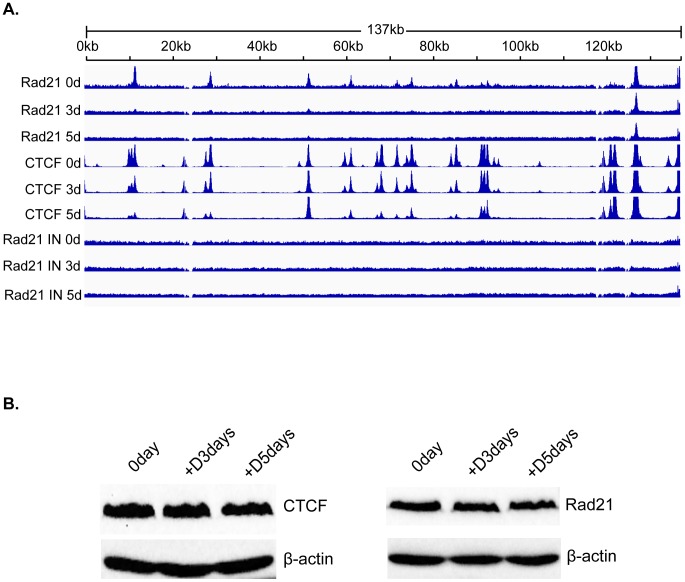
Kaposi's sarcoma-associated herpesvirus (KSHV) is a human herpesvirus that causes Kaposi's sarcoma and is associated with the development of lymphoproliferative diseases. KSHV reactivation from latency and virion production is dependent on efficient transcription of over eighty lytic cycle genes and viral DNA replication. CTCF and cohesin, cellular proteins that cooperatively regulate gene expression and mediate long-range DNA interactions, have been shown to bind at specific sites in herpesvirus genomes. CTCF and cohesin regulate KSHV gene expression during latency and may also control lytic reactivation, although their role in lytic gene expression remains incompletely characterized. Here, we analyze the dynamic changes in CTCF and cohesin binding that occur during the process of KSHV viral reactivation and virion production by high resolution chromatin immunoprecipitation and deep sequencing (ChIP-Seq) and show that both proteins dissociate from viral genomes in kinetically and spatially distinct patterns. By utilizing siRNAs to specifically deplete CTCF and Rad21, a cohesin component, we demonstrate that both proteins are potent restriction factors for KSHV replication, with cohesin knockdown leading to hundred-fold increases in viral yield. High-throughput RNA sequencing was used to characterize the transcriptional effects of CTCF and cohesin depletion, and demonstrated that both proteins have complex and global effects on KSHV lytic transcription. Specifically, both proteins act as positive factors for viral transcription initially but subsequently inhibit KSHV lytic transcription, such that their net effect is to limit KSHV RNA accumulation. Cohesin is a more potent inhibitor of KSHV transcription than CTCF but both proteins are also required for efficient transcription of a subset of KSHV genes. These data reveal novel effects of CTCF and cohesin on transcription from a relatively small genome that resemble their effects on the cellular genome by acting as gene-specific activators of some promoters, but differ in acting as global negative regulators of transcription.
卡波西肉瘤相关疱疹病毒(KSHV)是一种人类疱疹病毒,可引发卡波西肉瘤,并与淋巴增殖性疾病的发展相关。KSHV从潜伏期的重新激活以及病毒粒子的产生依赖于八十多个裂解周期基因的有效转录和病毒DNA复制。CTCF和黏连蛋白是协同调节基因表达并介导长程DNA相互作用的细胞蛋白,已被证明可结合在疱疹病毒基因组的特定位点。CTCF和黏连蛋白在潜伏期调节KSHV基因表达,并且可能也控制裂解性重新激活,尽管它们在裂解基因表达中的作用仍未完全明确。在此,我们通过高分辨率染色质免疫沉淀和深度测序(ChIP-Seq)分析了KSHV病毒重新激活和病毒粒子产生过程中CTCF和黏连蛋白结合的动态变化,结果表明这两种蛋白以动力学和空间上不同的模式从病毒基因组上解离。通过利用小干扰RNA(siRNA)特异性消耗CTCF和黏连蛋白的一个组分Rad21,我们证明这两种蛋白都是KSHV复制的有效限制因子,敲低黏连蛋白会导致病毒产量增加百倍。高通量RNA测序用于表征CTCF和黏连蛋白消耗的转录效应,并证明这两种蛋白对KSHV裂解转录具有复杂且全面的影响。具体而言,这两种蛋白最初作为病毒转录的正性因子起作用,但随后抑制KSHV裂解转录,因此它们的净效应是限制KSHV RNA积累。黏连蛋白是比CTCF更有效的KSHV转录抑制剂,但这两种蛋白对于KSHV基因子集的有效转录也是必需的。这些数据揭示了CTCF和黏连蛋白对相对较小基因组转录的新作用,这些作用类似于它们对细胞基因组的作用,即作为一些启动子的基因特异性激活剂,但在作为转录的全局负调节因子方面有所不同。