State Key Laboratory of Nuclear Physics and Technology, School of Physics, Peking University, Beijing, P. R. China.
Center for Microfluidic and Nanotechnology, The State Key Laboratory for Artificial Microstructures and Mesoscopic Physics, School of Physics, Peking University, Beijing, P. R. China.
PLoS One. 2014 Jan 9;9(1):e84654. doi: 10.1371/journal.pone.0084654. eCollection 2014.
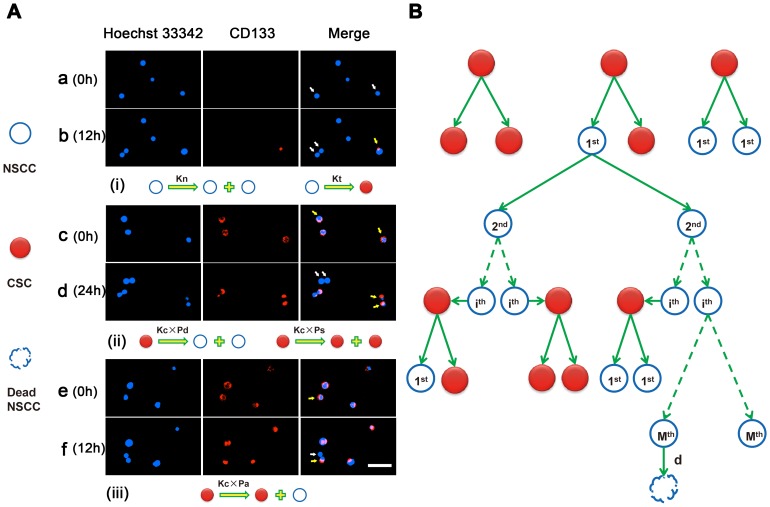
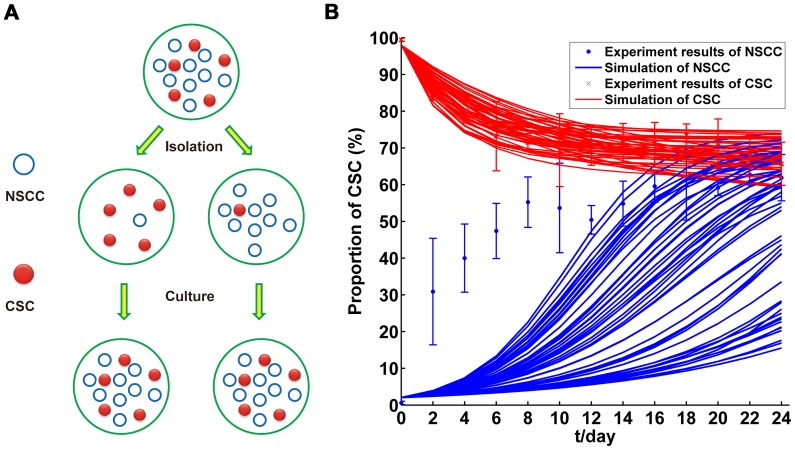
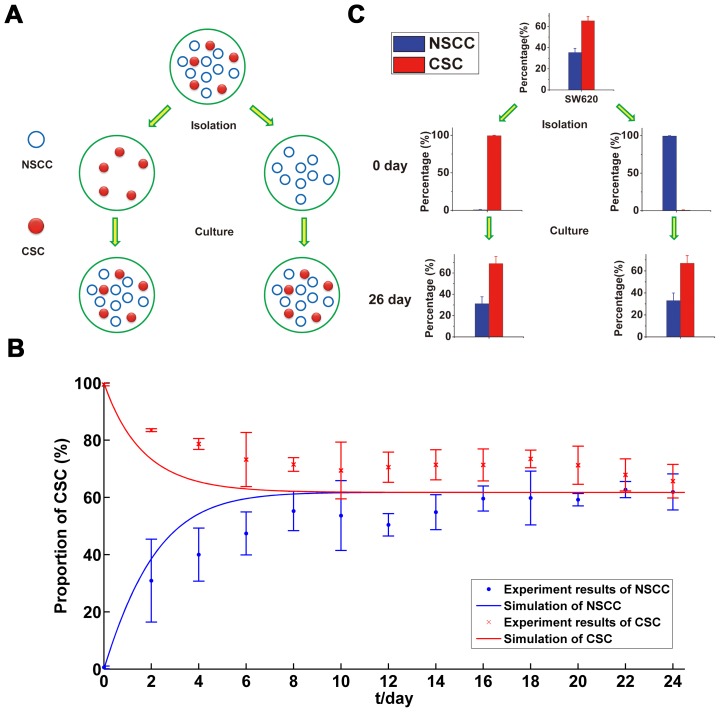
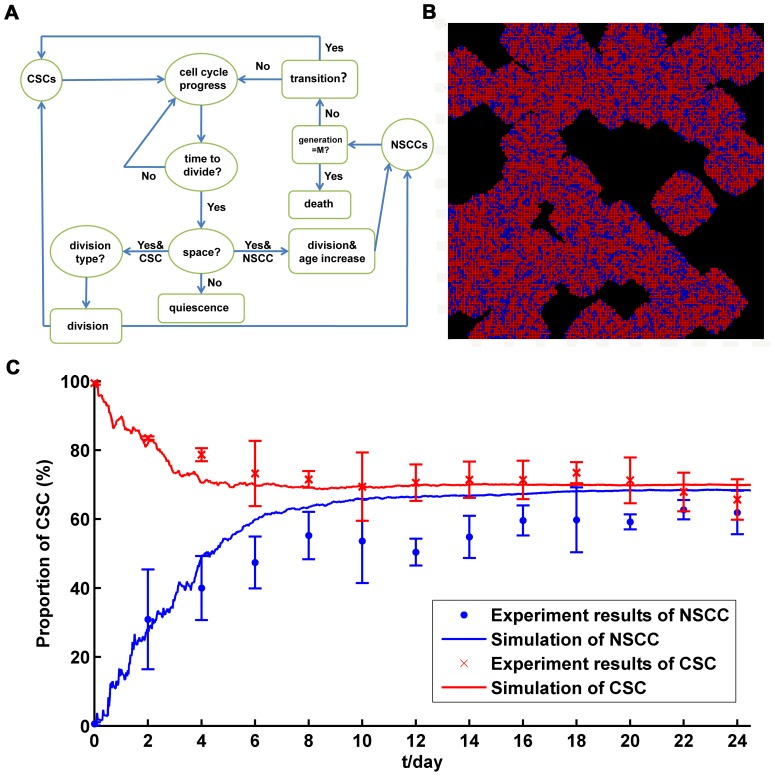
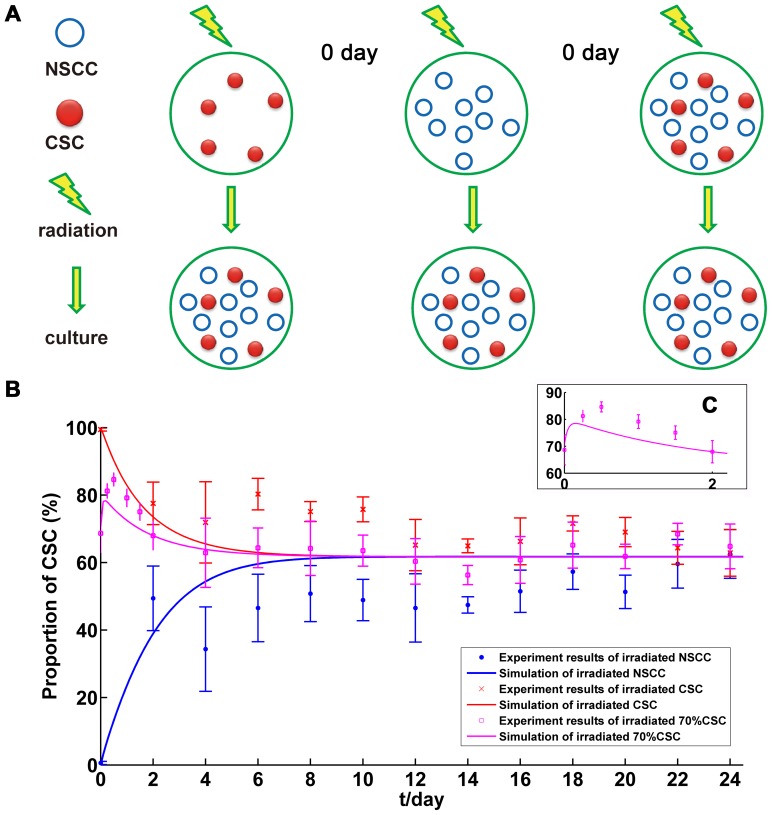
Tumors are often heterogeneous in which tumor cells of different phenotypes have distinct properties. For scientific and clinical interests, it is of fundamental importance to understand their properties and the dynamic variations among different phenotypes, specifically under radio- and/or chemo-therapy. Currently there are two controversial models describing tumor heterogeneity, the cancer stem cell (CSC) model and the stochastic model. To clarify the controversy, we measured probabilities of different division types and transitions of cells via in situ immunofluorescence. Based on the experiment data, we constructed a model that combines the CSC with the stochastic concepts, showing the existence of both distinctive CSC subpopulations and the stochastic transitions from NSCCs to CSCs. The results showed that the dynamic variations between CSCs and non-stem cancer cells (NSCCs) can be simulated with the model. Further studies also showed that the model can be used to describe the dynamics of the two subpopulations after radiation treatment. More importantly, analysis demonstrated that the experimental detectable equilibrium CSC proportion can be achieved only when the stochastic transitions from NSCCs to CSCs occur, indicating that tumor heterogeneity may exist in a model coordinating with both the CSC and the stochastic concepts. The mathematic model based on experimental parameters may contribute to a better understanding of the tumor heterogeneity, and provide references on the dynamics of CSC subpopulation during radiotherapy.
肿瘤通常是异质性的,不同表型的肿瘤细胞具有不同的特性。出于科学和临床的兴趣,了解它们的特性以及不同表型之间的动态变化,特别是在放射和/或化疗下的动态变化,是至关重要的。目前有两种描述肿瘤异质性的有争议的模型,即癌症干细胞(CSC)模型和随机模型。为了澄清争议,我们通过原位免疫荧光法测量了不同分裂类型和细胞间转换的概率。基于实验数据,我们构建了一个将 CSC 与随机概念相结合的模型,显示了独特的 CSC 亚群和从非干细胞癌(NSCC)到 CSC 的随机转换的存在。结果表明,该模型可以模拟 CSC 和非干细胞癌(NSCC)之间的动态变化。进一步的研究还表明,该模型可用于描述放射治疗后两个亚群的动力学。更重要的是,分析表明,只有当 NSCC 向 CSC 的随机转换发生时,才能达到实验可检测的平衡 CSC 比例,这表明肿瘤异质性可能存在于协调 CSC 和随机概念的模型中。基于实验参数的数学模型可能有助于更好地理解肿瘤异质性,并为放射治疗期间 CSC 亚群的动力学提供参考。