Department of Agricultural Biotechnology, Seoul National University, Seoul, Republic of Korea.
Division of Applied Life Science and Institute of Agriculture and Life Sciences, Gyeongsang National University, Jinju, Republic of Korea.
PLoS One. 2014 Jan 8;9(1):e84831. doi: 10.1371/journal.pone.0084831. eCollection 2014.
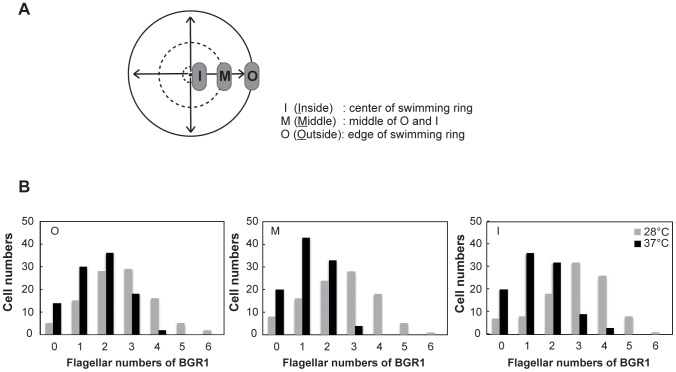
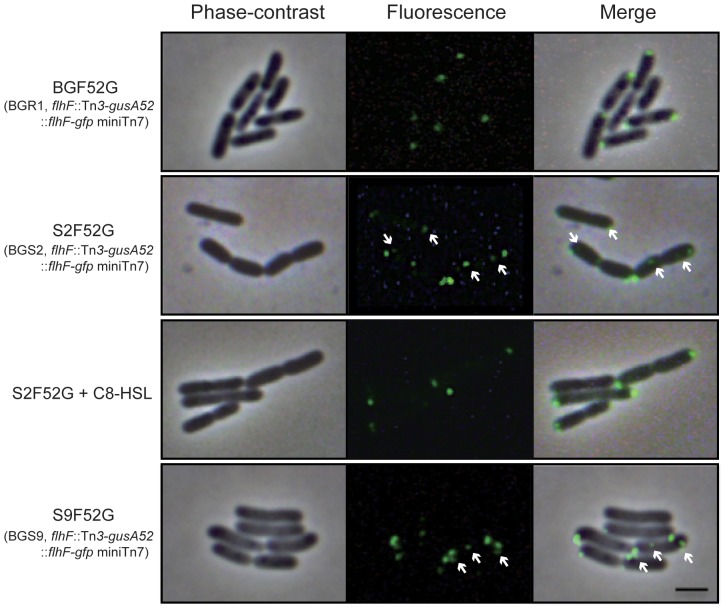
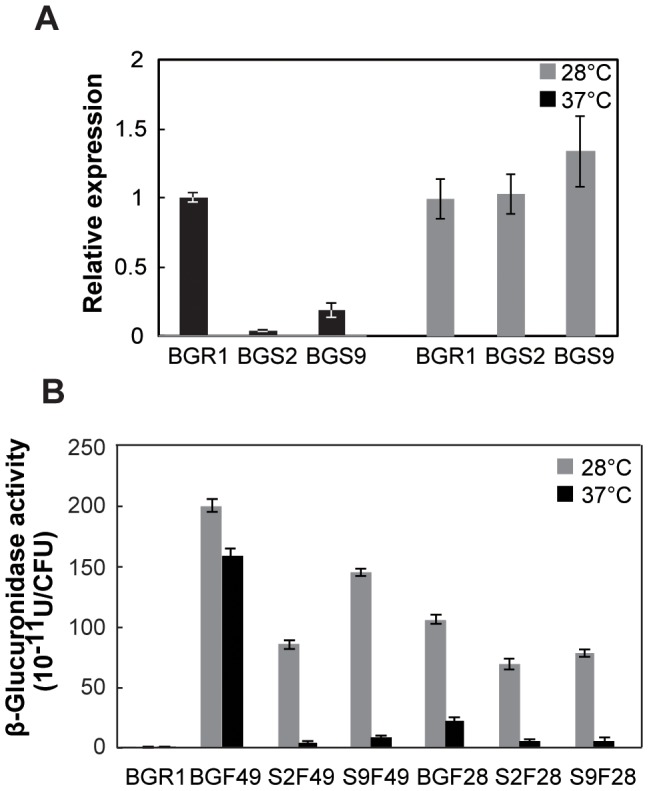
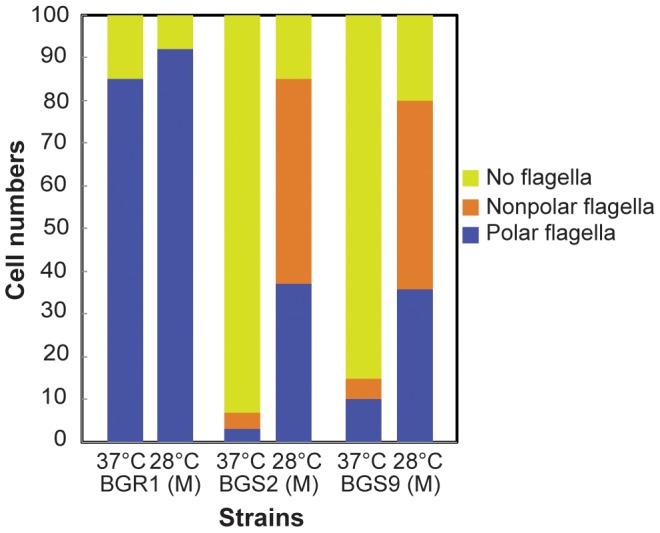
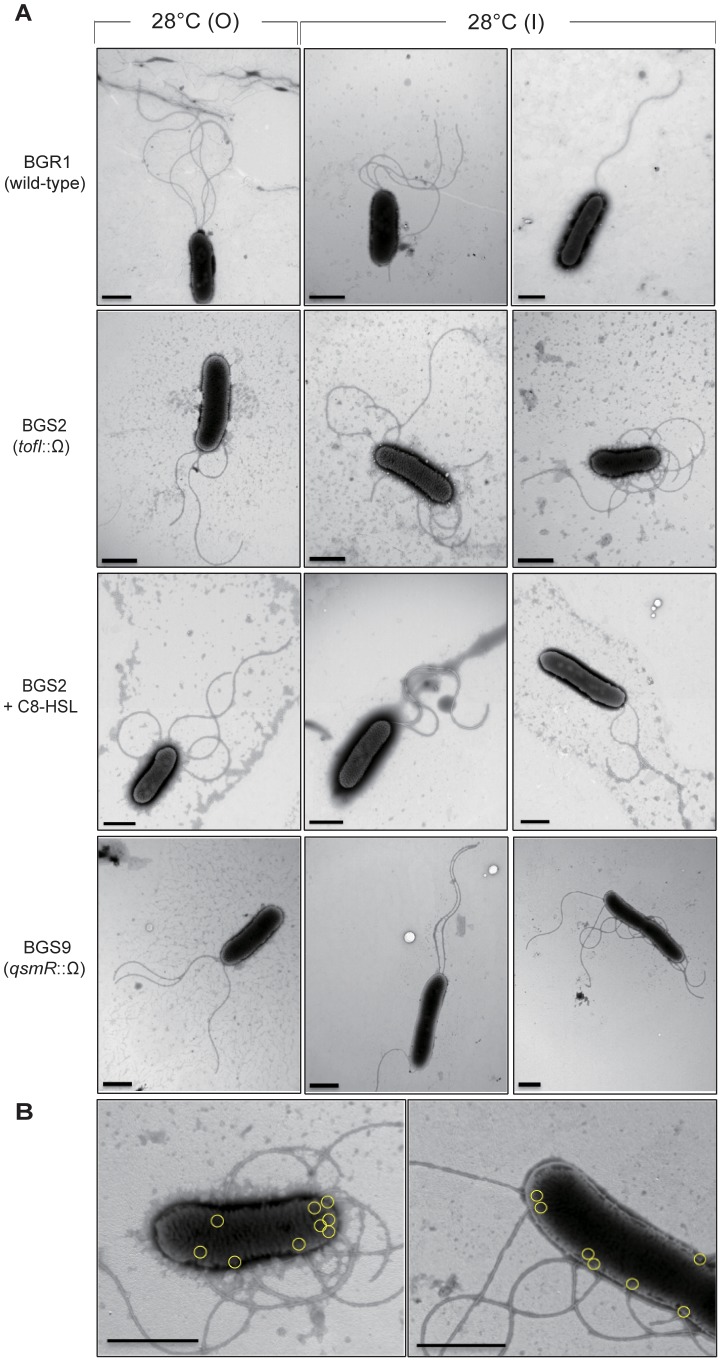
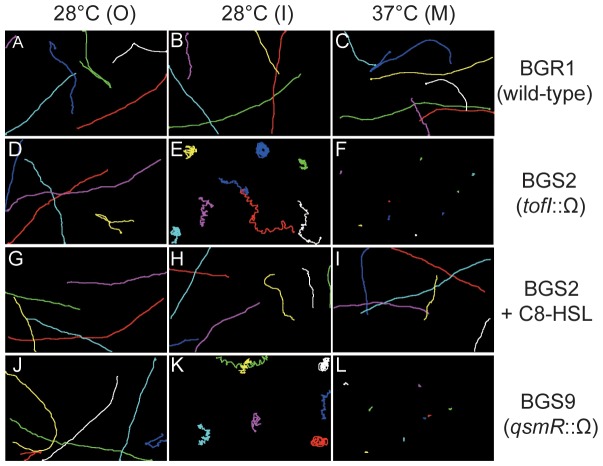
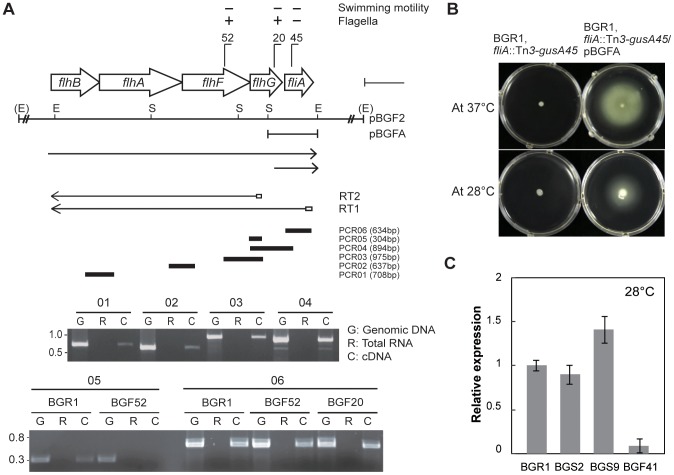
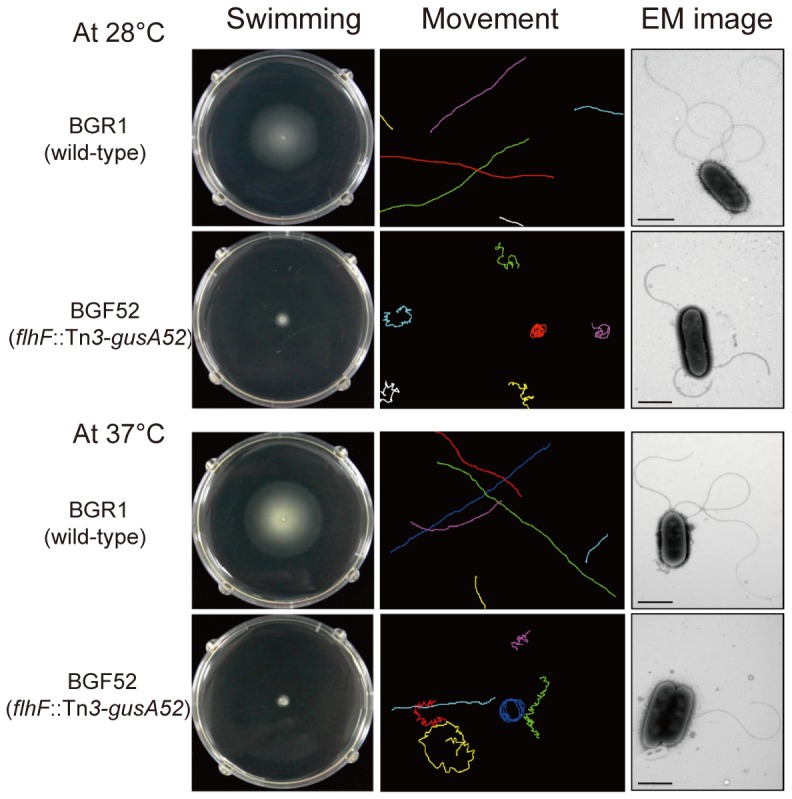
Burkholderia glumae is a motile plant pathogenic bacterium that has multiple polar flagella and one LuxR/LuxI-type quorum sensing (QS) system, TofR/TofI. A QS-dependent transcriptional regulator, QsmR, activates flagellar master regulator flhDC genes. FlhDC subsequently activates flagellar gene expression in B. glumae at 37°C. Here, we confirm that the interplay between QS and temperature is critical for normal polar flagellar morphogenesis in B. glumae. In the wild-type bacterium, flagellar gene expression and flagellar number were greater at 28°C compared to 37°C. The QS-dependent flhC gene was significantly expressed at 28°C in two QS-defective (tofI::Ω and qsmR::Ω) mutants. Thus, flagella were present in both tofI::Ω and qsmR::Ω mutants at 28°C, but were absent at 37°C. Most tofI::Ω and qsmR::Ω mutant cells possessed polar or nonpolar flagella at 28°C. Nonpolarly flagellated cells processing flagella around cell surface of both tofI::Ω and qsmR::Ω mutants exhibited tumbling and spinning movements. The flhF gene encoding GTPase involved in regulating the correct placement of flagella in other bacteria was expressed in QS mutants in a FlhDC-dependent manner at 28°C. However, FlhF was mislocalized in QS mutants, and was associated with nonpolar flagellar formation in QS mutants at 28°C. These results indicate that QS-independent expression of flagellar genes at 28°C allows flagellar biogenesis, but is not sufficient for normal polar flagellar morphogenesis in B. glumae. Our findings demonstrate that QS functions together with temperature to control flagellar morphogenesis in B. glumae.
谷单胞菌是一种运动型植物病原细菌,它具有多个极性鞭毛和一个 LuxR/LuxI 型群体感应(QS)系统,TofR/TofI。QS 依赖性转录调节剂 QsmR 激活鞭毛主调控基因 flhDC。FlhDC 随后在 37°C 下激活谷单胞菌中的鞭毛基因表达。在这里,我们证实了 QS 和温度之间的相互作用对于谷单胞菌中正常的极性鞭毛形态发生至关重要。在野生型细菌中,与 37°C 相比,28°C 时鞭毛基因表达和鞭毛数量更多。在两个 QS 缺陷(tofI::Ω 和 qsmR::Ω)突变体中,QS 依赖性 flhC 基因在 28°C 时显著表达。因此,在 28°C 时,tofI::Ω 和 qsmR::Ω 突变体中都存在鞭毛,但在 37°C 时不存在。在 28°C 时,大多数 tofI::Ω 和 qsmR::Ω 突变体细胞具有极性或非极性鞭毛。非极性鞭毛细胞在 tofI::Ω 和 qsmR::Ω 突变体的细胞表面周围处理鞭毛,表现出翻滚和旋转运动。FlhF 基因编码参与调节其他细菌中鞭毛正确位置的 GTPase,在 28°C 时以 FlhDC 依赖的方式在 QS 突变体中表达。然而,FlhF 在 QS 突变体中定位错误,并且与 28°C 时 QS 突变体中非极性鞭毛的形成有关。这些结果表明,28°C 时 QS 不依赖性表达鞭毛基因允许鞭毛发生,但不足以在谷单胞菌中进行正常的极性鞭毛形态发生。我们的研究结果表明,QS 与温度一起控制谷单胞菌中的鞭毛形态发生。