Abramo Francesca, Campora Luca, Albanese Francesco, della Valle Maria Federica, Cristino Luigia, Petrosino Stefania, Di Marzo Vincenzo, Miragliotta Vincenzo
Department of Veterinary Science, University of Pisa, Viale delle Piagge 2, Pisa, 56124, Italy.
BMC Vet Res. 2014 Jan 14;10:21. doi: 10.1186/1746-6148-10-21.
Despite the precise pathogenesis of atopic dermatitis (AD) is unknown, an immune dysregulation that causes Th2-predominant inflammation and an intrinsic defect in skin barrier function are currently the two major hypotheses, according to the so-called outside-inside-outside model. Mast cells (MCs) are involved in AD both by releasing Th2 polarizing cytokines and generating pruritus symptoms through release of histamine and tryptase. A link between MCs and skin barrier defects was recently uncovered, with histamine being found to profoundly contribute to the skin barrier defects.Palmitoylethanolamide and related lipid mediators are endogenous bioactive compounds, considered to play a protective homeostatic role in many tissues: evidence collected so far shows that the anti-inflammatory effect of palmitoylethanolamide depends on the down-modulation of MC degranulation.Based on this background, the purpose of the present study was twofold: (a) to determine if the endogenous levels of palmitoylethanolamide and other bioactive lipid mediators are changed in the skin of AD dogs compared to healthy animals; (b) to examine if MC number is increased in the skin of AD dogs and, if so, whether it depends on MC in-situ proliferation.
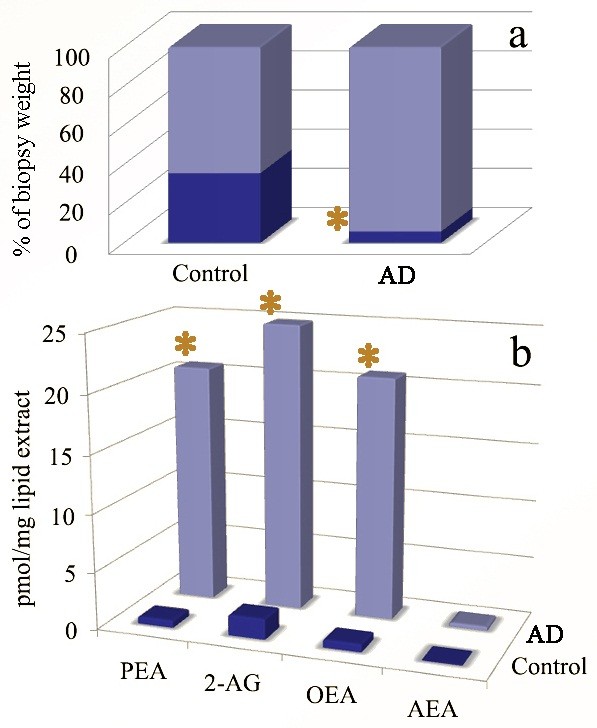
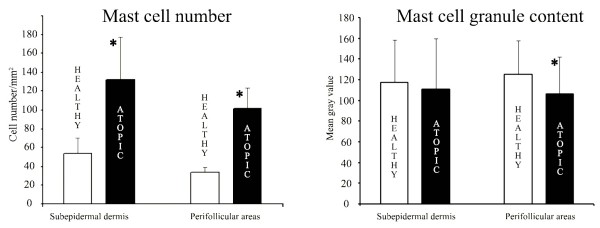
The amount of lipid extract expressed as percent of biopsy tissue weight was significantly reduced in AD skin while the levels of all analyzed bioactive lipid mediators were significantly elevated, with palmitoylethanolamide showing the highest increase.In dogs with AD, the number of MCs was significantly increased in both the subepidermal and the perifollicular compartments and their granule content was significantly decreased in the latter. Also, in situ proliferation of MCs was documented.
The levels of palmitoylethanolamide and other bioactive lipid mediators were shown to increase in AD skin compared to healthy samples, leading to the hypothesis that they may be part of the body's innate mechanisms to maintain cellular homeostasis when faced with AD-related inflammation. In particular, the increase may be considered a temptative response to down-regulating the observed elevation in the number, functionality and proliferative state of MCs in the skin of AD dogs. Further studies are warranted to confirm the hypothesis.
尽管特应性皮炎(AD)的确切发病机制尚不清楚,但根据所谓的“内外-外”模型,目前两大主要假说是:导致以Th2为主导的炎症的免疫失调以及皮肤屏障功能的内在缺陷。肥大细胞(MC)通过释放Th2极化细胞因子以及通过释放组胺和类胰蛋白酶产生瘙痒症状而参与AD。最近发现MC与皮肤屏障缺陷之间存在联系,发现组胺对皮肤屏障缺陷有深远影响。棕榈酰乙醇胺和相关脂质介质是内源性生物活性化合物,被认为在许多组织中发挥保护性稳态作用:迄今为止收集的证据表明,棕榈酰乙醇胺的抗炎作用取决于MC脱颗粒的下调。基于此背景,本研究的目的有两个:(a)确定与健康动物相比,AD犬皮肤中棕榈酰乙醇胺和其他生物活性脂质介质的内源性水平是否发生变化;(b)检查AD犬皮肤中MC数量是否增加,如果增加,是否取决于MC原位增殖。
以活检组织重量百分比表示的脂质提取物量在AD皮肤中显著降低,而所有分析的生物活性脂质介质水平均显著升高,棕榈酰乙醇胺升高幅度最大。在患有AD的犬中,表皮下和毛囊周围区域的MC数量均显著增加,而后者的颗粒含量显著降低。此外,记录到MC的原位增殖。
与健康样本相比,AD皮肤中棕榈酰乙醇胺和其他生物活性脂质介质水平升高,这导致了一种假说,即当面对与AD相关的炎症时,它们可能是身体维持细胞稳态的固有机制的一部分。特别是,这种增加可被视为对下调AD犬皮肤中MC数量、功能和增殖状态升高的一种尝试性反应。需要进一步研究来证实这一假说。