1] Division of Psychosocial Research and Epidemiology, The Netherlands Cancer Institute, PO Box 90203, 1006 BE Amsterdam, The Netherlands [2] Division of Biomedical Genetics, University Medical Center Utrecht, PO Box 85090, 3508 AB Utrecht, The Netherlands.
Division of Psychosocial Research and Epidemiology, The Netherlands Cancer Institute, PO Box 90203, 1006 BE Amsterdam, The Netherlands.
Br J Cancer. 2014 Feb 18;110(4):1081-7. doi: 10.1038/bjc.2013.805. Epub 2014 Jan 14.
Female breast cancer patients with a BRCA1/2 mutation have an increased risk of contralateral breast cancer. We investigated the effect of rapid genetic counselling and testing (RGCT) on choice of surgery.
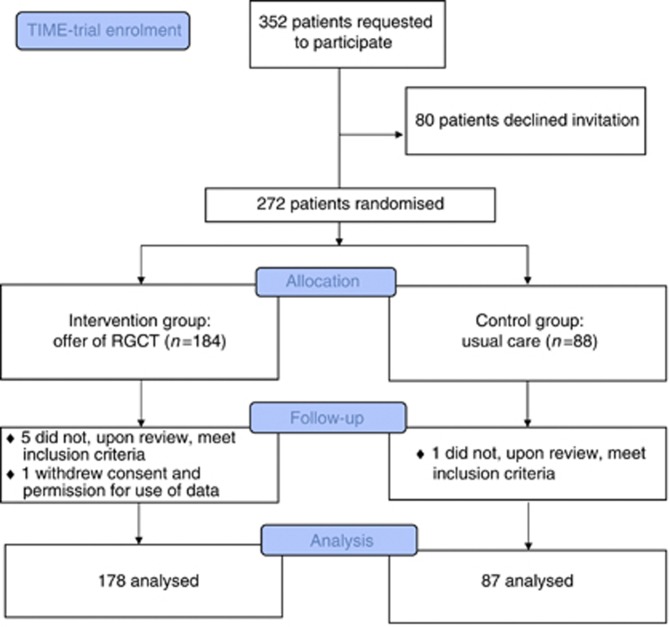
Newly diagnosed breast cancer patients with at least a 10% risk of a BRCA1/2 mutation were randomised to an intervention group (offer of RGCT) or a control group (usual care; ratio 2 : 1). Primary study outcomes were uptake of direct bilateral mastectomy (BLM) and delayed contralateral prophylactic mastectomy (CPM).
Between 2008 and 2010, we recruited 265 women. On the basis of intention-to-treat analyses, no significant group differences were observed in percentage of patients opting for a direct BLM (14.6% for the RGCT group vs 9.2% for the control group; odds ratio (OR) 2.31; confidence interval (CI) 0.92-5.81; P=0.08) or for a delayed CPM (4.5% for the RGCT group vs 5.7% for the control group; OR 0.89; CI 0.27-2.90; P=0.84). Per-protocol analysis indicated that patients who received DNA test results before surgery (59 out of 178 women in the RGCT group) opted for direct BLM significantly more often than patients who received usual care (22% vs 9.2%; OR 3.09, CI 1.15-8.31, P=0.03).
Although the large majority of patients in the intervention group underwent rapid genetic counselling, only a minority received DNA test results before surgery. This may explain why offering RGCT yielded only marginally significant differences in uptake of BLM. As patients who received DNA test results before surgery were more likely to undergo BLM, we hypothesise that when DNA test results are made routinely available pre-surgery, they will have a more significant role in surgical treatment decisions.
携带 BRCA1/2 突变的女性乳腺癌患者对侧乳腺癌发病风险增加。我们研究了快速基因咨询和检测(RGCT)对手术选择的影响。
新诊断的乳腺癌患者,BRCA1/2 突变风险至少为 10%,被随机分配到干预组(提供 RGCT)或对照组(常规护理;比例为 2:1)。主要研究结局是直接双侧乳房切除术(BLM)和延迟对侧预防性乳房切除术(CPM)的接受率。
在 2008 年至 2010 年期间,我们招募了 265 名女性。根据意向治疗分析,两组患者选择直接 BLM 的比例无显著差异(RGCT 组为 14.6%,对照组为 9.2%;比值比(OR)为 2.31;置信区间(CI)为 0.92-5.81;P=0.08)或延迟 CPM(RGCT 组为 4.5%,对照组为 5.7%;OR 为 0.89;CI 为 0.27-2.90;P=0.84)。按方案分析表明,在 RGCT 组中,59 名(178 名患者中的 59 名)在术前接受 DNA 检测结果的患者,选择直接 BLM 的比例显著高于接受常规护理的患者(22%比 9.2%;OR 3.09,CI 1.15-8.31,P=0.03)。
尽管干预组的大多数患者都接受了快速基因咨询,但只有少数患者在术前接受了 DNA 检测结果。这可能解释了为什么提供 RGCT 仅导致 BLM 接受率略有显著差异。由于接受 DNA 检测结果的患者更有可能接受 BLM,我们假设当 DNA 检测结果在术前常规提供时,它们将在手术治疗决策中发挥更重要的作用。