Psychology Section, Department of Neuroscience, Psychology, Drug Research and Child Health, University of Florence Firenze, FI, Italy.
Front Psychol. 2014 Jan 3;4:1001. doi: 10.3389/fpsyg.2013.01001. eCollection 2014.
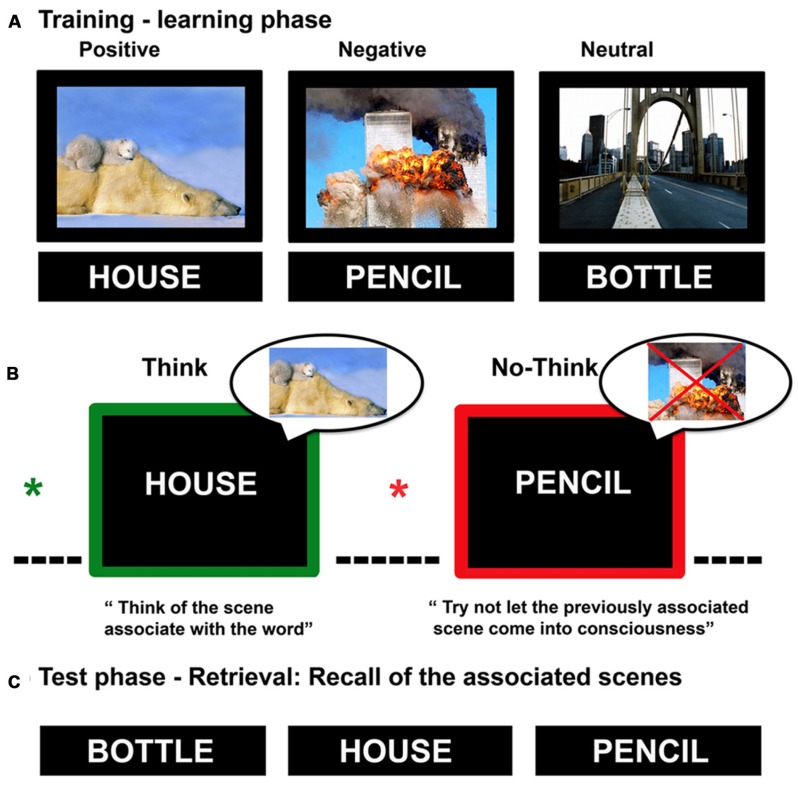
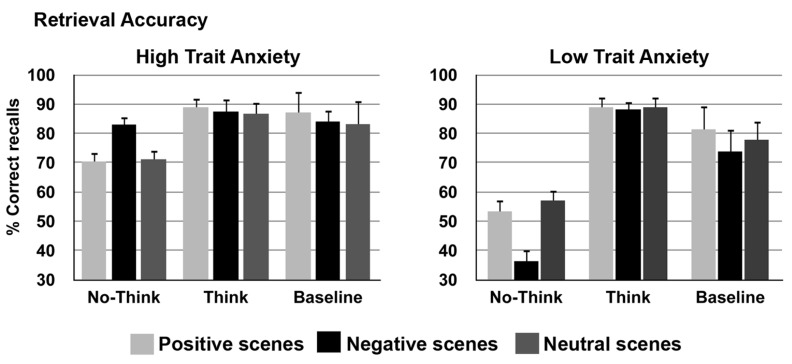
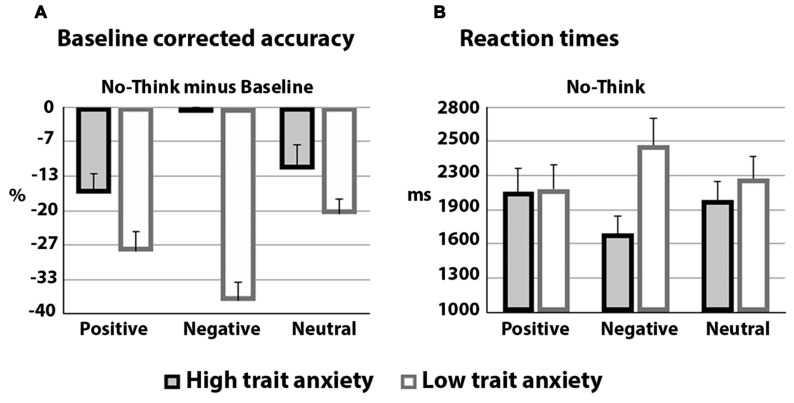
The question that motivated this study was to investigate the relation between trait anxiety, emotions and memory control. To this aim, memory suppression was explored in high and low trait anxiety individuals with the Think/No-think paradigm. After learning associations between neutral words and emotional scenes (negative, positive, and neutral), participants were shown a word and were requested either to think about the associated scene or to block it out from mind. Finally, in a test phase, participants were again shown each word and asked to recall the paired scene. The results show that memory control is influenced by high trait anxiety and emotions. Low trait anxiety individuals showed a memory suppression effect, whereas there was a lack of memory suppression in high trait anxious individuals, especially for emotionally negative scenes. Thus, we suggest that individuals with anxiety may have difficulty exerting cognitive control over memories with a negative valence. These findings provide evidence that memory suppression can be impaired by anxiety thus highlighting the crucial relation between cognitive control, emotions, and individual differences in regulating emotions.
本研究旨在探讨特质焦虑、情绪与记忆控制之间的关系。为此,我们采用思维抑制范式,探究了高、低特质焦虑个体的记忆抑制情况。在学习了中性词与情绪场景(消极、积极和中性)之间的关联后,参与者会看到一个单词,并被要求要么思考与之相关的场景,要么将其从脑海中排除。最后,在测试阶段,参与者再次看到每个单词,并被要求回忆配对的场景。结果表明,记忆控制受到高特质焦虑和情绪的影响。低特质焦虑个体表现出记忆抑制效应,而高特质焦虑个体则缺乏记忆抑制,特别是对于消极情绪场景。因此,我们认为焦虑个体可能难以对具有负性效价的记忆进行认知控制。这些发现为记忆抑制可能被焦虑所损害提供了证据,从而突出了认知控制、情绪以及个体调节情绪差异之间的关键关系。