Guangzhou Center for Disease Control and Prevention, Guangdong Province 510440, China.
Parasit Vectors. 2014 Jan 15;7:29. doi: 10.1186/1756-3305-7-29.
Human infection with Clonorchis sinensis is still a big public health problem in Guangzhou. To investigate the correlation between clonorchiasis and climatic factors, we analyzed the clonorchiasis reported cases and simultaneous meteorological data during 2006-2012 in Guangzhou City, China.
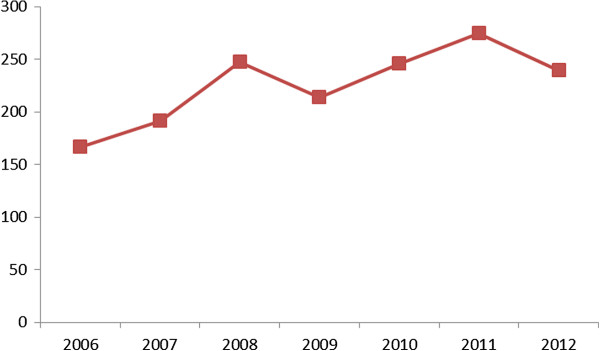
Annual incidence rate of clonorchiasis from 2006 to 2012 was 166.76, 191.55, 247.37, 213.82, 246.03, 274.71, and 239.63 (per 100 000), respectively. Each 1°C rise of temperature corresponded to an increase of 1.18% (95% CI 0.88% to 1.48%) in the monthly number of cases, and a one millimeter rise of rainfall corresponded to increase of 0.03% (95% CI 0.01% to 0.04%). Whereas each one percent rise of relative humidity corresponded to a decrease in the number of cases by 1.51% (95% CI -1.75% to -1.27%).
We reported incidence rates of clonorchiasis showed an increasing trend by years. Temperature and rainfall were positively associated with clonorchiasis incidence, while relative humidity was inversely associated with clonorchiasis incidence. Our study provided evidence that climatic factors affect the occurrence of clonorchiasis in Guangzhou city, China.
人感染华支睾吸虫在中国广州仍然是一个重大的公共卫生问题。为了研究华支睾吸虫病与气候因素的相关性,我们分析了 2006-2012 年广州地区报告的华支睾吸虫病病例和同期气象资料。
2006 年至 2012 年,华支睾吸虫病的年发病率分别为 166.76、191.55、247.37、213.82、246.03、274.71 和 239.63(每 10 万人)。温度每升高 1°C,每月病例数相应增加 1.18%(95%CI 0.88%至 1.48%),降雨量每增加 1 毫米,病例数相应增加 0.03%(95%CI 0.01%至 0.04%)。而相对湿度每升高 1%,病例数相应减少 1.51%(95%CI -1.75%至-1.27%)。
我们报告的华支睾吸虫病发病率呈逐年上升趋势。温度和降雨量与华支睾吸虫病的发病率呈正相关,而相对湿度与华支睾吸虫病的发病率呈负相关。本研究为气候因素影响中国广州市华支睾吸虫病的发生提供了证据。