Nabulsi Mona, Hamadeh Haya, Tamim Hani, Kabakian Tamar, Charafeddine Lama, Yehya Nadine, Sinno Durriyah, Sidani Saadieh
Department of Pediatrics and Adolescent Medicine, American University of Beirut, Beirut, Lebanon.
BMC Public Health. 2014 Jan 15;14:36. doi: 10.1186/1471-2458-14-36.
Breastfeeding has countless benefits to mothers, children and community at large, especially in developing countries. Studies from Lebanon report disappointingly low breastfeeding exclusivity and continuation rates. Evidence reveals that antenatal breastfeeding education, professional lactation support, and peer lay support are individually effective at increasing breastfeeding duration and exclusivity, particularly in low-income settings. Given the complex nature of the breastfeeding ecosystem and its barriers in Lebanon, we hypothesize that a complex breastfeeding support intervention, which is centered on the three components mentioned above, would significantly increase breastfeeding rates.
METHODS/DESIGN: A multi-center randomized controlled trial.
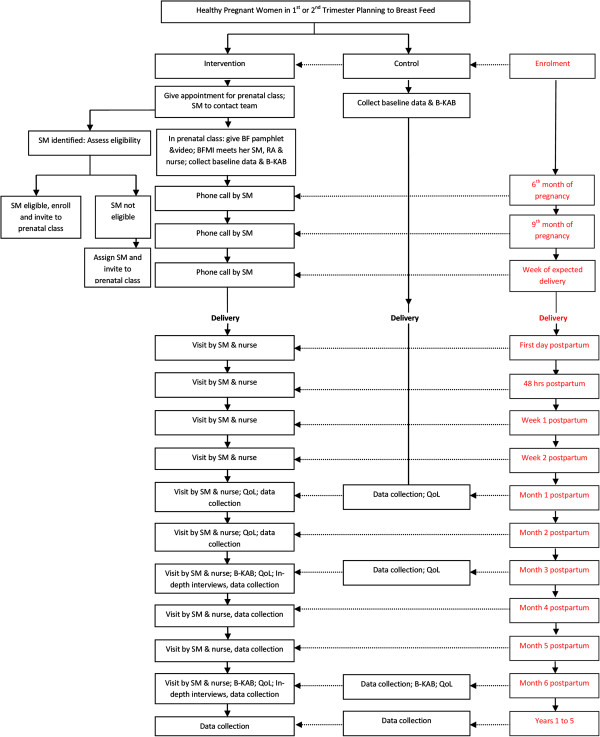
443 healthy pregnant women in their first trimester will be randomized to control or intervention group.
A "prenatal/postnatal" professional and peer breastfeeding support package continuing till 6 months postpartum, guided by the Social Network and Social Support Theory. Control group will receive standard prenatal and postnatal care. Mothers will be followed up from early pregnancy till five years after delivery.
Total and exclusive breastfeeding rates, quality of life at 1, 3 and 6 months postpartum, maternal breastfeeding knowledge and attitudes at 6 months postpartum, maternal exclusive breastfeeding rates of future infants up to five years from baseline, cost-benefit and cost-effectiveness analyses of the intervention.
Descriptive and regression analysis will be conducted under the intention to treat basis using the most recent version of SPSS.
Exclusive breastfeeding is a cost-effective public health measure that has a significant impact on infant morbidity and mortality. In a country with limited healthcare resources like Lebanon, developing an effective breastfeeding promotion and support intervention that is easily replicated across various settings becomes a priority. If positive, the results of this study would provide a generalizable model to bolster breastfeeding promotion efforts and contribute to improved child health in Lebanon and the Middle East and North Africa (MENA) region.
Current Controlled Trials ISRCTN17875591.
母乳喂养对母亲、儿童乃至整个社区都有无数益处,在发展中国家尤其如此。黎巴嫩的研究报告显示,纯母乳喂养率和持续母乳喂养率低得令人失望。有证据表明,产前母乳喂养教育、专业泌乳支持和同伴非专业支持各自都能有效延长母乳喂养时间并提高纯母乳喂养率,尤其是在低收入环境中。鉴于黎巴嫩母乳喂养生态系统的复杂性及其存在的障碍,我们推测,以上述三个要素为核心的综合母乳喂养支持干预措施将显著提高母乳喂养率。
方法/设计:一项多中心随机对照试验。
443名处于孕早期的健康孕妇将被随机分为对照组或干预组。
以社会网络和社会支持理论为指导,提供一套“产前/产后”专业及同伴母乳喂养支持方案,持续至产后6个月。对照组将接受标准的产前和产后护理。从怀孕早期开始对母亲进行随访,直至分娩后五年。
纯母乳喂养率和总体母乳喂养率、产后1个月、3个月和6个月时的生活质量、产后6个月时母亲的母乳喂养知识和态度、自基线起未来五年内母亲生育的婴儿的纯母乳喂养率、干预措施的成本效益和成本效果分析。
将使用最新版的SPSS软件,在意向性分析的基础上进行描述性分析和回归分析。
纯母乳喂养是一项具有成本效益的公共卫生措施,对婴儿发病率和死亡率有重大影响。在黎巴嫩这样医疗资源有限的国家,制定一项易于在各种环境中推广的有效母乳喂养促进和支持干预措施成为当务之急。如果本研究结果呈阳性,将提供一个可推广的模式,以加强母乳喂养促进工作,并有助于改善黎巴嫩以及中东和北非(MENA)地区的儿童健康状况。
国际标准随机对照试验编号ISRCTN17875591。