The Department of Pediatrics, Stanford University, Stanford, CA, USA.
Stanford University's Digital Medical Education International Collaborative (Digital MEdIC), Cape Town, South Africa.
BMC Health Serv Res. 2019 Apr 2;19(1):211. doi: 10.1186/s12913-019-4000-x.
In South Africa, rates of exclusive breastfeeding remain low and breastfeeding promotion is a national health priority. Mobile health and narrative entertainment-education are recognized strategies for health promotion. In-home counseling by community health workers (CHWs) is a proven breastfeeding promotion strategy. This protocol outlines a cluster-randomized controlled trial with a nested mixed-methods evaluation of the MObile Video Intervention for Exclusive breastfeeding (MOVIE) program. The evaluation will quantify the causal effect of the MOVIE program and generate a detailed understanding of the context in which the intervention took place and the mechanisms through which it enacted change. Findings from the study will inform the anticipated scale-up of mobile video health interventions in South Africa and the wider sub-Saharan region.
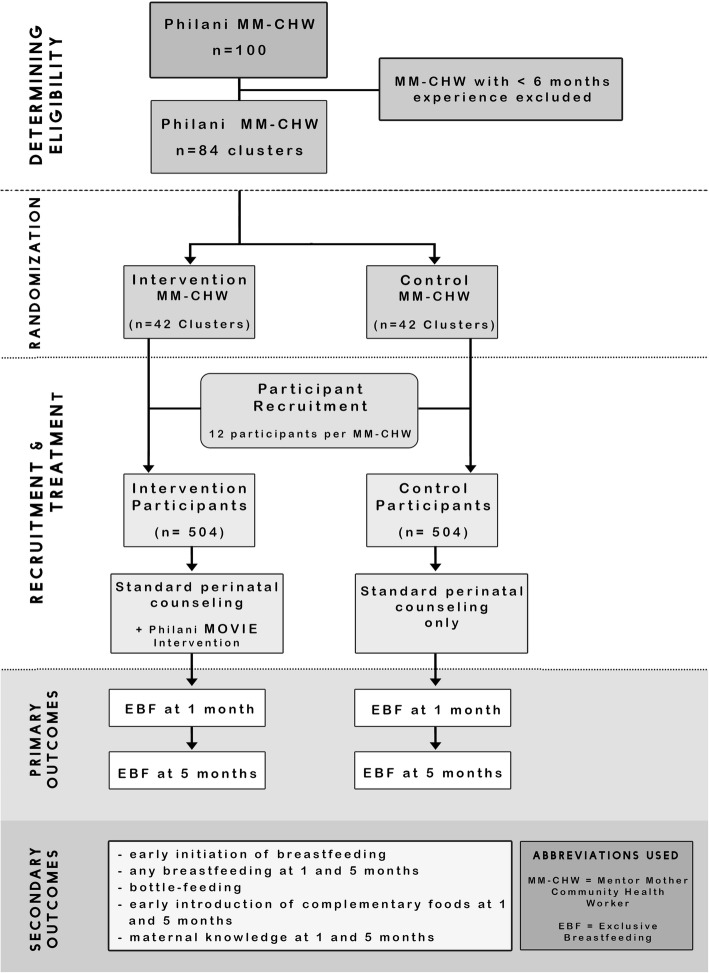
We will conduct a stratified cluster-randomized controlled trial in urban communities of the Western Cape, to measure the effect of the MOVIE intervention on exclusive breastfeeding and other infant feeding practices. Eighty-four mentor-mothers (CHWs employed by the Philani Maternal Child Health and Nutrition Trust) will be randomized 1:1 into intervention and control arms, stratified by neighborhood type. Mentor-mothers in the control arm will provide standard of care (SoC) perinatal in-home counseling. Mentor-mothers in the intervention arm will provide SoC plus the MOVIE intervention. At least 1008 pregnant participants will be enrolled in the study and mother-child pairs will be followed until 5 months post-delivery. The primary outcomes of the study are exclusive breastfeeding at 1 and 5 months of age. Secondary outcomes are other infant feeding practices and maternal knowledge. In order to capture human-centered underpinnings of the intervention, we will conduct interviews with stakeholders engaged in the intervention design. To contextualize quantitative findings and understand the mechanisms through which the intervention enacted change, end-line focus groups with mentor-mothers will be conducted.
This trial will be among the first to explore a video-based, entertainment-education intervention delivered by CHWs and created using a community-based, human-centered design approach. As such, it could inform health policy, with regards to both the routine adoption of this intervention and, more broadly, the development of other entertainment-education interventions for health promotion in under-resourced settings.
The study and its outcomes were registered at clinicaltrials.gov ( #NCT03688217 ) on September 27th, 2018.
在南非,纯母乳喂养率仍然很低,促进母乳喂养是国家卫生重点。移动医疗和叙事娱乐教育是公认的健康促进策略。社区卫生工作者(CHW)的家庭咨询是一种经过验证的促进母乳喂养的策略。本方案概述了一项以社区为基础的随机对照试验,对移动视频促进纯母乳喂养(MOVIE)方案进行嵌套混合方法评估。该评估将量化 MOVIE 方案的因果效应,并深入了解干预发生的背景以及干预实施变革的机制。该研究的结果将为移动视频健康干预在南非和撒哈拉以南非洲更广泛地区的预期扩大提供信息。
我们将在西开普省城市社区进行分层社区随机对照试验,以衡量 MOVIE 干预对纯母乳喂养和其他婴儿喂养方式的影响。84 名导师母亲(由 Philani 母婴健康和营养信托雇用的 CHW)将按社区类型分层随机分为干预组和对照组,每组 1:1。对照组的导师母亲将提供标准的围产期家庭咨询。干预组的导师母亲将提供标准的围产期家庭咨询和 MOVIE 干预。将有至少 1008 名孕妇参加研究,母亲-儿童对将在产后 5 个月进行随访。研究的主要结局是 1 个月和 5 个月时的纯母乳喂养。次要结局是其他婴儿喂养方式和母亲知识。为了捕捉干预的以人为中心的基础,我们将对参与干预设计的利益相关者进行访谈。为了使定量发现具有背景,并了解干预实施变革的机制,将对导师母亲进行最终的焦点小组讨论。
这项试验将是第一个探索由 CHW 提供并使用基于社区的以人为中心设计方法创建的基于视频的娱乐教育干预措施的试验之一。因此,它可以为卫生政策提供信息,不仅涉及到常规采用这种干预措施,而且更广泛地涉及到在资源匮乏的环境中为促进健康而开发其他娱乐教育干预措施。
该研究及其结果于 2018 年 9 月 27 日在 clinicaltrials.gov(#NCT03688217)上注册。