Bioanalytical Mass Spectrometry Facility, University of New South Wales, Sydney, Australia.
Proteome Sci. 2014 Jan 17;12(1):5. doi: 10.1186/1477-5956-12-5.
With the promise of disease modifying treatments, there is a need for more specific diagnosis and prognosis of Alzheimer's disease (AD) and mild cognitive impairment (MCI). Plasma biomarkers are likely to be utilised to increase diagnostic accuracy and specificity of AD and cognitive decline.
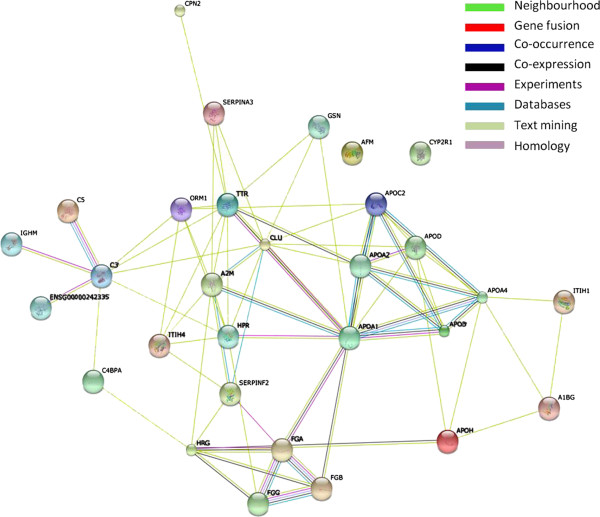
Isobaric tags (iTRAQ) and proteomic methods were used to identify potential plasma biomarkers of MCI and AD. Relative protein expression level changes were quantified in plasma of 411 cognitively normal subjects, 19 AD patients and 261 MCI patients. Plasma was pooled into 4 groups including normal control, AD, amnestic single and multiple domain MCI (aMCI), and nonamnestic single and multiple domain MCI (nMCI). Western-blotting was used to validate iTRAQ data. Integrated function and protein interactions were explored using WEB based bioinformatics tools (DAVID v6.7 and STRING v9.0).
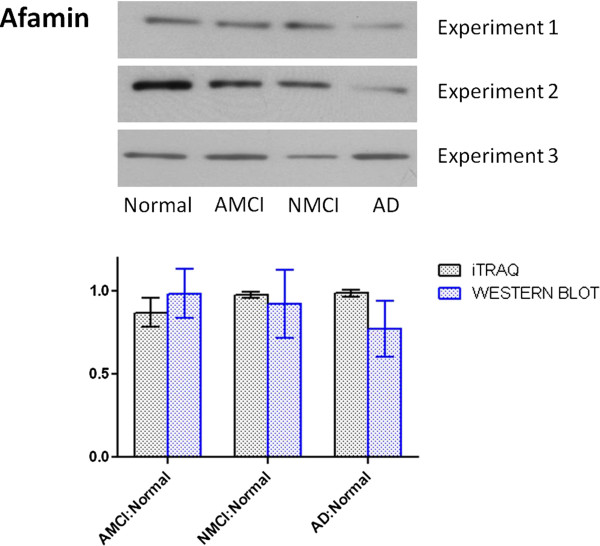
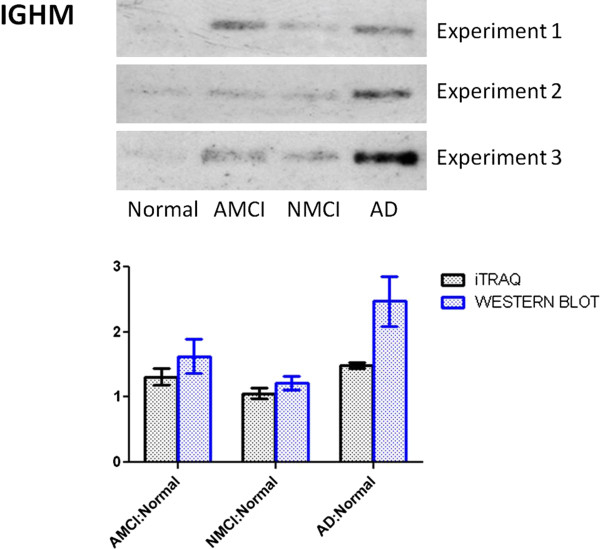
In at least two iTRAQ replicate experiments, 30 proteins were significantly dysregulated in MCI and AD plasma, relative to controls. These proteins included ApoA1, ApoB100, complement C3, C4b-binding protein, afamin, vitamin D-binding protein precursor, isoform 1 of Gelsolin actin regulator, Ig mμ chain C region (IGHM), histidine-rich glycoprotein and fibrinogen β and γ chains. Western-blotting confirmed that afamin was decreased and IGHM was increased in MCI and AD groups. Bioinformatics results indicated that these dysregulated proteins represented a diversity of biological processes, including acute inflammatory response, cholesterol transport and blood coagulation.
These findings demonstrate that expression level changes in multiple proteins are observed in MCI and AD plasma. Some of these, such as afamin and IGHM, may be candidate biomarkers for AD and the predementia condition of MCI.
随着有疾病修饰作用的治疗方法的出现,我们需要更具体的阿尔茨海默病(AD)和轻度认知障碍(MCI)的诊断和预后方法。血浆生物标志物可能会被用于提高 AD 和认知能力下降的诊断准确性和特异性。
使用等重标记物(iTRAQ)和蛋白质组学方法来鉴定 MCI 和 AD 的潜在血浆生物标志物。在 411 名认知正常的受试者、19 名 AD 患者和 261 名 MCI 患者的血浆中定量相对蛋白表达水平的变化。将血浆分为 4 组,包括正常对照组、AD 组、遗忘型单域和多域 MCI(aMCI)组和非遗忘型单域和多域 MCI(nMCI)组。使用 Western 印迹法验证 iTRAQ 数据。使用基于网络的生物信息学工具(DAVID v6.7 和 STRING v9.0)探索整合功能和蛋白质相互作用。
在至少两个 iTRAQ 重复实验中,与对照组相比,MCI 和 AD 血浆中 30 种蛋白质的表达水平显著失调。这些蛋白质包括 ApoA1、ApoB100、补体 C3、C4b 结合蛋白、载脂蛋白、维生素 D 结合蛋白前体、Gelsolin 肌动蛋白调节因子同工型 1、IG mμ 链 C 区(IGHM)、组氨酸丰富糖蛋白和纤维蛋白原β和γ链。Western 印迹法证实,afamin 在 MCI 和 AD 组中减少,IGHM 增加。生物信息学结果表明,这些失调的蛋白质代表了多种生物学过程,包括急性炎症反应、胆固醇转运和血液凝固。
这些发现表明,MCI 和 AD 血浆中观察到多种蛋白质的表达水平变化。其中一些,如 afamin 和 IGHM,可能是 AD 和 MCI 前驱期的候选生物标志物。