• 文献检索
  • 文档翻译
  • 深度研究
  • 学术资讯
  • Suppr Zotero 插件Zotero 插件
  • 邀请有礼
  • 套餐&价格
  • 历史记录
应用&插件
Suppr Zotero 插件Zotero 插件浏览器插件Mac 客户端Windows 客户端微信小程序
定价
高级版会员购买积分包购买API积分包
服务
文献检索文档翻译深度研究API 文档MCP 服务
关于我们
关于 Suppr公司介绍联系我们用户协议隐私条款
关注我们

Suppr 超能文献

核心技术专利:CN118964589B侵权必究
粤ICP备2023148730 号-1Suppr @ 2026

文献检索

告别复杂PubMed语法,用中文像聊天一样搜索,搜遍4000万医学文献。AI智能推荐,让科研检索更轻松。

立即免费搜索

文件翻译

保留排版,准确专业,支持PDF/Word/PPT等文件格式,支持 12+语言互译。

免费翻译文档

深度研究

AI帮你快速写综述,25分钟生成高质量综述,智能提取关键信息,辅助科研写作。

立即免费体验

质量很重要:具有良好疏水接触的残基簇的扩展稳定(超)嗜热蛋白质。

Quality matters: extension of clusters of residues with good hydrophobic contacts stabilize (hyper)thermophilic proteins.

机构信息

Institute for Pharmaceutical and Medicinal Chemistry, Department of Mathematics and Natural Sciences, Heinrich Heine University , Universitätsstr. 1, 40225 Düsseldorf, Germany.

出版信息

J Chem Inf Model. 2014 Feb 24;54(2):355-61. doi: 10.1021/ci400568c. Epub 2014 Jan 28.

DOI:10.1021/ci400568c
PMID:24437522
原文链接:https://pmc.ncbi.nlm.nih.gov/articles/PMC3985445/
Abstract

Identifying determinant(s) of protein thermostability is key for rational and data-driven protein engineering. By analyzing more than 130 pairs of mesophilic/(hyper)thermophilic proteins, we identified the quality (residue-wise energy) of hydrophobic interactions as a key factor for protein thermostability. This distinguishes our study from previous ones that investigated predominantly structural determinants. Considering this key factor, we successfully discriminated between pairs of mesophilic/(hyper)thermophilic proteins (discrimination accuracy: ∼80%) and searched for structural weak spots in E. coli dihydrofolate reductase (classification accuracy: 70%).

摘要

确定蛋白质热稳定性的决定因素对于理性和数据驱动的蛋白质工程至关重要。通过分析超过 130 对嗜温/(超)嗜热蛋白质,我们确定了疏水相互作用的质量(残基能量)是蛋白质热稳定性的关键因素。这使我们的研究与以前主要研究结构决定因素的研究区分开来。考虑到这个关键因素,我们成功地区分了嗜温/(超)嗜热蛋白质对(区分准确性:约 80%),并搜索了大肠杆菌二氢叶酸还原酶的结构弱点(分类准确性:70%)。
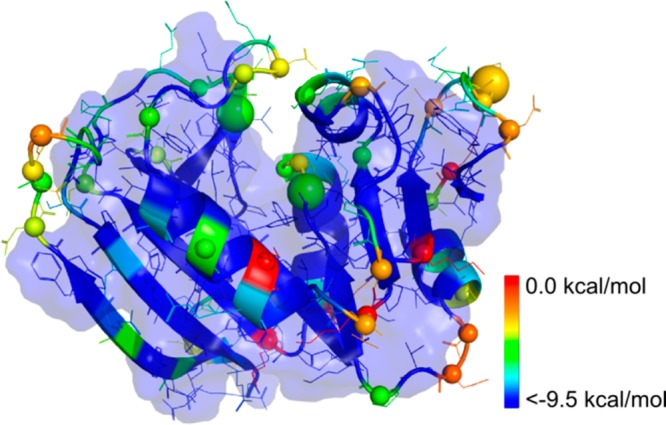
https://cdn.ncbi.nlm.nih.gov/pmc/blobs/5fcb/3985445/a119a393a602/ci-2013-00568c_0005.jpg
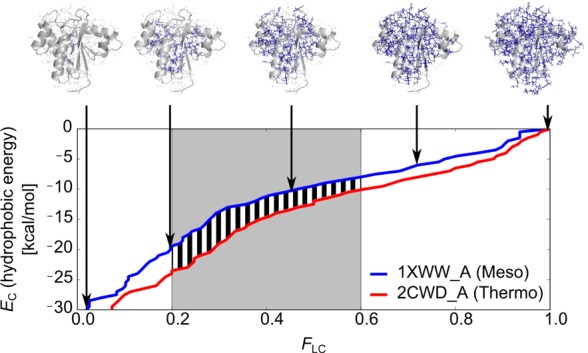
https://cdn.ncbi.nlm.nih.gov/pmc/blobs/5fcb/3985445/78222ece6d1b/ci-2013-00568c_0002.jpg
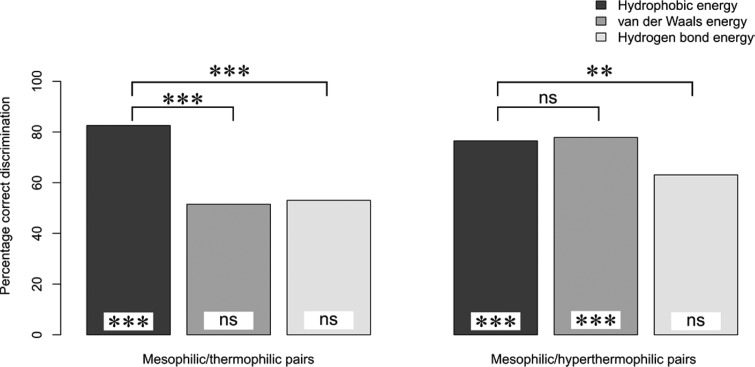
https://cdn.ncbi.nlm.nih.gov/pmc/blobs/5fcb/3985445/00c4bc7d0677/ci-2013-00568c_0003.jpg
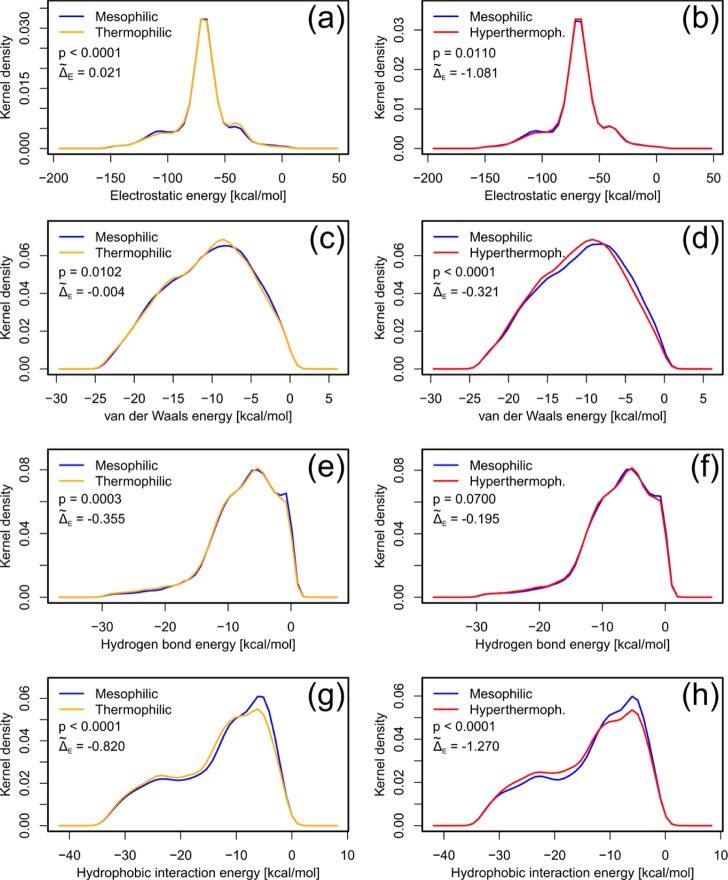
https://cdn.ncbi.nlm.nih.gov/pmc/blobs/5fcb/3985445/ca9e54ee9f90/ci-2013-00568c_0004.jpg
https://cdn.ncbi.nlm.nih.gov/pmc/blobs/5fcb/3985445/a119a393a602/ci-2013-00568c_0005.jpg
https://cdn.ncbi.nlm.nih.gov/pmc/blobs/5fcb/3985445/78222ece6d1b/ci-2013-00568c_0002.jpg
https://cdn.ncbi.nlm.nih.gov/pmc/blobs/5fcb/3985445/00c4bc7d0677/ci-2013-00568c_0003.jpg
https://cdn.ncbi.nlm.nih.gov/pmc/blobs/5fcb/3985445/ca9e54ee9f90/ci-2013-00568c_0004.jpg
https://cdn.ncbi.nlm.nih.gov/pmc/blobs/5fcb/3985445/a119a393a602/ci-2013-00568c_0005.jpg

相似文献

1
Quality matters: extension of clusters of residues with good hydrophobic contacts stabilize (hyper)thermophilic proteins.质量很重要:具有良好疏水接触的残基簇的扩展稳定(超)嗜热蛋白质。
J Chem Inf Model. 2014 Feb 24;54(2):355-61. doi: 10.1021/ci400568c. Epub 2014 Jan 28.
2
Hydrophobic environment is a key factor for the stability of thermophilic proteins.疏水环境是嗜热蛋白质稳定性的关键因素。
Proteins. 2013 Apr;81(4):715-21. doi: 10.1002/prot.24232. Epub 2013 Jan 15.
3
Differences in thermal structural changes and melting between mesophilic and thermophilic dihydrofolate reductase enzymes.嗜温型和嗜热型二氢叶酸还原酶在热结构变化和熔融方面的差异。
Phys Chem Chem Phys. 2020 Sep 7;22(33):18361-18373. doi: 10.1039/d0cp02738c. Epub 2020 Aug 13.
4
"Hot cores" in proteins: comparative analysis of the apolar contact area in structures from hyper/thermophilic and mesophilic organisms.蛋白质中的“热核”:嗜热/超嗜热生物与嗜温生物结构中非极性接触面积的比较分析
BMC Struct Biol. 2008 Feb 29;8:14. doi: 10.1186/1472-6807-8-14.
5
Contribution of main chain and side chain atoms and their locations to the stability of thermophilic proteins.主链和侧链原子及其位置对嗜热蛋白质稳定性的贡献。
J Mol Graph Model. 2016 Mar;64:85-93. doi: 10.1016/j.jmgm.2016.01.001. Epub 2016 Jan 11.
6
Protein dynamics and stability: the distribution of atomic fluctuations in thermophilic and mesophilic dihydrofolate reductase derived using elastic incoherent neutron scattering.蛋白质动力学与稳定性:利用弹性非相干中子散射得出的嗜热和嗜温二氢叶酸还原酶中原子涨落的分布
Biophys J. 2008 Jun;94(12):4812-8. doi: 10.1529/biophysj.107.121418. Epub 2008 Feb 29.
7
Protein Thermostability Is Owing to Their Preferences to Non-Polar Smaller Volume Amino Acids, Variations in Residual Physico-Chemical Properties and More Salt-Bridges.蛋白质的热稳定性归因于它们对非极性较小体积氨基酸的偏好、残留理化性质的变化以及更多的盐桥。
PLoS One. 2015 Jul 15;10(7):e0131495. doi: 10.1371/journal.pone.0131495. eCollection 2015.
8
Important inter-residue contacts for enhancing the thermal stability of thermophilic proteins.增强嗜热蛋白质热稳定性的重要残基间接触。
Biophys Chem. 2001 Jun 15;91(1):71-7. doi: 10.1016/s0301-4622(01)00154-5.
9
Turning a mesophilic protein into a thermophilic one: a computational approach based on 3D structural features.将中温蛋白转变为嗜热蛋白:一种基于三维结构特征的计算方法。
J Chem Inf Model. 2009 Jul;49(7):1741-50. doi: 10.1021/ci900183m.
10
Investigation of thermal stability characteristic in family A DNA polymerase - A theoretical study.家族 A DNA 聚合酶的热稳定性特征研究——理论研究。
Prog Biophys Mol Biol. 2023 Sep;182:15-25. doi: 10.1016/j.pbiomolbio.2023.05.003. Epub 2023 May 13.

引用本文的文献

1
Characterization of thermostable serine hydroxymethyltransferase for β-hydroxy amino acids synthesis.热稳定丝氨酸羟甲基转移酶的性质及其在β-羟氨基酸合成中的应用。
Amino Acids. 2023 Jan;55(1):75-88. doi: 10.1007/s00726-022-03205-w. Epub 2022 Dec 17.
2
Are coarse-grained models apt to detect protein thermal stability? The case of OPEP force field.粗粒度模型是否易于检测蛋白质的热稳定性?以OPEP力场为例。
J Non Cryst Solids. 2015 Jan 1;407:494-501. doi: 10.1016/j.jnoncrysol.2014.07.005. Epub 2014 Jul 22.
3
Stay Wet, Stay Stable? How Internal Water Helps the Stability of Thermophilic Proteins.

本文引用的文献

1
Hydrophobic environment is a key factor for the stability of thermophilic proteins.疏水环境是嗜热蛋白质稳定性的关键因素。
Proteins. 2013 Apr;81(4):715-21. doi: 10.1002/prot.24232. Epub 2013 Jan 15.
2
Hydrophobic interaction network analysis for thermostabilization of a mesophilic xylanase.疏水性相互作用网络分析用于嗜温木聚糖酶的热稳定性提高。
J Biotechnol. 2012 Sep 15;161(1):49-59. doi: 10.1016/j.jbiotec.2012.04.015. Epub 2012 May 27.
3
Thermostabilizing mutations preferentially occur at structural weak spots with a high mutation ratio.
保持湿润,保持稳定?内部水如何帮助嗜热蛋白质保持稳定。
J Phys Chem B. 2015 Oct 8;119(40):12760-70. doi: 10.1021/acs.jpcb.5b05791. Epub 2015 Sep 23.
4
Interface matters: the stiffness route to stability of a thermophilic tetrameric malate dehydrogenase.界面很重要:嗜热四聚体苹果酸脱氢酶稳定性的刚度途径
PLoS One. 2014 Dec 1;9(12):e113895. doi: 10.1371/journal.pone.0113895. eCollection 2014.
5
Role of Internal Water on Protein Thermal Stability: The Case of Homologous G Domains.内部水对蛋白质热稳定性的作用:同源G结构域的实例
J Phys Chem B. 2015 Jul 23;119(29):8939-49. doi: 10.1021/jp507571u. Epub 2014 Oct 15.
热稳定突变优先发生在具有高突变率的结构薄弱点。
J Biotechnol. 2012 Jun 15;159(3):135-44. doi: 10.1016/j.jbiotec.2012.01.027. Epub 2012 Feb 1.
4
Protein rigidity and thermophilic adaptation.蛋白质刚性与嗜热适应。
Proteins. 2011 Apr;79(4):1089-108. doi: 10.1002/prot.22946. Epub 2011 Jan 18.
5
Discrimination of thermophilic and mesophilic proteins.嗜热蛋白和嗜温蛋白的鉴别
BMC Struct Biol. 2010 May 17;10 Suppl 1(Suppl 1):S5. doi: 10.1186/1472-6807-10-S1-S5.
6
Comparative analysis of thermophilic and mesophilic proteins using Protein Energy Networks.利用蛋白能量网络对嗜热蛋白和嗜中温蛋白进行比较分析。
BMC Bioinformatics. 2010 Jan 18;11 Suppl 1(Suppl 1):S49. doi: 10.1186/1471-2105-11-S1-S49.
7
Different packing of external residues can explain differences in the thermostability of proteins from thermophilic and mesophilic organisms.外部残基的不同堆积方式可以解释嗜热生物和中温生物蛋白质热稳定性的差异。
Bioinformatics. 2007 Sep 1;23(17):2231-8. doi: 10.1093/bioinformatics/btm345. Epub 2007 Jun 28.
8
Protein engineering: opportunities and challenges.蛋白质工程:机遇与挑战。
Appl Microbiol Biotechnol. 2007 Jul;75(6):1225-32. doi: 10.1007/s00253-007-0964-2. Epub 2007 Apr 3.
9
Better library design: data-driven protein engineering.更好的文库设计:数据驱动的蛋白质工程
Biotechnol J. 2007 Feb;2(2):180-91. doi: 10.1002/biot.200600170.
10
Lessons in stability from thermophilic proteins.嗜热蛋白的稳定性研究
Protein Sci. 2006 Jul;15(7):1569-78. doi: 10.1110/ps.062130306.