Walker Bruce F, Losco Christine D, Armson Anthony, Meyer Amanda, Stomski Norman J
School of Health Professions, Murdoch University, Murdoch, Australia.
Chiropr Man Therap. 2014 Jan 20;22(1):5. doi: 10.1186/2045-709X-22-5.
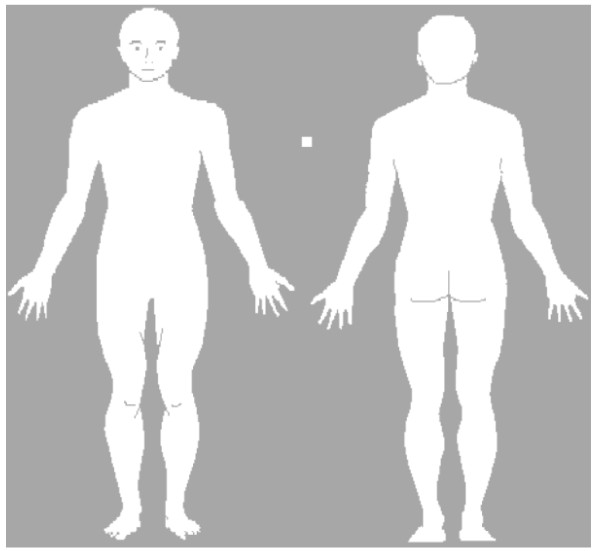
The development of clinical practice guidelines for managing spinal pain have been informed by a biopsychosocial framework which acknowledges that pain arises from a combination of psychosocial and biomechanical factors. There is an extensive body of evidence that has associated various psychosocial factors with an increased risk of experiencing persistent pain. Clinicians require instruments that are brief, easy to administer and score, and capable of validly identifying psychosocial factors. The pain diagram is potentially such an instrument. The aim of our study was to examine the association between pain diagram area and psychosocial factors.
183 adults, aged 20-85, with spinal pain were recruited. We administered a demographic checklist; pain diagram; 11-point Numerical Rating Scale assessing pain intensity; Pain Catastrophising Scale (PCS); MOS 36 Item Short Form Health Survey (SF-36); and the Fear Avoidance Beliefs Questionnaire (FABQ). Open source software, GIMP, was used to calculate the total pixilation area on each pain diagram. Linear regression was used to examine the relationship between pain diagram area and the following variables: age; gender; pain intensity; PCS total score; FABQ-Work scale score; FABQ-Activity scale score; and SF-36 Mental Health scale score.
There were no significant associations between pain diagram area and any of the clinical variables.
Our findings showed that that pain diagram area was not a valid measure to identify psychosocial factors. Several limitations constrained our results and further studies are warranted to establish if pain diagram area can be used assess psychosocial factors.
脊柱疼痛管理临床实践指南的制定参考了生物心理社会框架,该框架承认疼痛源于心理社会因素和生物力学因素的综合作用。有大量证据表明,各种心理社会因素与持续性疼痛风险增加相关。临床医生需要简短、易于实施和评分且能够有效识别心理社会因素的工具。疼痛图可能就是这样一种工具。我们研究的目的是检验疼痛图面积与心理社会因素之间的关联。
招募了183名年龄在20 - 85岁之间的脊柱疼痛成年人。我们发放了一份人口统计学清单;疼痛图;用于评估疼痛强度的11点数字评定量表;疼痛灾难化量表(PCS);医学结局研究简明健康调查(SF - 36);以及恐惧回避信念问卷(FABQ)。使用开源软件GIMP计算每张疼痛图上的总像素面积。采用线性回归分析疼痛图面积与以下变量之间的关系:年龄;性别;疼痛强度;PCS总分;FABQ - 工作分量表得分;FABQ - 活动分量表得分;以及SF - 36心理健康分量表得分。
疼痛图面积与任何临床变量之间均无显著关联。
我们的研究结果表明,疼痛图面积并非识别心理社会因素的有效指标。若干局限性限制了我们的研究结果,有必要进行进一步研究以确定疼痛图面积是否可用于评估心理社会因素。