Lutz Wolfgang, Hofmann Stefan G, Rubel Julian, Boswell James F, Shear M Katherine, Gorman Jack M, Woods Scott W, Barlow David H
Department of Psychology, University of Trier.
Department of Psychology, Boston University.
J Consult Clin Psychol. 2014 Apr;82(2):287-97. doi: 10.1037/a0035535. Epub 2014 Jan 20.
Recently, innovative statistical tools have been used to model patterns of change in psychological treatments. These tools can detect patterns of change in patient progress early in treatment and allow for the prediction of treatment outcomes and treatment length.
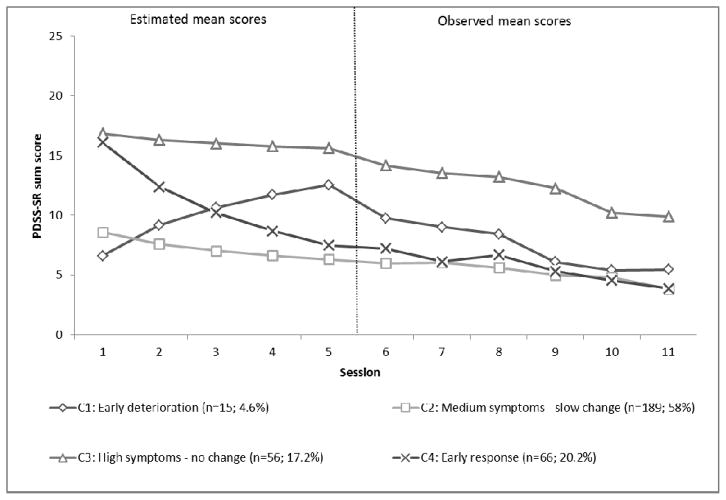
We used growth mixture modeling to identify different latent classes of early change in patients with panic disorder (N = 326) who underwent a manualized cognitive-behavioral treatment.
Four latent subgroups were identified, showing clusters of change trajectories over the first 5 sessions. One of the subgroups consisted of patients whose symptoms rapidly decreased and also showed the best outcomes. This information improved treatment prediction by 16.1% over patient intake characteristics. Early change patterns also significantly predicted patients' early treatment termination. Patient intake characteristics that significantly predicted class membership included functional impairment and separation anxiety.
These findings suggest that early treatment changes are uniquely predictive of treatment outcome.
最近,创新的统计工具已被用于对心理治疗中的变化模式进行建模。这些工具可以在治疗早期检测患者进展的变化模式,并预测治疗结果和治疗时长。
我们使用生长混合模型来识别接受标准化认知行为治疗的恐慌症患者(N = 326)早期变化的不同潜在类别。
识别出四个潜在亚组,显示了前5次治疗期间变化轨迹的聚类。其中一个亚组由症状迅速减轻且治疗效果最佳的患者组成。该信息比患者初诊特征将治疗预测提高了16.1%。早期变化模式也显著预测了患者的早期治疗终止。显著预测类别归属的患者初诊特征包括功能损害和分离焦虑。
这些发现表明,早期治疗变化对治疗结果具有独特的预测作用。