Columbia University College of Physicians & Surgeons, and New York State Psychiatric Institute, New York, New York 10032, USA.
Depress Anxiety. 2011 Jul;28(7):525-31. doi: 10.1002/da.20849.
This study examined whether reductions in depression symptoms at different time points over the course of therapy predict remission for depressed adolescents treated with interpersonal psychotherapy (IPT-A) or treatment as usual (TAU) delivered in school-based health clinics.
Participants were 63 adolescents (ages 12-18) drawn from a randomized controlled clinical trial examining the effectiveness of IPT-A Mufson et al. [2004; Archives of General Psychiatry 61:577-584]. Adolescents were randomized to receive IPT-A or TAU delivered by school-based mental health clinicians. Assessments were completed at baseline and weeks 4, 8, 12, and 16 (or at early termination) and included the Hamilton Rating Scale for Depression (HRSD; Hamilton [1967; British Journal of Social and Clinical Psychology 6:278-2962]).
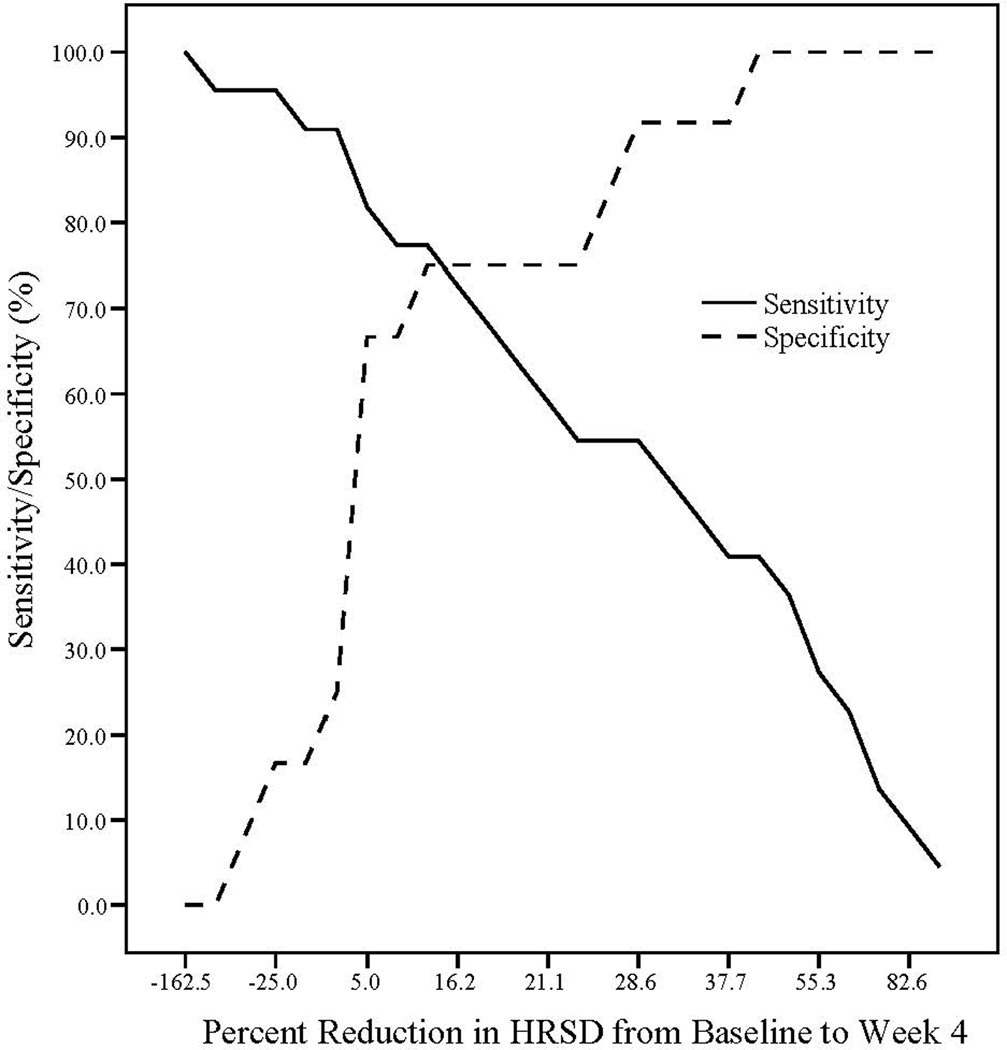
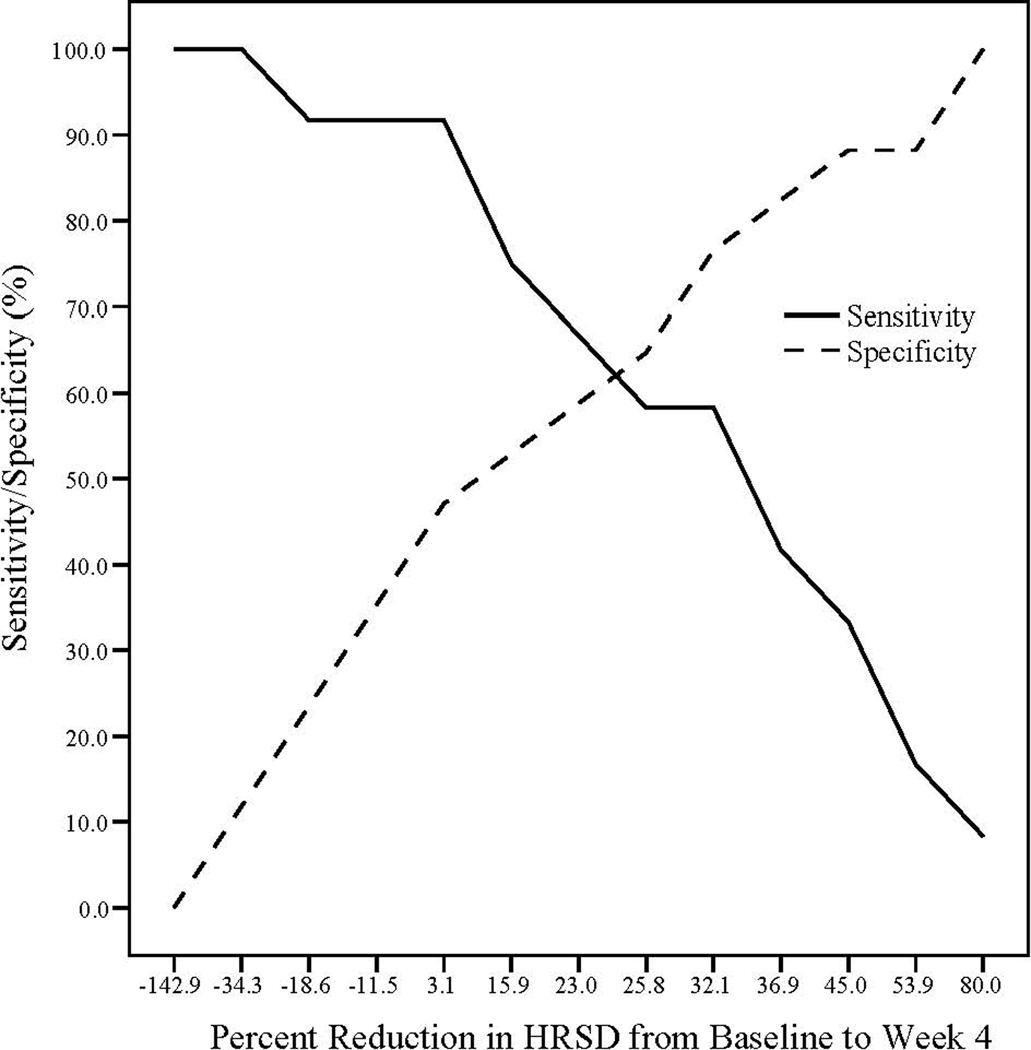
Receiver operating characteristic analysis was used to identify the time point and degree of reduction in HRSD that best predicted remission (HRSD <7) at the end of the trial (week 16). Week 4 was the best time point for classifying adolescents as likely to remit or not likely to remit for both IPT-A and TAU. A 16.2% reduction in HRSD from baseline represented the best combined sensitivity and specificity in predicting week 16 remission status for adolescents treated with IPT-A. A 24.4% reduction in depressive symptoms represented the best combined sensitivity and specificity in predicting remission status for TAU.
These findings provide preliminary evidence of one early marker of remission with IPT-A. Replication with larger samples would suggest that depressed adolescents who have not demonstrated at least a 16.2% reduction in their depressive symptoms after 4 weeks of IPT-A may benefit from a change in the treatment plan.
本研究旨在探讨在以学校为基础的健康诊所中接受人际心理治疗(IPT-A)或常规治疗(TAU)的抑郁青少年中,治疗过程中不同时间点抑郁症状的减轻是否能预测其缓解。
参与者是从一项随机对照临床试验中抽取的 63 名青少年(年龄 12-18 岁),该试验旨在检验 IPT-A Mufson 等人的有效性[2004;《普通精神病学档案》61:577-584]。青少年被随机分配接受由学校心理健康临床医生提供的 IPT-A 或 TAU。在基线和第 4、8、12 和 16 周(或提前终止)进行评估,包括汉密尔顿抑郁量表(HRSD;Hamilton [1967;《英国社会与临床心理学杂志》6:278-2962])。
使用受试者工作特征分析来确定 HRSD 最佳的时间点和降低程度,以预测试验结束时(第 16 周)的缓解(HRSD <7)。第 4 周是对IPT-A 和 TAU 治疗的青少年进行缓解或不缓解分类的最佳时间点。HRSD 基线值降低 16.2%是预测IPT-A 治疗青少年第 16 周缓解状态的最佳综合敏感性和特异性。抑郁症状减轻 24.4%是预测 TAU 缓解状态的最佳综合敏感性和特异性。
这些发现为IPT-A 缓解的一个早期标志物提供了初步证据。更大样本的复制可能表明,IPT-A 治疗 4 周后抑郁症状未减轻至少 16.2%的抑郁青少年可能受益于治疗计划的改变。