Beelen Karin, Opdam Mark, Severson Tesa M, Koornstra Rutger H T, Vincent Andrew D, Wesseling Jelle, Muris Jettie J, Berns Els M J J, Vermorken Jan B, van Diest Paul J, Linn Sabine C
Breast Cancer Res. 2014 Jan 21;16(1):R6. doi: 10.1186/bcr3598.
Activation of the phosphatidylinositol-3-kinase (PI3K) and/or mitogen-activated protein kinase (MAPK) pathways results in anti-estrogen resistance in vitro, but a biomarker with clinical validity to predict intrinsic resistance has not been identified. In metastatic breast cancer patients with previous exposure to endocrine therapy, the addition of a mammalian target of rapamycine (mTOR) inhibitor has been shown to be beneficial. Whether or not patients on adjuvant endocrine treatment might benefit from these drugs is currently unclear. A biomarker that predicts intrinsic resistance could potentially be used as companion diagnostic in this setting. We tested the clinical validity of different downstream-activated proteins in the PI3K and/or MAPK pathways to predict intrinsic tamoxifen resistance in postmenopausal primary breast cancer patients.
We recollected primary tumor tissue from patients who participated in a randomized trial of adjuvant tamoxifen (1-3 years) versus observation. After constructing a tissue micro-array, cores from 563 estrogen receptor α positive were immunostained for p-AKT(Thr308), p-AKT(Ser473), p-mTOR, p-p706SK and p-ERK1/2. Cox proportional hazard models for recurrence free interval were used to assess hazard ratios and interactions between these markers and tamoxifen treatment efficacy.
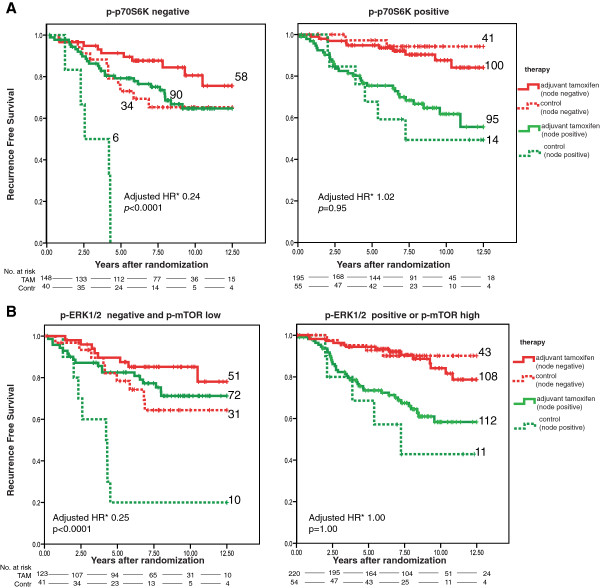
Interactions were identified between tamoxifen and p-AKT(Thr308), p-mTOR, p-p70S6K and p-ERK1/2. Applying a conservative level of significance, p-p70S6K remained significantly associated with tamoxifen resistance. Patients with p-p70S6K negative tumors derived significant benefit from tamoxifen (HR 0.24, P < 0.0001), while patients whose tumor did express p-p70S6K did not (HR = 1.02, P =0.95), P for interaction 0.004. In systemically untreated breast cancer patients, p-p70S6K was associated with a decreased risk for recurrence.
Patients whose tumor expresses p-p70S6K, as a marker of downstream PI3K and/or MAPK pathway activation, have a favorable prognosis, but do not benefit from adjuvant tamoxifen. A potential benefit from inhibitors of the PI3K/Akt/mTOR pathway in these patients needs to be further explored.
磷脂酰肌醇-3-激酶(PI3K)和/或丝裂原活化蛋白激酶(MAPK)通路的激活在体外会导致抗雌激素耐药,但尚未确定具有临床有效性的预测内在耐药性的生物标志物。在既往接受过内分泌治疗的转移性乳腺癌患者中,添加雷帕霉素哺乳动物靶点(mTOR)抑制剂已显示出益处。目前尚不清楚接受辅助内分泌治疗的患者是否能从这些药物中获益。一种预测内在耐药性的生物标志物在这种情况下可能用作伴随诊断。我们测试了PI3K和/或MAPK通路中不同下游激活蛋白预测绝经后原发性乳腺癌患者他莫昔芬内在耐药性的临床有效性。
我们从参与他莫昔芬辅助治疗(1 - 3年)与观察的随机试验的患者中重新收集原发性肿瘤组织。构建组织微阵列后,对563个雌激素受体α阳性样本的核心进行免疫染色,检测p-AKT(Thr308)、p-AKT(Ser473)、p-mTOR、p-p706SK和p-ERK1/2。使用无复发生存期的Cox比例风险模型评估风险比以及这些标志物与他莫昔芬治疗疗效之间的相互作用。
确定了他莫昔芬与p-AKT(Thr308)、p-mTOR、p-p70S6K和p-ERK1/2之间存在相互作用。采用保守的显著性水平,p-p70S6K仍与他莫昔芬耐药显著相关。肿瘤p-p70S6K阴性的患者从他莫昔芬中显著获益(风险比0.24,P < 0.0001),而肿瘤表达p-p70S6K的患者则未获益(风险比 = 1.02,P = 0.95),相互作用P值为0.004。在未经全身治疗的乳腺癌患者中,p-p70S6K与复发风险降低相关。
肿瘤表达p-p70S6K的患者,作为PI3K和/或MAPK通路下游激活的标志物,预后良好,但不能从辅助他莫昔芬治疗中获益。这些患者中PI3K/Akt/mTOR通路抑制剂的潜在益处需要进一步探索。