Department of Molecular Biology, The Netherlands Cancer Institute, Amsterdam, The Netherlands; Department of Medical Oncology, The Netherlands Cancer Institute, Amsterdam, The Netherlands.
Int J Cancer. 2014 Sep 1;135(5):1257-63. doi: 10.1002/ijc.28769. Epub 2014 Feb 27.
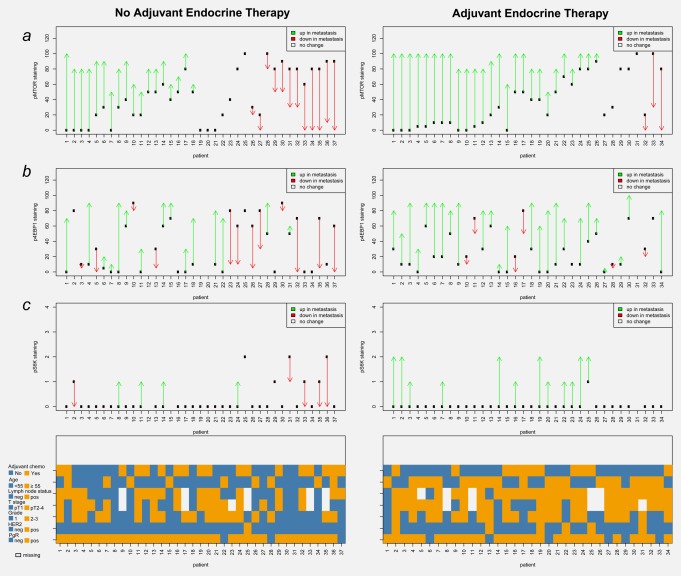
Both preclinical and clinical data suggest that activation of the PI3K/AKT/mTOR pathway in response to hormonal therapy results in acquired endocrine therapy resistance. We evaluated differences in activation of the PI3K/AKT/mTOR pathway in estrogen receptor α (ERα) positive primary and corresponding metastatic breast cancer tissues using immunohistochemistry for downstream activated proteins, like phosphorylated mTOR (p-mTOR), phosphorylated 4E Binding Protein 1 (p-4EBP1) and phosphorylated p70S6K (p-p70S6K). For p-mTOR and p-4EBP1, the proportion of immunostained tumor cells (0-100%) was scored. Cytoplasmic intensity (0-3) was assessed for p-p70S6K. The difference between expression of these activated PI3K/AKT/mTOR proteins- in primary and metastatic tumor was calculated and tested for an association with adjuvant endocrine therapy. In patients who had received endocrine therapy (N = 34), p-mTOR expression increased in metastatic tumor lesions compared to the primary tumor (median difference 45%), while in patients who had not received adjuvant endocrine therapy (N = 37), no difference was found. Similar results were observed for p-4EBP1 and p-p70S6K expression. In multivariate analyses, adjuvant endocrine therapy was significantly associated with an increase in p-mTOR (p = 0.01), p-4EBP1 (p = 0.03) and p-p70S6K (p = 0.001), indicating that compensatory activation of the PI3K/AKT/mTOR pathway might indeed be a clinically relevant resistance mechanism resulting in acquired endocrine therapy resistance.
临床前和临床数据均表明,激素治疗引起的 PI3K/AKT/mTOR 通路激活可导致获得性内分泌治疗耐药。我们通过免疫组化检测下游激活蛋白(如磷酸化 mTOR(p-mTOR)、磷酸化 4E 结合蛋白 1(p-4EBP1)和磷酸化 p70S6K(p-p70S6K))评估了 ERα 阳性原发性和相应转移性乳腺癌组织中 PI3K/AKT/mTOR 通路的激活差异。对于 p-mTOR 和 p-4EBP1,通过对免疫染色肿瘤细胞的比例(0-100%)进行评分。p-p70S6K 的细胞质强度(0-3)进行评估。计算这些激活的 PI3K/AKT/mTOR 蛋白在原发性和转移性肿瘤中的表达差异,并检测其与辅助内分泌治疗的相关性。在接受内分泌治疗的患者(N=34)中,与原发性肿瘤相比,转移性肿瘤病变中 p-mTOR 的表达增加(中位数差异为 45%),而在未接受辅助内分泌治疗的患者(N=37)中,未发现差异。p-4EBP1 和 p-p70S6K 表达也观察到了类似的结果。多变量分析表明,辅助内分泌治疗与 p-mTOR(p=0.01)、p-4EBP1(p=0.03)和 p-p70S6K(p=0.001)的增加显著相关,这表明 PI3K/AKT/mTOR 通路的代偿性激活可能确实是导致获得性内分泌治疗耐药的一种临床相关耐药机制。