Liao Ying-Yi, Yang Yea-Ru, Wu Yih-Ru, Wang Ray-Yau
Department of Physical Therapy and Assistive Technology, National Yang-Ming University, Taipei, Taiwan ; Department of Rehabilitation, Jen-Teh Junior College of Medicine, Nursing and Management, Miaoli, Taiwan.
Department of Physical Therapy and Assistive Technology, National Yang-Ming University, Taipei, Taiwan.
PLoS One. 2014 Jan 13;9(1):e84245. doi: 10.1371/journal.pone.0084245. eCollection 2014.
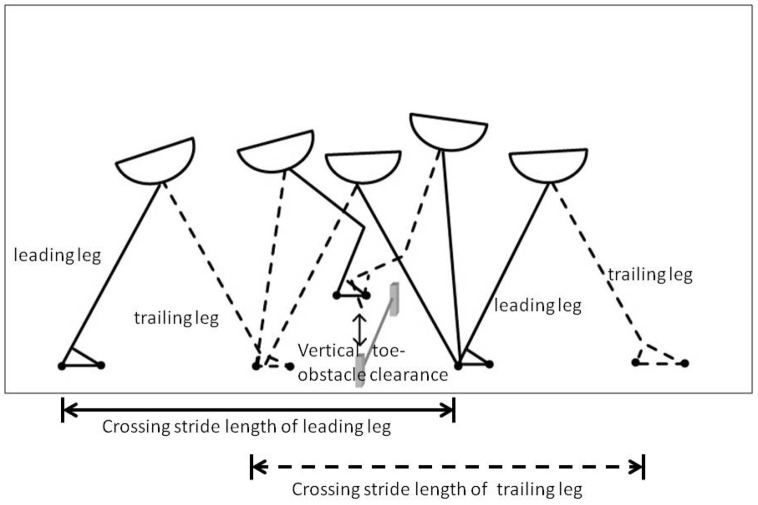
Tripping over obstacles is the major cause of falls in community-dwelling patients with Parkinson's disease (PD). Understanding the factors associated with the obstacle crossing behavior may help to develop possible training programs for crossing performance. This study aimed to identify the relationships and important factors determining obstacle crossing performance in patients with PD.
Forty-two idiopathic patients with PD (Hoehn and Yahr stages I to III) participated in this study. Obstacle crossing performance was recorded by the Liberty system, a three-dimensional motion capture device. Maximal isometric strength of the lower extremity was measured by a handheld dynamometer. Dynamic balance and sensory integration ability were assessed using the Balance Master system. Movement velocity (MV), maximal excursion (ME), and directional control (DC) were obtained during the limits of stability test to quantify dynamic balance. The sum of sensory organization test (SOT) scores was used to quantify sensory organization ability.
Both crossing stride length and stride velocity correlated significantly with lower extremity muscle strength, dynamic balance control (forward and sideward), and sum of SOT scores. From the regression model, forward DC and ankle dorsiflexor strength were identified as two major determinants for crossing performance (R(2) = .37 to.41 for the crossing stride length, R(2) = .43 to.44 for the crossing stride velocity).
Lower extremity muscle strength, dynamic balance control and sensory integration ability significantly influence obstacle crossing performance. We suggest an emphasis on muscle strengthening exercises (especially ankle dorsiflexors), balance training (especially forward DC), and sensory integration training to improve obstacle crossing performance in patients with PD.
在社区居住的帕金森病(PD)患者中,绊倒在障碍物上是跌倒的主要原因。了解与跨越障碍物行为相关的因素可能有助于制定改善跨越能力的训练方案。本研究旨在确定PD患者跨越障碍物能力的相关关系和重要决定因素。
42例特发性PD患者(Hoehn和Yahr分期为I至III期)参与了本研究。使用Liberty系统(一种三维运动捕捉设备)记录跨越障碍物的表现。用手持测力计测量下肢的最大等长肌力。使用Balance Master系统评估动态平衡和感觉整合能力。在稳定性极限测试中获取运动速度(MV)、最大偏移(ME)和方向控制(DC),以量化动态平衡。感觉组织测试(SOT)分数总和用于量化感觉组织能力。
跨越步长和步速均与下肢肌肉力量、动态平衡控制(向前和向侧方)以及SOT分数总和显著相关。根据回归模型,向前DC和踝背屈肌力量被确定为跨越表现的两个主要决定因素(跨越步长的R(2) = 0.37至0.41,跨越步速的R(2) = 0.43至0.44)。
下肢肌肉力量、动态平衡控制和感觉整合能力显著影响跨越障碍物的表现。我们建议着重进行肌肉强化训练(尤其是踝背屈肌)、平衡训练(尤其是向前DC)和感觉整合训练,以改善PD患者跨越障碍物的表现。