Department of Farm Animal Health, Faculty of Veterinary Medicine, Utrecht University, Utrecht, The Netherlands.
Department Bacteriology and TSEs, Central Veterinary Institute, part of Wageningen University and Research Centre, Lelystad, The Netherlands.
PLoS One. 2014 Jan 15;9(1):e85424. doi: 10.1371/journal.pone.0085424. eCollection 2014.
Q fever is a zoonosis caused by Coxiella burnetii, a Gram negative bacterium present worldwide. Small ruminants are considered the main reservoirs for infection of humans. This study aimed to estimate the extent of C. burnetii infection among sheep and goats in part of The Gambia.
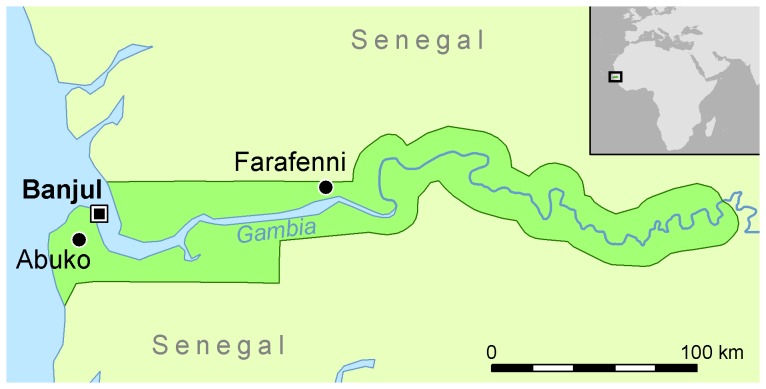
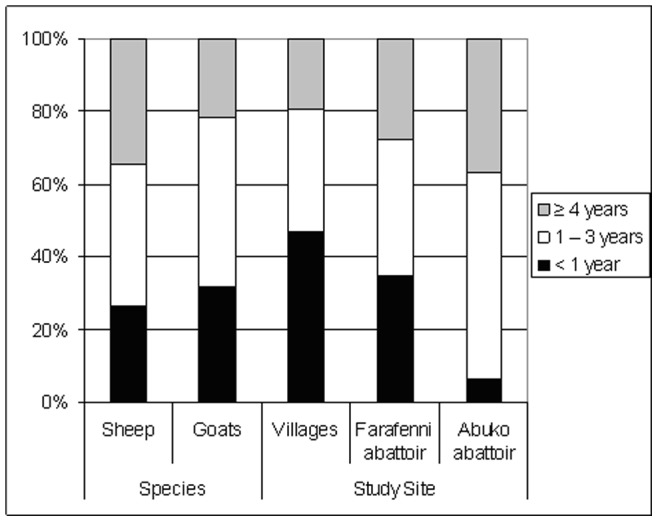
METHODOLOGY/PRINCIPAL FINDINGS: This survey was carried out from March to May 2012 at two areas in The Gambia. The first area comprised a cluster of seven rural villages situated 5-15 km west of Farafenni as well as the local abattoir. A second sampling was done at the central abattoir in Abuko (30 km from the capital, Banjul) in the Western Region. Serum samples were obtained from 490 goats and 398 sheep. In addition, 67 milk samples were obtained from lactating dams. Sera were tested with a Q fever ELISA kit. C. burnetii DNA was extracted from milk samples and then detected using a specific quantitative multiplex PCR assay, targeting the IS1111a element. A multivariable mixed logistic regression model was used to examine the relationship between seropositivity and explanatory variables. An overall seroprevalence of 21.6% was found. Goats had a significantly higher seroprevalence than sheep, respectively 24.2% and 18.5%. Seropositive animals were significantly older than seronegative animals. Animals from the villages had a significantly lower seroprevalence than animals from the central abattoir (15.1% versus 29.1%). C. burnetii DNA was detected in 2 out of 67 milk samples, whereas 8 samples gave a doubtful result.
CONCLUSION/SIGNIFICANCE: A substantial C. burnetii seroprevalence in sheep and goats in The Gambia was demonstrated. People living in close proximity to small ruminants are exposed to C. burnetii. Q fever should be considered as a possible cause of acute febrile illness in humans in The Gambia. Future studies should include a simultaneous assessment of veterinary and human serology, and include aetiology of febrile illness in local clinics.
Q 热是由贝氏柯克斯体引起的一种人畜共患病,这种革兰氏阴性菌广泛存在于世界各地。小反刍动物被认为是人类感染的主要宿主。本研究旨在评估冈比亚部分地区绵羊和山羊中贝氏柯克斯体的感染程度。
方法/主要发现:本调查于 2012 年 3 月至 5 月在冈比亚的两个地区进行。第一个地区包括位于法非尼以西 5-15 公里的七个农村村庄和当地的屠宰场。第二个采样点位于西部阿布库的中央屠宰场(距离首都班珠尔 30 公里)。从 490 只山羊和 398 只绵羊中采集血清样本。此外,还从哺乳期母羊中采集了 67 份奶样。使用 Q 热 ELISA 试剂盒检测血清。从奶样中提取贝氏柯克斯体 DNA,然后使用针对 IS1111a 元件的特异性定量多重 PCR 检测方法进行检测。采用多变量混合逻辑回归模型分析血清阳性率与解释变量之间的关系。结果发现,总体血清阳性率为 21.6%。与绵羊相比,山羊的血清阳性率显著更高,分别为 24.2%和 18.5%。血清阳性动物的年龄明显大于血清阴性动物。来自村庄的动物的血清阳性率明显低于来自中央屠宰场的动物(15.1%比 29.1%)。在 67 份奶样中,有 2 份检测到了贝氏柯克斯体 DNA,8 份样本结果可疑。
结论/意义:本研究表明,冈比亚的绵羊和山羊中存在大量的贝氏柯克斯体血清阳性率。与小反刍动物密切接触的人群接触到了贝氏柯克斯体。Q 热应被视为冈比亚人类急性发热性疾病的一个可能病因。未来的研究应同时评估兽医和人类的血清学,并包括当地诊所发热性疾病的病因。