Department of Orthopaedics , Lund University, Skåne University Hospital , Malmö
Acta Orthop. 2014 Feb;85(1):18-25. doi: 10.3109/17453674.2014.885356. Epub 2014 Jan 24.
Hemiarthroplasties are performed in great numbers worldwide but are seldom registered on a national basis. Our aim was to identify risk factors for reoperation after fracture-related hemiarthroplasty in Norway and Sweden.
A common dataset was created based on the Norwegian Hip Fracture Register and the Swedish Hip Arthroplasty Register. 33,205 hip fractures in individuals > 60 years of age treated with modular hemiarthroplasties were reported for the period 2005-2010. Cox regression analyses based on reoperations were performed (covariates: age group, sex, type of stem and implant head, surgical approach, and hospital volume).
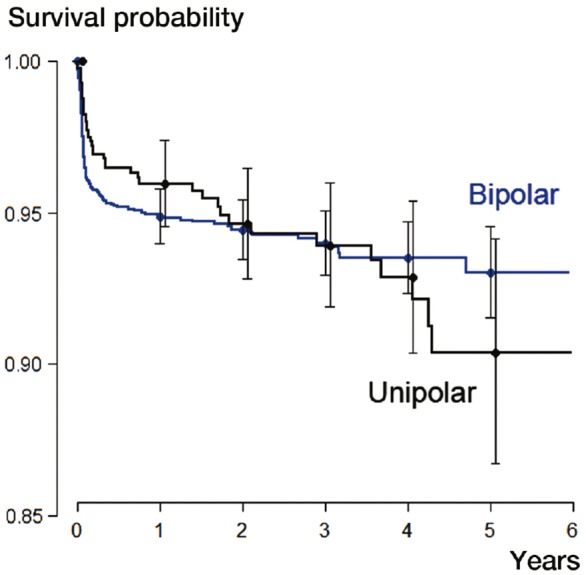
1,164 patients (3.5%) were reoperated during a mean follow-up of 2.7 (SD 1.7) years. In patients over 85 years, an increased risk of reoperation was found for uncemented stems (HR = 2.2, 95% CI: 1.7-2.8), bipolar heads (HR = 1.4, CI: 1.2-1.8), posterior approach (HR = 1.4, CI: 1.2-1.8) and male sex (HR = 1.3, CI: 1.0-1.6). For patients aged 75-85 years, uncemented stems (HR = 1.6, 95% CI: 1.2-2.0) and men (HR = 1.3, CI: 1.1-1.6) carried an increased risk. Increased risk of reoperation due to infection was found for patients aged < 75 years (HR = 1.5, CI: 1.1-2.0) and for uncemented stems. For open surgery due to dislocation, the strongest risk factor was a posterior approach (HR = 2.2, CI: 1.8-2.6). Uncemented stems in particular (HR = 3.6, CI: 2.4-5.3) and male sex increased the risk of periprosthetic fracture surgery.
Cemented stems and a direct lateral transgluteal approach reduced the risk of reoperation after hip fractures treated with hemiarthroplasty in patients over 75 years. Men and younger patients had a higher risk of reoperation. For the age group 60-74 years, there were no such differences in risk in this material.
全球范围内进行了大量的半髋关节置换术,但很少在全国范围内进行登记。我们的目的是确定挪威和瑞典与骨折相关的半髋关节置换术后再次手术的危险因素。
基于挪威髋关节骨折登记处和瑞典髋关节置换登记处创建了一个共同数据集。报告了 2005 年至 2010 年期间年龄在 60 岁以上接受模块化半髋关节置换术治疗的 33205 例髋关节骨折患者。对基于再手术的 Cox 回归分析进行了(协变量:年龄组、性别、柄和假体头类型、手术入路和医院量)。
3.5%(1164 例)患者在平均 2.7(SD 1.7)年的随访中接受了再次手术。在 85 岁以上的患者中,发现非骨水泥柄(HR=2.2,95%CI:1.7-2.8)、双极头(HR=1.4,CI:1.2-1.8)、后入路(HR=1.4,CI:1.2-1.8)和男性(HR=1.3,CI:1.0-1.6)的再次手术风险增加。对于 75-85 岁的患者,非骨水泥柄(HR=1.6,95%CI:1.2-2.0)和男性(HR=1.3,CI:1.1-1.6)的风险增加。感染导致的再手术风险增加见于年龄<75 岁的患者(HR=1.5,CI:1.1-2.0)和非骨水泥柄。对于因脱位而进行的开放性手术,最强的危险因素是后路(HR=2.2,CI:1.8-2.6)。非骨水泥柄(HR=3.6,CI:2.4-5.3)和男性特别增加了假体周围骨折手术的风险。
对于 75 岁以上的髋关节骨折患者,骨水泥柄和直接外侧经臀肌入路降低了半髋关节置换术后再次手术的风险。男性和年轻患者的再手术风险较高。对于 60-74 岁年龄组,在该材料中没有这种风险差异。