Gramage E, Li J, Hitchcock P
Department of Ophthalmology and Visual Sciences, W. K. Kellogg Eye Center, University of Michigan, Ann Arbor, MI, USA.
Br J Pharmacol. 2014 Feb;171(4):913-23. doi: 10.1111/bph.12495.
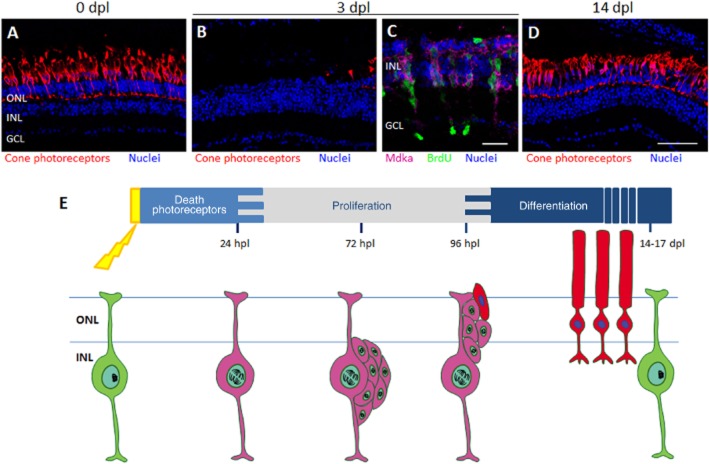
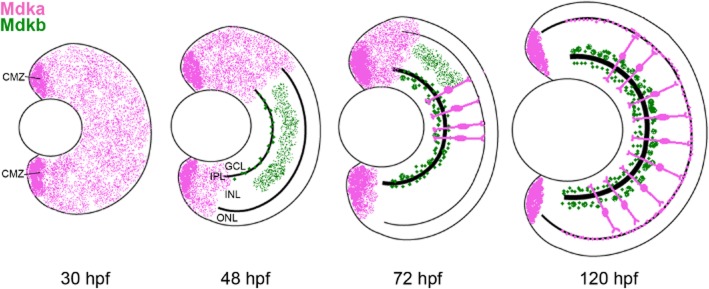
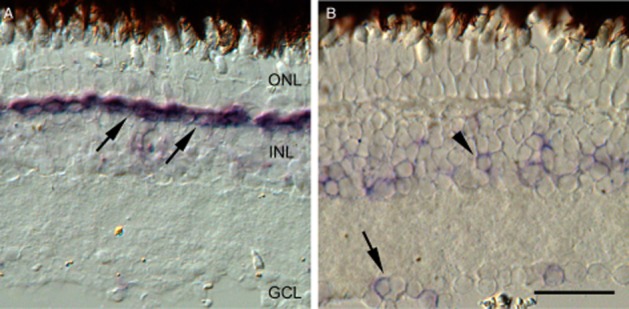
The functional role of midkine during development, following injury and in disease has been studied in a variety of tissues. In this review, we summarize what is known about midkine in the vertebrate retina, focusing largely on recent studies utilizing the zebrafish (Danio rerio) as an animal model. Zebrafish are a valuable animal model for studying the retina, due to its very rapid development and amazing ability for functional neuronal regeneration following neuronal cell death. The zebrafish genome harbours two midkine paralogues, midkine-a (mdka) and midkine-b (mdkb), which, during development, are expressed in nested patterns among different cell types. mdka is expressed in the retinal progenitors and mdkb is expressed in newly post-mitotic cells. Interestingly, studies of loss- and gain-of-function in zebrafish larvae indicate that midkine-a regulates cell cycle kinetics. Moreover, both mdka and mdkb are expressed in different cell types in the normal adult zebrafish retina, but after light-induced death of photoreceptors, both are up-regulated and expressed in proliferating Müller glia and photoreceptor progenitors, suggesting an important and (perhaps) coincident role for these cytokines during stem cell-based neuronal regeneration. Based on its known role in other tissues and the expression and function of the midkine paralogues in the zebrafish retina, we propose that midkine has an important functional role both during development and regeneration in the retina. Further studies are needed to understand this role and the mechanisms that underlie it.
This article is part of a themed section on Midkine. To view the other articles in this section visit http://dx.doi.org/10.1111/bph.2014.171.issue-4.
中期因子在发育、损伤后及疾病过程中的功能作用已在多种组织中得到研究。在本综述中,我们总结了脊椎动物视网膜中有关中期因子的已知信息,主要聚焦于近期利用斑马鱼(Danio rerio)作为动物模型的研究。斑马鱼是研究视网膜的一种有价值的动物模型,因为其发育非常迅速,且在神经元细胞死亡后具有惊人的功能性神经元再生能力。斑马鱼基因组含有两个中期因子旁系同源物,即中期因子-a(mdka)和中期因子-b(mdkb),在发育过程中,它们在不同细胞类型中呈嵌套模式表达。mdka在视网膜祖细胞中表达,mdkb在新的有丝分裂后细胞中表达。有趣的是,对斑马鱼幼虫进行的功能丧失和功能获得研究表明,中期因子-a调节细胞周期动力学。此外,mdka和mdkb在正常成年斑马鱼视网膜的不同细胞类型中均有表达,但在光诱导的光感受器死亡后,两者均上调并在增殖的穆勒胶质细胞和光感受器祖细胞中表达,这表明这些细胞因子在基于干细胞的神经元再生过程中具有重要且(可能)一致的作用。基于其在其他组织中的已知作用以及中期因子旁系同源物在斑马鱼视网膜中的表达和功能,我们提出中期因子在视网膜发育和再生过程中具有重要的功能作用。需要进一步研究以了解这一作用及其潜在机制。
本文是关于中期因子主题部分的一部分。若要查看本部分的其他文章,请访问http://dx.doi.org/10.1111/bph.2014.171.issue-4。