Hyun Cheol Hwan, Yoon Chae Young, Lee He-Jin, Lee Seung-Jae
Institute of Biomedical Science and Technology, School of Medicine, Konkuk University, Seoul 143-701, Korea.
Institute of Biomedical Science and Technology, School of Medicine, Konkuk University, Seoul 143-701, Korea. ; Department of Anatomy, School of Medicine, Konkuk University, Seoul 143-701, Korea.
Exp Neurobiol. 2013 Dec;22(4):249-57. doi: 10.5607/en.2013.22.4.249. Epub 2013 Dec 31.
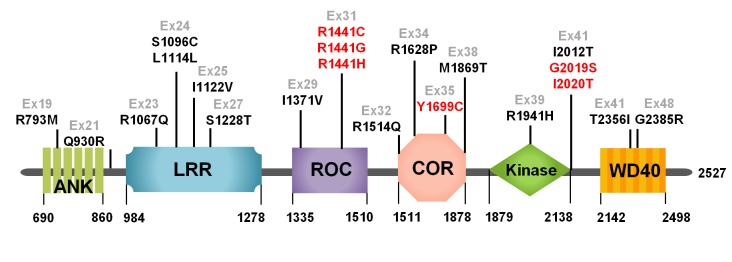
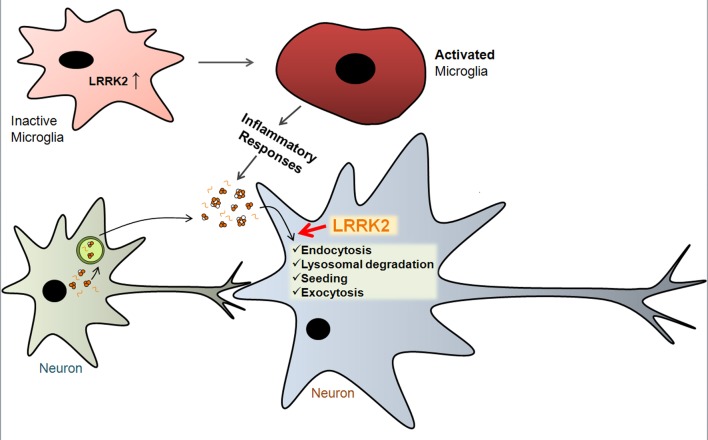
Parkinson's disease (PD) and related Lewy body diseases are characterized by deposition of α-synuclein aggregates in both the central nervous system and peripheral nervous system. Synucleinopathy lesions spread to larger brain areas as the disease progresses, and prion-like cell-to-cell transmission of aggregated α-synuclein is thought to be the underlying mechanism for this pathological spreading. LRRK2 is another protein linked to the pathogenesis of PD, and its presence in Lewy bodies has attracted much attention as to whether LRRK2 and α-synuclein interplay during the pathogenesis of PD. However, the relationship between these two crucial proteins still remains unclear. In this review article, we will discuss the current state of knowledge in terms of how these proteins cause the disease and provide the hypothetical mechanisms by which LRRK2 might modify the generation and progression of synucleinopathy.
帕金森病(PD)及相关路易体病的特征是α-突触核蛋白聚集体在中枢神经系统和外周神经系统中沉积。随着疾病进展,突触核蛋白病病变会扩散至更大的脑区,而聚集的α-突触核蛋白的朊病毒样细胞间传播被认为是这种病理扩散的潜在机制。富含亮氨酸重复激酶2(LRRK2)是另一种与PD发病机制相关的蛋白,其在路易小体中的存在引发了人们对LRRK2与α-突触核蛋白在PD发病过程中是否相互作用的诸多关注。然而,这两种关键蛋白之间的关系仍不清楚。在这篇综述文章中,我们将讨论关于这些蛋白如何导致疾病的当前知识状态,并提供LRRK2可能改变突触核蛋白病发生和进展的假设机制。