Department of Neuroscience, Kyung Hee University, Seoul 02447, Korea.
Department of Physiology, Kyung Hee University School of Medicine, Seoul 02447, Korea.
Cells. 2020 Nov 30;9(12):2565. doi: 10.3390/cells9122565.
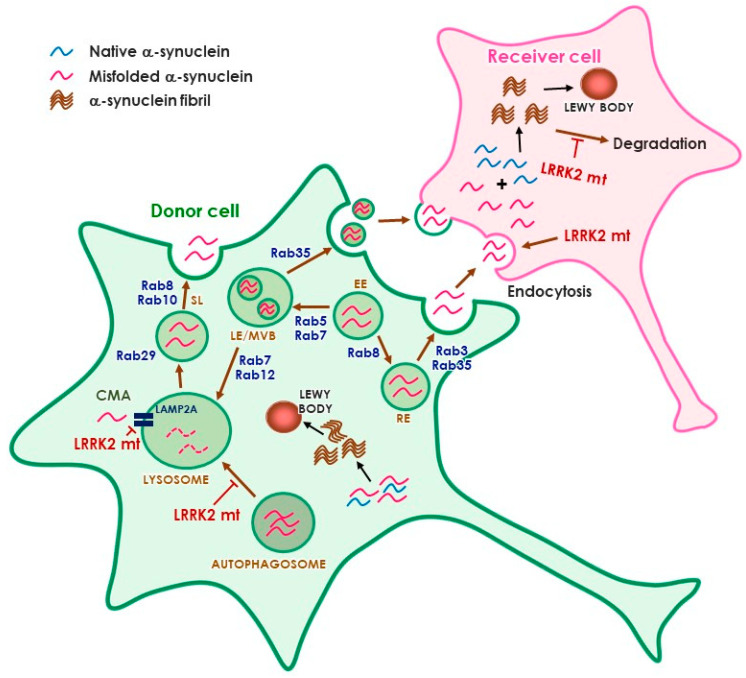
Mutations in the gene encoding leucine-rich repeat kinase 2 (LRRK2) are common genetic risk factors for both familial and sporadic Parkinson's disease (PD). Pathogenic mutations in LRRK2 have been shown to induce changes in its activity, and abnormal increase in LRRK2 kinase activity is thought to contribute to PD pathology. The precise molecular mechanisms underlying LRRK2-associated PD pathology are far from clear, however the identification of LRRK2 substrates and the elucidation of cellular pathways involved suggest a role of LRRK2 in microtubule dynamics, vesicular trafficking, and synaptic transmission. Moreover, LRRK2 is associated with pathologies of α-synuclein, a major component of Lewy bodies (LBs). Evidence from various cellular and animal models supports a role of LRRK2 in the regulation of aggregation and propagation of α-synuclein. Here, we summarize our current understanding of how pathogenic mutations dysregulate LRRK2 and discuss the possible mechanisms leading to neurodegeneration.
LRRK2 基因编码亮氨酸丰富重复激酶 2 的突变是家族性和散发性帕金森病 (PD) 的常见遗传风险因素。LRRK2 的致病性突变已被证明会导致其活性发生变化,并且 LRRK2 激酶活性的异常增加被认为有助于 PD 病理学。然而,LRRK2 相关 PD 病理学的确切分子机制尚不清楚,LRRK2 底物的鉴定和涉及的细胞途径的阐明表明 LRRK2 在微管动力学、囊泡运输和突触传递中起作用。此外,LRRK2 与α-突触核蛋白的病理学有关,α-突触核蛋白是路易体 (LB) 的主要成分。来自各种细胞和动物模型的证据支持 LRRK2 在调节 α-突触核蛋白的聚集和传播中的作用。在这里,我们总结了我们目前对致病突变如何使 LRRK2 失活的理解,并讨论了导致神经退行性变的可能机制。