Francis Jasmine H, Abramson David H, Gobin Y Pierre, Marr Brian P, Dunkel Ira J, Riedel Elyn R, Brodie Scott E
Ophthalmic Oncology Service, Memorial Sloan-Kettering Cancer Center, New York, New York, United States of America.
Ophthalmic Oncology Service, Memorial Sloan-Kettering Cancer Center, New York, New York, United States of America ; Department of Ophthalmology, Weill Cornell Medical College, New York, New York, United States of America.
PLoS One. 2014 Jan 20;9(1):e84247. doi: 10.1371/journal.pone.0084247. eCollection 2014.
To report electroretinogram responses of retinoblastoma children under anesthesia before and after treatment with chemotherapeutic drugs (melphalan, topotecan, carboplatin) delivery by ophthalmic artery chemosurgery (OAC).
A cohort study of 81 patients with retinoblastoma treated with OAC. All patients treated with OAC at our center through May 2012 for whom the requisite ERG data were available are included in the analysis. This study recorded the ERG 30 Hz flicker amplitude response changes from baseline, at 3 and 12 months following OAC treatment completion. Both univariate and multivariate linear regression models were evaluated, with generalized estimating equations to correct for correlations within patients. Independent numerical variables included maximum doses and cumulative doses of melphalan, topotecan and carboplatin.
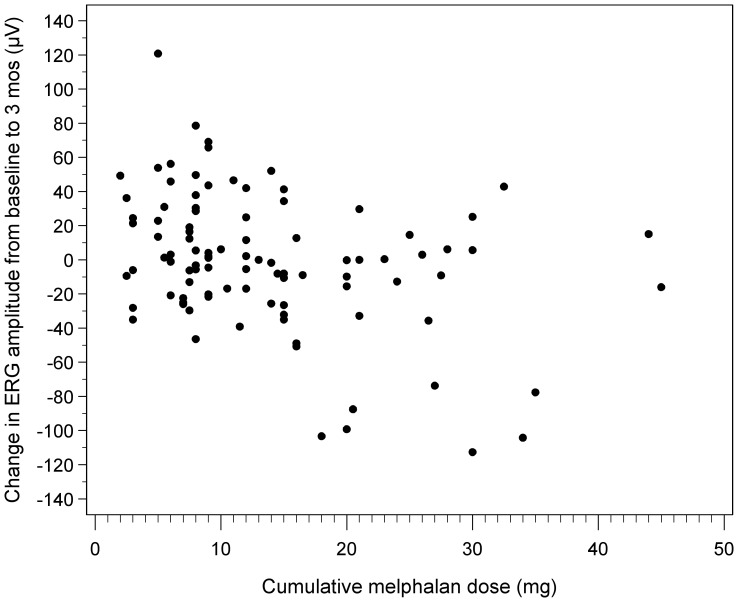
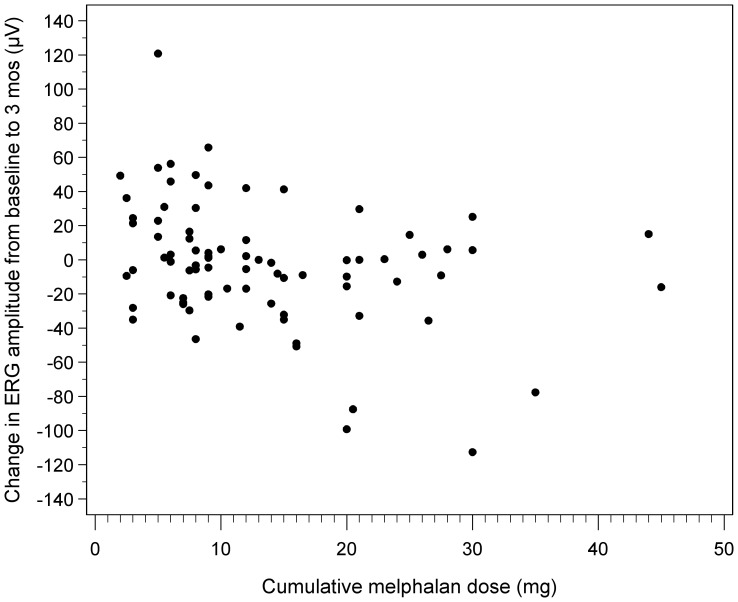
By univariate analysis, both melphalan and topotecan appear to be associated with changes in ERG amplitude at both 3 and 12 months; but for the most part, these changes are minimal and likely clinically insignificant. By multivariate analysis, maximum and cumulative melphalan have a modest, temporary effect on the ERG amplitude change, which is apparent at 3 months but no longer evident at 12 months after completing treatment. By multivariate analysis, topotecan and carboplatin do not appear to adversely effect the change in ERG response.
Melphalan has the strongest, and carboplatin the weakest association with reduction in ERG response amplitudes; but for the most part, these changes are minimal and likely clinically insignificant. These conclusions apply only over the dose ranges used here, and should be applied with caution.
报告视网膜母细胞瘤患儿在通过眼动脉化疗(OAC)给予化疗药物(美法仑、拓扑替康、卡铂)治疗前后麻醉状态下的视网膜电图反应。
对81例接受OAC治疗的视网膜母细胞瘤患者进行队列研究。纳入分析的患者为2012年5月前在本中心接受OAC治疗且有必要视网膜电图数据的所有患者。本研究记录了OAC治疗完成后3个月和12个月时视网膜电图30Hz闪烁振幅反应相对于基线的变化。评估了单变量和多变量线性回归模型,并使用广义估计方程校正患者内的相关性。独立数值变量包括美法仑、拓扑替康和卡铂的最大剂量和累积剂量。
单变量分析显示,美法仑和拓扑替康在3个月和12个月时似乎均与视网膜电图振幅变化有关;但在大多数情况下,这些变化很小,可能在临床上无显著意义。多变量分析显示,美法仑的最大剂量和累积剂量对视网膜电图振幅变化有适度的暂时影响,在治疗完成后3个月时明显,但在12个月时不再明显。多变量分析显示,拓扑替康和卡铂似乎不会对视网膜电图反应变化产生不利影响。
美法仑与视网膜电图反应振幅降低的关联最强,卡铂最弱;但在大多数情况下,这些变化很小,可能在临床上无显著意义。这些结论仅适用于此处使用的剂量范围,应用时应谨慎。