Xu Mingjie, Wen Xuefa, Wang Huimin, Zhang Wenjiang, Dai Xiaoqin, Song Jie, Wang Yidong, Fu Xiaoli, Liu Yunfen, Sun Xiaomin, Yu Guirui
Qianyanzhou Ecological Station, Key Laboratory of Ecosystem Network Observation and Modeling, Institute of Geographic Sciences and Natural Resources Research, Chinese Academy of Sciences, Beijing, China ; University of Chinese Academy of Sciences, Beijing, China.
Qianyanzhou Ecological Station, Key Laboratory of Ecosystem Network Observation and Modeling, Institute of Geographic Sciences and Natural Resources Research, Chinese Academy of Sciences, Beijing, China.
PLoS One. 2014 Jan 22;9(1):e85593. doi: 10.1371/journal.pone.0085593. eCollection 2014.
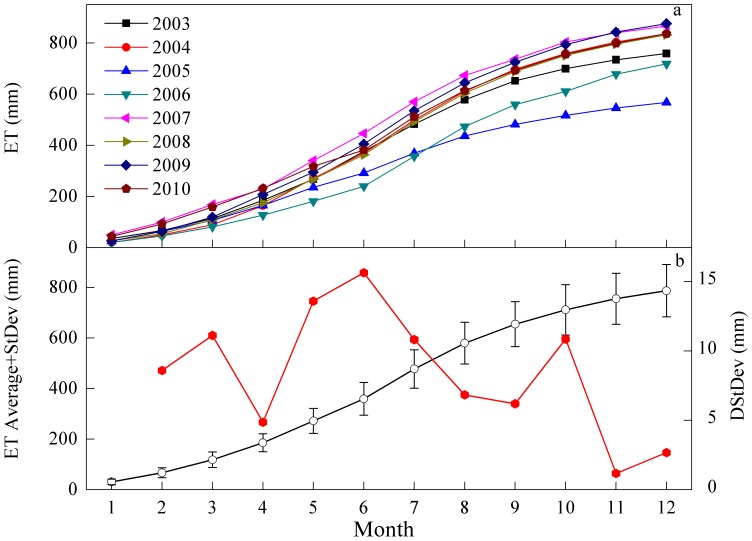
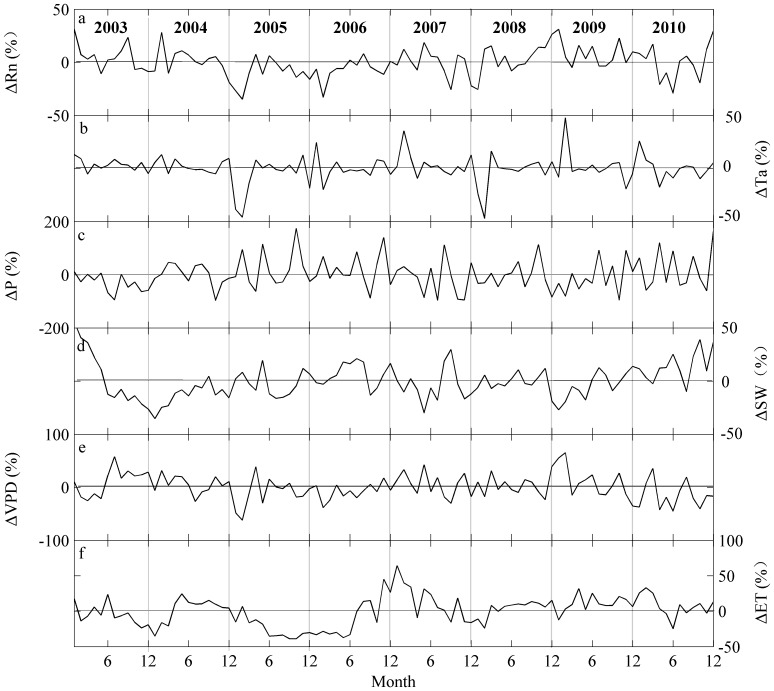
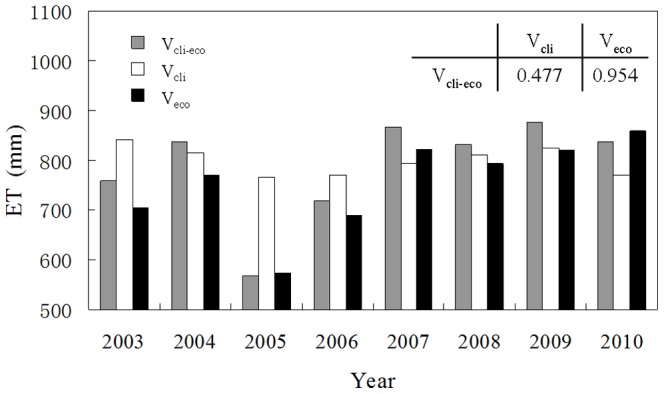
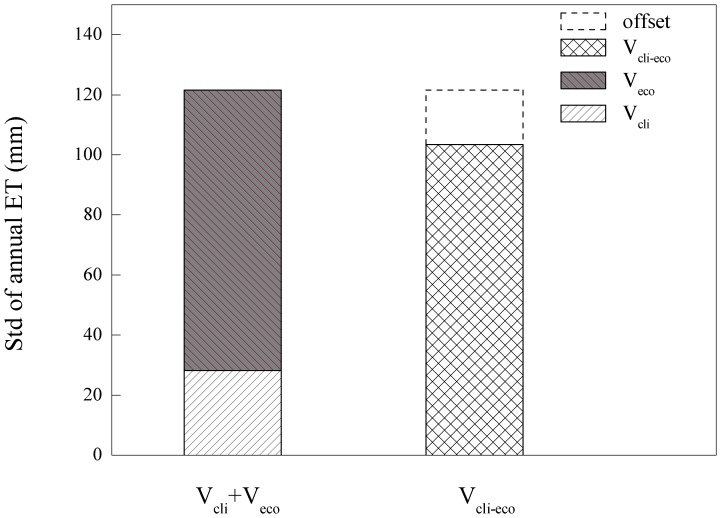
Because evapotranspiration (ET) is the second largest component of the water cycle and a critical process in terrestrial ecosystems, understanding the inter-annual variability of ET is important in the context of global climate change. Eight years of continuous eddy covariance measurements (2003-2010) in a subtropical coniferous plantation were used to investigate the impacts of climatic factors and ecosystem responses on the inter-annual variability of ET. The mean and standard deviation of annual ET for 2003-2010 were 786.9 and 103.4 mm (with a coefficient of variation of 13.1%), respectively. The inter-annual variability of ET was largely created in three periods: March, May-June, and October, which are the transition periods between seasons. A set of look-up table approaches were used to separate the sources of inter-annual variability of ET. The annual ETs were calculated by assuming that (a) both the climate and ecosystem responses among years are variable (Vcli-eco), (b) the climate is variable but the ecosystem responses are constant (Vcli), and (c) the climate is constant but ecosystem responses are variable (Veco). The ETs that were calculated under the above assumptions suggested that the inter-annual variability of ET was dominated by ecosystem responses and that there was a negative interaction between the effects of climate and ecosystem responses. These results suggested that for long-term predictions of water and energy balance in global climate change projections, the ecosystem responses must be taken into account to better constrain the uncertainties associated with estimation.
由于蒸散(ET)是水循环的第二大组成部分,也是陆地生态系统中的一个关键过程,因此在全球气候变化背景下了解ET的年际变化具有重要意义。利用亚热带针叶人工林连续八年(2003 - 2010年)的涡度协方差测量数据,研究气候因子和生态系统响应对ET年际变化的影响。2003 - 2010年年均ET及其标准差分别为786.9和103.4毫米(变异系数为13.1%)。ET的年际变化主要出现在三个时期:3月、5 - 6月和10月,这些都是季节之间的过渡时期。采用一组查找表方法来区分ET年际变化的来源。通过假设(a)年份间气候和生态系统响应均可变(Vcli - eco)、(b)气候可变但生态系统响应恒定(Vcli)、(c)气候恒定但生态系统响应可变(Veco)来计算年ET量。根据上述假设计算得到的ET量表明,ET的年际变化主要受生态系统响应主导,并且气候和生态系统响应的影响之间存在负相互作用。这些结果表明,在全球气候变化预测中对水和能量平衡进行长期预测时,必须考虑生态系统响应,以更好地限制与估计相关的不确定性。