Ricotta Carlo, Celesti-Grapow Laura, Kühn Ingolf, Rapson Gillian, Pyšek Petr, La Sorte Frank A, Thompson Ken
Department of Environmental Biology, University of Rome 'La Sapienza', Rome, Italy.
UFZ, Helmholtz Centre for Environmental Research, Department of Community Ecology, Halle, Germany ; German Centre for Integrative Biodiversity Research (iDiv) Halle-Jena-Leipzig, Leipzig, Germany.
PLoS One. 2014 Jan 22;9(1):e85661. doi: 10.1371/journal.pone.0085661. eCollection 2014.
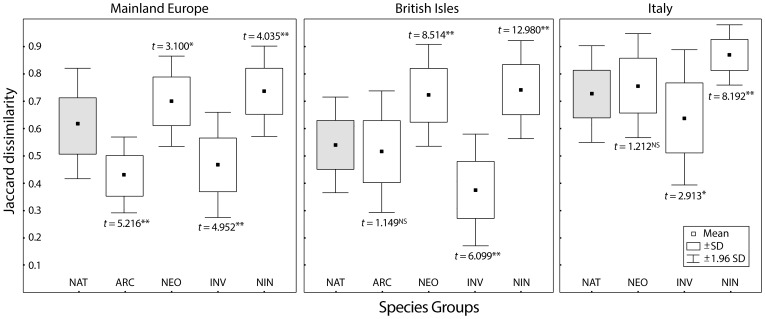
Understanding the mechanisms that affect invasion success of alien species is an important prerequisite for the effective management of present and future aliens. To gain insight into this matter we asked the following questions: Are the geographical patterns of species distributions in urban floras different for native compared with alien plant species? Does the introduction of alien species contribute to the homogenization of urban floras? We used a Mantel test on Jaccard dissimilarity matrices of 30 urban floras across the British Isles, Italy and central Europe to compare the spatial distribution of native species with four classes of alien species: archaeophytes, all neophytes, non-invasive neophytes, and invasive neophytes. Archaeophytes and neophytes are species that were introduced into Europe before and after 1500 AD, respectively. To analyze the homogenizing effect of alien species on the native urban floras, we tested for differences in the average dissimilarity of individual cities from their group centroid in ordination space. Our results show that the compositional patterns of native and alien species seem to respond to the same environmental drivers, such that all four classes of alien species were significantly related to native species across urban floras. In this framework, alien species may have an impact on biogeographic patterns of urban floras in ways that reflect their history of introduction and expansion: archaeophytes and invasive neophytes tended to homogenize, while non-invasive neophytes tended to differentiate urban floras.
了解影响外来物种入侵成功的机制是有效管理当前及未来外来物种的重要前提。为深入了解这一问题,我们提出了以下问题:与外来植物物种相比,城市植物区系中本地物种的地理分布模式是否不同?外来物种的引入是否有助于城市植物区系的同质化?我们对不列颠群岛、意大利和中欧的30个城市植物区系的杰卡德相似度矩阵进行了曼特尔检验,以比较本地物种与四类外来物种的空间分布:古植物、所有新植物、非入侵性新植物和入侵性新植物。古植物和新植物分别是在公元1500年之前和之后引入欧洲的物种。为了分析外来物种对本地城市植物区系的同质化影响,我们测试了单个城市在排序空间中与其组质心的平均差异。我们的结果表明,本地物种和外来物种的组成模式似乎对相同的环境驱动因素做出反应,因此在所有城市植物区系中,这四类外来物种都与本地物种显著相关。在此框架下,外来物种可能以反映其引入和扩张历史的方式对城市植物区系的生物地理模式产生影响:古植物和入侵性新植物倾向于使植物区系同质化,而非入侵性新植物则倾向于使城市植物区系分化。