Lee Justin A, Halpern Elise M, Lovblom Leif E, Yeung Emily, Bril Vera, Perkins Bruce A
Division of Endocrinology and Metabolism, Department of Medicine, University of Toronto, Ontario, Canada.
Division of Neurology, Department of Medicine, University of Toronto, Ontario, Canada.
PLoS One. 2014 Jan 22;9(1):e86515. doi: 10.1371/journal.pone.0086515. eCollection 2014.
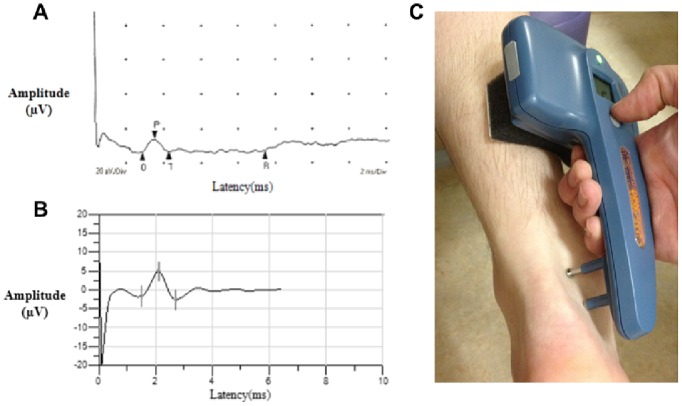
Confirmation of diabetic sensorimotor polyneuropathy (DSP) relies on standard nerve conduction studies (NCS) performed in specialized clinics. We explored the utility of a point-of-care device (POCD) for DSP detection by nontechnical personnel and a validation of diagnostic thresholds with those observed in a normative database.
44 subjects with type 1 and type 2 diabetes underwent standard NCS (reference method). Two nontechnical examiners measured sural nerve amplitude potential (SNAP) and conduction velocity (SNCV) using the POCD. Reliability was determined by intraclass correlation coefficients (ICC [2], [1]). Validity was determined by Bland-Altman analysis and receiver operating characteristic curves.
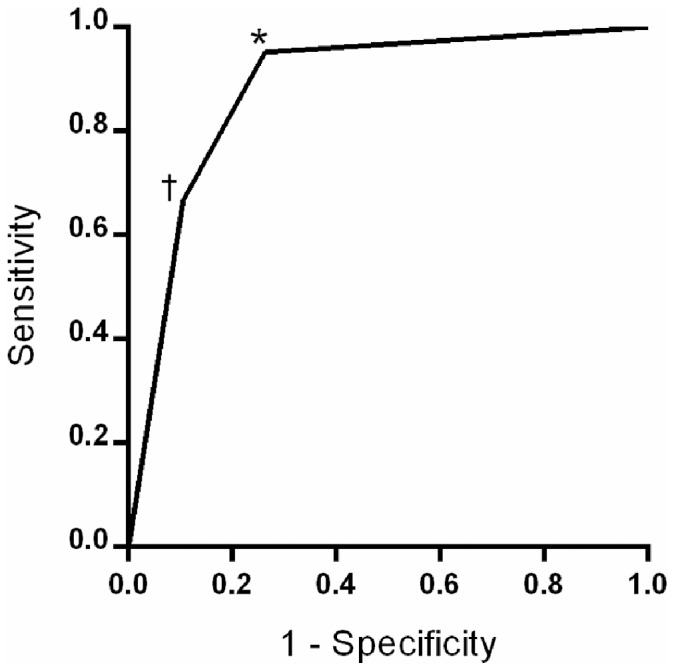
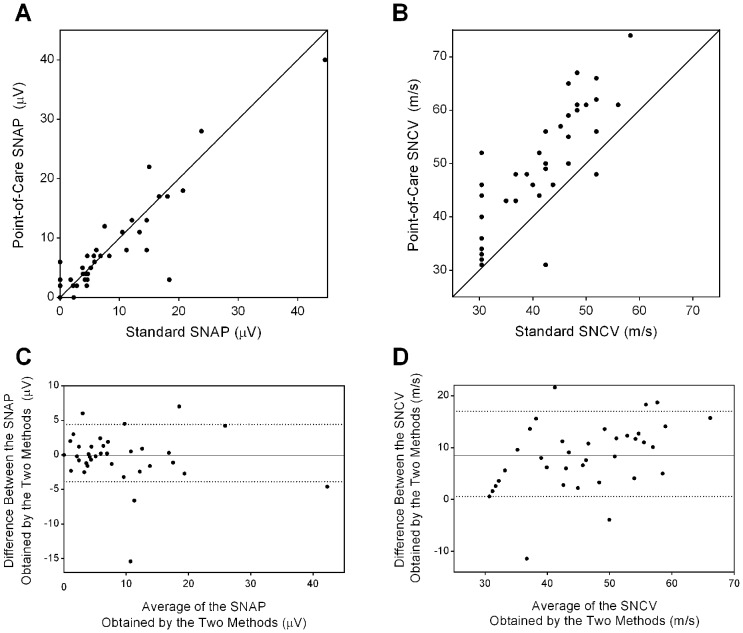
The 44 subjects (50% female) with mean age 56 ± 18 years had mean SNAP and SNCV of 8.0 ± 8.6 µV and 41.5 ± 8.2 m/s using standard NCS and 8.0 ± 8.2 µV and 49.9 ± 11.1 m/s using the POCD. Intrarater reproducibility ICC values were 0.97 for SNAP and 0.94 for SNCV while interrater reproducibility values were 0.83 and 0.79, respectively. Mean bias of the POCD was -0.1 ± 3.6 µV for SNAP and +8.4 ± 6.4 m/s for SNCV. A SNAP of ≤6 µV had 88% sensitivity and 94% specificity for identifying age-and height-standardized reference NCS values, while a SNCV of ≤48 m/s had 94% sensitivity and 82% specificity [corrected].. Abnormality in one or more of these thresholds was associated with 95% sensitivity and 71% specificity for identification of DSP according to electrophysiological criteria.
The POCD demonstrated excellent reliability and acceptable accuracy. Threshold values for DSP identification validated those of published POCD normative values. We emphasize the presence of measurement bias--particularly for SNCV--that requires adjustment of threshold values to reflect those of standard NCS.
糖尿病感觉运动性多发性神经病变(DSP)的确诊依赖于在专业诊所进行的标准神经传导研究(NCS)。我们探讨了一种即时检测设备(POCD)用于非专业人员检测DSP的效用,并对诊断阈值与在规范数据库中观察到的阈值进行了验证。
44名1型和2型糖尿病患者接受了标准NCS(参考方法)。两名非专业检查人员使用POCD测量腓肠神经动作电位(SNAP)和传导速度(SNCV)。可靠性通过组内相关系数(ICC[2,1])确定。有效性通过Bland-Altman分析和受试者工作特征曲线确定。
44名受试者(50%为女性),平均年龄56±18岁,使用标准NCS时平均SNAP和SNCV分别为8.0±8.6µV和41.5±8.2m/s,使用POCD时分别为8.0±8.2µV和49.9±11.1m/s。检查者内部重复性ICC值SNAP为0.97,SNCV为0.94,而检查者间重复性值分别为0.83和0.79。POCD的平均偏差SNAP为-0.1±3.6µV,SNCV为+8.4±6.4m/s。SNAP≤6µV对识别年龄和身高标准化的参考NCS值具有88%的敏感性和94%的特异性,而SNCV≤48m/s具有94%的敏感性和82%的特异性[校正后]。根据电生理标准,这些阈值中一个或多个异常与识别DSP的95%敏感性和71%特异性相关。
POCD显示出优异的可靠性和可接受的准确性。DSP识别的阈值验证了已发表的POCD规范值。我们强调存在测量偏差——尤其是对于SNCV——这需要调整阈值以反映标准NCS的阈值。