Department of Medicine, Kihoku Hospital, Wakayama Medical University, Wakayama, Japan.
J Diabetes Investig. 2018 Sep;9(5):1173-1181. doi: 10.1111/jdi.12818. Epub 2018 Mar 6.
AIM/INTRODUCTION: Studies on a novel point-of-care device for nerve conduction study called DPNCheck have been limited to Westerners. We aimed to clarify Japanese normal limits of nerve action potential amplitude (Amp) and conduction velocity by DPNCheck (investigation I), and the validity of DPNCheck to identify diabetic symmetric sensorimotor polyneuropathy (DSPN; investigation II).
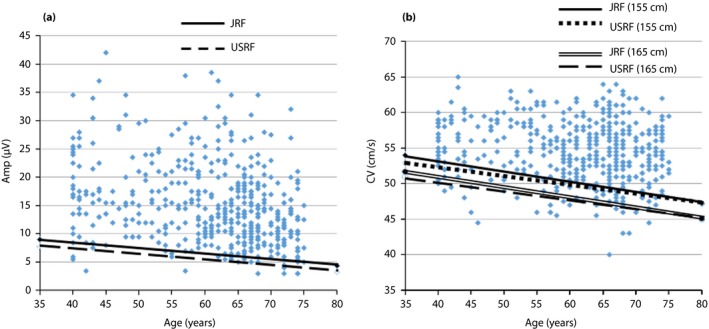
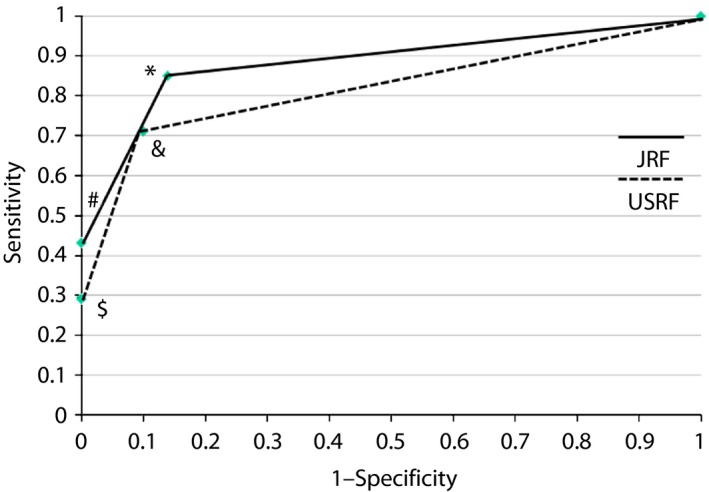
For investigation I, 463 non-neuropathic Japanese participants underwent DPNCheck examinations. Regression formulas calculating the normal limits of Amp and conduction velocity (Japanese regression formulas [JRF]) were determined by quantile regression and then compared with regression formulas of individuals from the USA (USRF). For investigation II, in 92 Japanese diabetes patients, 'probable DSPN' was diagnosed and nerve conduction abnormalities (NCA1: one or more abnormalities, and NCA2: two abnormalities in Amp and conduction velocity) were determined. Validity of NCAs to identify 'probable DSPN' was evaluated by determining sensitivity, specificity, reproducibility (kappa-coefficient) and the area under the curve of receiver operating characteristic curves.
For investigation I, JRF was different from USRF, and normal limits by JRF were higher than that of USRF. The prevalence of Amp abnormality calculated by JRF was significantly higher than that of USRF. For investigation II, the sensitivity, specificity and reproducibility of NCA1 and NCA2 judged from JRF were 85%, 86% and 0.57, and 43%, 100% and 0.56, respectively. These values of JRF were higher than those of USRF. The area under the curve of JRF (0.89) was larger than USRF (0.82).
A significant difference in the normal limits of nerve conduction parameters by DPNCheck between Japanese and USA individuals was suggested. Validity to identify DSPN of NCAs might improve by changing the judgment criteria from USRF to JRF.
目的/引言: 用于神经传导研究的新型即时检测设备 DPNCheck 的研究仅限于西方人。我们旨在通过 DPNCheck 明确日本的神经动作电位幅度(Amp)和传导速度的正常范围(研究 I),并验证 DPNCheck 识别糖尿病对称性感觉运动多发性神经病(DSPN;研究 II)的有效性。
对于研究 I,463 名无神经病变的日本参与者接受了 DPNCheck 检查。通过分位数回归确定计算 Amp 和传导速度正常范围的回归公式(日本回归公式[JRF]),并与来自美国的个体的回归公式(USRF)进行比较。对于研究 II,在 92 名日本糖尿病患者中,诊断为“可能的 DSPN”,并确定神经传导异常(NCA1:一种或多种异常,NCA2:Amp 和传导速度的两种异常)。通过确定灵敏度、特异性、重现性(kappa 系数)和接受者操作特征曲线下的面积,评估 NCAs 识别“可能的 DSPN”的有效性。
对于研究 I,JRF 与 USRF 不同,并且 JRF 的正常范围高于 USRF。根据 JRF 计算的 Amp 异常的患病率明显高于 USRF。对于研究 II,根据 JRF 判断的 NCA1 和 NCA2 的灵敏度、特异性和重现性分别为 85%、86%和 0.57,以及 43%、100%和 0.56。这些 JRF 的值高于 USRF。JRF 的曲线下面积(0.89)大于 USRF(0.82)。
建议 DPNCheck 用于神经传导参数的正常范围在日本人和美国人之间存在显著差异。通过将判断标准从 USRF 更改为 JRF,NCAs 识别 DSPN 的有效性可能会提高。