Sims Michelle, Salway Ruth, Langley Tessa, Lewis Sarah, McNeill Ann, Szatkowski Lisa, Gilmore Anna B
UK Centre for Tobacco and Alcohol Studies, Department for Health, University of Bath, Bath, UK.
Addiction. 2014 Jun;109(6):986-94. doi: 10.1111/add.12501. Epub 2014 Mar 10.
To examine whether government-funded tobacco control television advertising shown in England between 2002 and 2010 reduced adult smoking prevalence and cigarette consumption.
Analysis of monthly cross-sectional surveys using generalised additive models.
England.
More than 80 000 adults aged 18 years or over living in England and interviewed in the Opinions and Lifestyle Survey.
Current smoking status, smokers' daily cigarette consumption, tobacco control gross rating points (GRPs-a measure of per capita advertising exposure combining reach and frequency), cigarette costliness, tobacco control activity, socio-demographic variables.
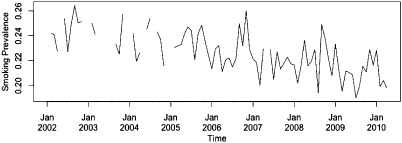
After adjusting for other tobacco control policies, cigarette costliness and individual characteristics, we found that a 400-point increase in tobacco control GRPs per month, equivalent to all adults in the population seeing four advertisements per month (although actual individual-level exposure varies according to TV exposure), was associated with 3% lower odds of smoking 2 months later [odds ratio (OR) = 0.97, 95% confidence interval (CI) = 0.95, 0.999] and accounted for 13.5% of the decline in smoking prevalence seen over this period. In smokers, a 400-point increase in GRPs was associated with a 1.80% (95%CI = 0.47, 3.11) reduction in average cigarette consumption in the following month and accounted for 11.2% of the total decline in consumption over the period 2002-09.
Government-funded tobacco control television advertising shown in England between 2002 and 2010 was associated with reductions in smoking prevalence and smokers' cigarette consumption.
研究2002年至2010年在英格兰播放的由政府资助的烟草控制电视广告是否降低了成人吸烟率和香烟消费量。
使用广义相加模型对月度横断面调查进行分析。
英格兰。
居住在英格兰的8万多名18岁及以上成年人,他们参与了意见和生活方式调查。
当前吸烟状况、吸烟者每日香烟消费量、烟草控制总收视率(GRPs,一种结合覆盖范围和频率的人均广告曝光量指标)、香烟成本、烟草控制活动、社会人口统计学变量。
在对其他烟草控制政策、香烟成本和个体特征进行调整后,我们发现,每月烟草控制GRPs增加400点,相当于全体成年人每月观看4条广告(尽管实际个体层面的曝光量因电视观看情况而异),与2个月后吸烟几率降低3%相关[比值比(OR)=0.97,95%置信区间(CI)=0.95,0.999],并占该时期吸烟率下降的13.5%。在吸烟者中,GRPs增加400点与次月平均香烟消费量降低1.80%(95%CI=0.47,3.11)相关,占2002年至2009年期间消费总量下降的11.2%。
2002年至2010年在英格兰播放的由政府资助的烟草控制电视广告与吸烟率降低和吸烟者香烟消费量减少有关。