Department of Clinical and Molecular Ophthalmogenetics, the Netherlands Institute for Neuroscience (NIN), Royal Netherlands Academy of Arts and Sciences (KNAW), Meibergdreef 47, Amsterdam 1105 BA, The Netherlands.
Fluids Barriers CNS. 2014 Jan 29;11(1):2. doi: 10.1186/2045-8118-11-2.
The neuroepithelia of the choroid plexus (CP) in the brain and the ciliary body (CB) of the eye have common embryological origins and share similar micro-structure and functions. The CP epithelium (CPE) and the non-pigmented epithelium (NPE) of the CB produce the cerebrospinal fluid (CSF) and the aqueous humor (AH) respectively. Production and outflow of the CSF determine the intracranial pressure (ICP); production and outflow of the AH determine the intraocular pressure (IOP). Together, the IOP and ICP determine the translaminar pressure on the optic disc which may be involved in the pathophysiology of primary open angle glaucoma (POAG). The aim of this study was to compare the molecular machinery of the secretory neuroepithelia of the CP and CB (CPE versus NPE) and to determine their potential role in POAG.
We compared the transcriptomes and functional annotations of healthy human CPE and NPE. Microarray and bioinformatic studies were performed using an Agilent platform and the Ingenuity Knowledge Database (IPA).
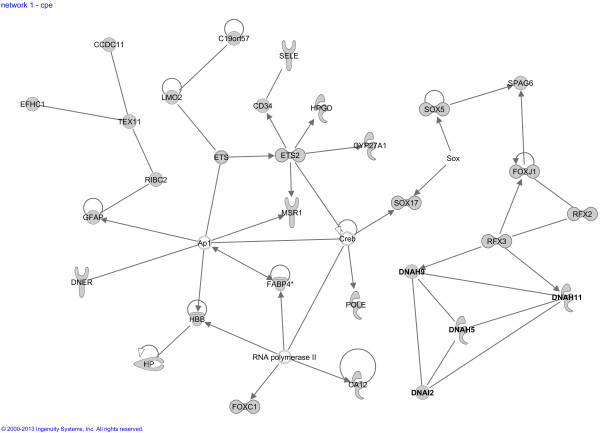
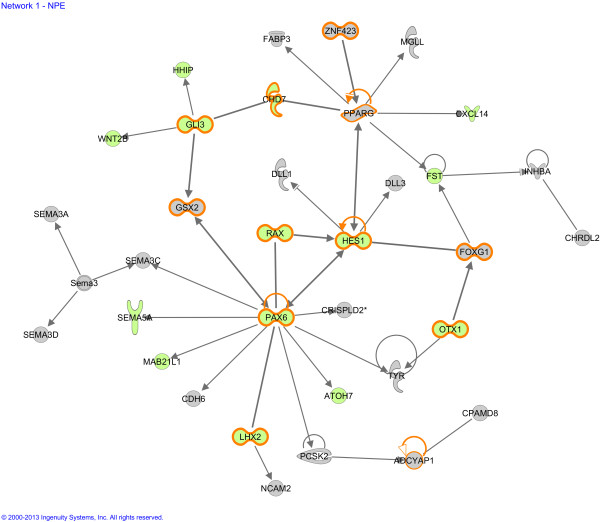
Based on gene expression profiles, we found many similar functions for the CPE and NPE including molecular transport, neurological disease processes, and immunological functions. With commonly-used selection criteria (fold-change > 2.5, p-value < 0.05), 14% of the genes were expressed significantly differently between CPE and NPE. When we used stricter selection criteria (fold-change > 5, p-value < 0.001), still 4.5% of the genes were expressed differently, which yielded specific functions for the CPE (ciliary movement and angiogenesis/hematopoiesis) and for the NPE (neurodevelopmental properties). Apart from a few exceptions (e.g. SLC12A2, SLC4A4, SLC4A10, KCNA5, and SCN4B), all ion transport protein coding genes involved in CSF and AH production had similar expression profiles in CPE and NPE. Three POAG disease genes were expressed significantly higher in the CPE than the NPE, namely CDH1, CDKN2B and SIX1.
The transcriptomes of the CPE and NPE were less similar than we previously anticipated. High expression of CSF/AH production genes and candidate POAG disease genes in the CPE and NPE suggest that both might be involved in POAG.
脑脉络丛(CP)的神经上皮和眼的睫状体(CB)具有共同的胚胎起源,具有相似的微观结构和功能。脉络丛上皮(CPE)和非色素上皮(NPE)分别产生脑脊液(CSF)和房水(AH)。CSF 的产生和流出决定颅内压(ICP);AH 的产生和流出决定眼内压(IOP)。IOP 和 ICP 共同决定视盘上的跨层压力,这可能与原发性开角型青光眼(POAG)的病理生理学有关。本研究旨在比较 CP 和 CB 的分泌性神经上皮(CPE 与 NPE)的分子机制,并确定它们在 POAG 中的潜在作用。
我们比较了健康人 CPE 和 NPE 的转录组和功能注释。使用安捷伦平台和 Ingenuity Knowledge Database(IPA)进行微阵列和生物信息学研究。
根据基因表达谱,我们发现 CPE 和 NPE 具有许多相似的功能,包括分子转运、神经疾病过程和免疫功能。使用常用的选择标准(倍数变化>2.5,p 值<0.05),CPE 和 NPE 之间有 14%的基因表达差异显著。当我们使用更严格的选择标准(倍数变化>5,p 值<0.001)时,仍然有 4.5%的基因表达不同,这为 CPE(睫状运动和血管生成/造血)和 NPE(神经发育特性)产生了特定的功能。除了少数例外(例如 SLC12A2、SLC4A4、SLC4A10、KCNA5 和 SCN4B),所有参与 CSF 和 AH 产生的离子转运蛋白编码基因在 CPE 和 NPE 中的表达模式相似。三个 POAG 疾病基因在 CPE 中的表达明显高于 NPE,即 CDH1、CDKN2B 和 SIX1。
CPE 和 NPE 的转录组比我们之前预期的要不相似。CPE 和 NPE 中 CSF/AH 产生基因和候选 POAG 疾病基因的高表达表明两者都可能参与 POAG。