University of Arizona, 1515 N. Campbell Ave., Cancer Center, Tucson, AZ 85724.
Cancer Prev Res (Phila). 2014 Apr;7(4):426-34. doi: 10.1158/1940-6207.CAPR-13-0269. Epub 2014 Jan 28.
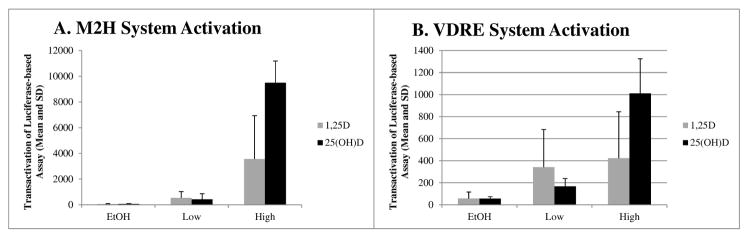
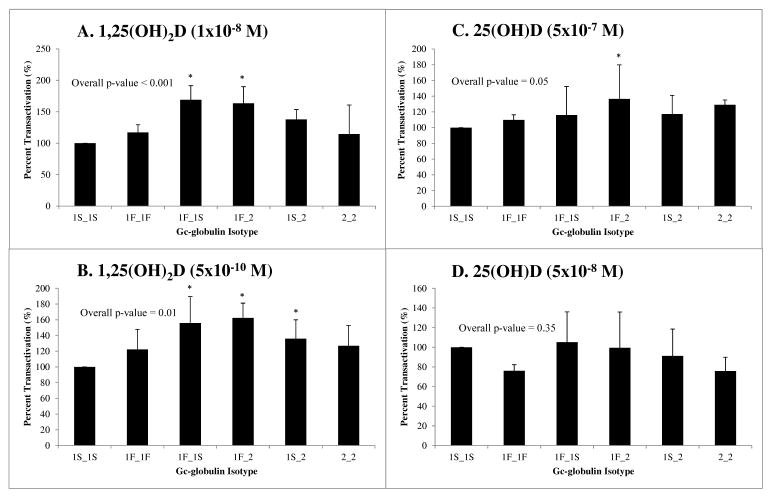
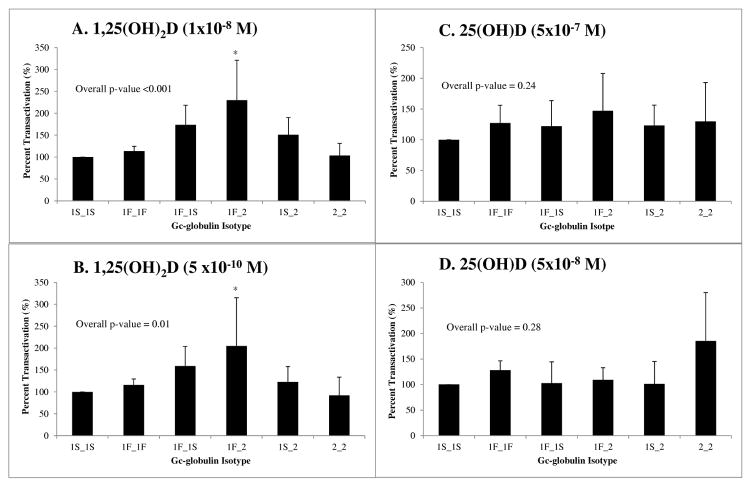
Vitamin D metabolites have been extensively studied as cancer chemopreventive agents. Gc-globulin (GC) isotypes, based on rs7041 and rs4588 diplotypes, have varying affinities for 1α,25-dihydroxyvitamin D (1,25(OH)2D) and 25-hydroxyvitamin D (25(OH)D), which may affect circulating metabolite concentration as well as delivery at the cellular level. We evaluated associations between GC isotype and circulating vitamin D metabolite concentrations in 403 ursodeoxycholic acid (UDCA) clinical trial participants. Metabolite uptake was evaluated in human colon cancer (HCT-116) cells treated with ethanol vehicle, 1,25(OH)2D, or 25(OH)D, and with plasma from individuals with known GC isotype. Mammalian-2-hybrid and vitamin D-responsive element-based luciferase assays were used to measure the vitamin D receptor pathway activation as a marker for metabolite uptake. Regression analysis demonstrated significantly lower serum 25(OH)D concentration for clinical trial participants with 1F_2, 1S_2, or 2_2 isotypes (P < 0.01) compared with 1S_1S. Consistent with these in vivo observations, cellular data revealed that 25(OH)D uptake varied less by GC isotype only at the higher concentration tested (P = 0.05), while 1,25(OH)2D uptake differed markedly by GC isotype across concentration and assay (P < 0.01). The 1F_1S and 1F_2 isotypes produced the greatest reporter gene induction with 1,25(OH)2D treatment and, while activation varied less with 25(OH)D, the 2_2 isotype demonstrated increased induction at the lower concentration. These results suggest that vitamin D metabolite concentration and delivery to colon cells may vary not only by GC isotype, but also that certain isotypes may more effectively deliver 1,25(OH)2D versus 25(OH)D. Overall, these results may help identify populations at risk for cancer and potential recipients of targeted chemoprevention.
维生素 D 代谢物已被广泛研究作为癌症化学预防剂。Gc-球蛋白(GC)同工型基于 rs7041 和 rs4588 二态性,对 1α,25-二羟维生素 D(1,25(OH)2D)和 25-羟维生素 D(25(OH)D)具有不同的亲和力,这可能会影响循环代谢物浓度以及细胞水平的输送。我们评估了 403 名熊去氧胆酸(UDCA)临床试验参与者的 GC 同工型与循环维生素 D 代谢物浓度之间的关联。用人结肠癌(HCT-116)细胞评估代谢物摄取,这些细胞用乙醇载体、1,25(OH)2D 或 25(OH)D 处理,并使用已知 GC 同工型的个体的血浆处理。哺乳动物-2-杂交和维生素 D 反应元件基础荧光素酶测定用于测量维生素 D 受体途径的激活作为代谢物摄取的标志物。回归分析表明,与 1S_1S 相比,具有 1F_2、1S_2 或 2_2 同工型的临床试验参与者的血清 25(OH)D 浓度显著降低(P < 0.01)。与这些体内观察结果一致,细胞数据显示,只有在较高浓度下,GC 同工型对 25(OH)D 的摄取差异较小(P = 0.05),而在整个浓度和测定中,GC 同工型对 1,25(OH)2D 的摄取差异显著(P < 0.01)。1F_1S 和 1F_2 同工型用 1,25(OH)2D 处理产生最大的报告基因诱导,而 25(OH)D 的激活变化较小,但 2_2 同工型在较低浓度下显示出诱导增加。这些结果表明,维生素 D 代谢物浓度和向结肠细胞的输送不仅可能因 GC 同工型而异,而且某些同工型可能更有效地输送 1,25(OH)2D 而不是 25(OH)D。总体而言,这些结果可能有助于识别癌症风险人群和潜在的靶向化学预防的接受者。