Albuquerque Carla Lorenna Ferreira de, Costa Marla da Paschoa, Nunes Felipe Moreira, Freitas Roberto Wagner Junior Freire de, Azevedo Paulo Roberto Medeiros de, Fernandes José Veríssimo, Rego Juciane Vaz, Barreto Humberto Medeiros
Universidade Federal do Piauí, Department of Health Sciences, FlorianoPiauí, Brazil.
Universidade Federal do Piauí, Department of Health Sciences, FlorianoPiauí, Brazil, Nursing Undergraduate, Department of Health Sciences, Universidade Federal do Piauí (UFPI), Floriano, Piauí, Brazil.
Sao Paulo Med J. 2014;132(1):3-9. doi: 10.1590/1516-3180.2014.1321551.
The Papanicolaou (Pap) test has been shown to be effective in preventing cervical cancer. However, both the national and international literature shows that Pap testing has not reached the level of coverage desired. The objective of this study was to assess women's knowledge, attitudes and practices regarding the Pap test and to investigate whether there are any associations between these three factors and the women's sociodemographic characteristics.
Cross-sectional descriptive study conducted in Floriano, Piauí.
The study was conducted among 493 women between November 2009 and December 2010. A questionnaire with precoded questions was sed, and the responses were analyzed in terms of appropriateness in relation to the Pap test.
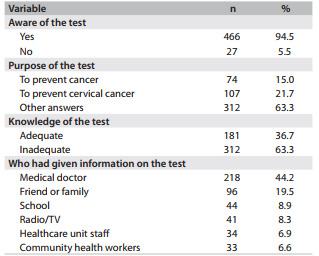
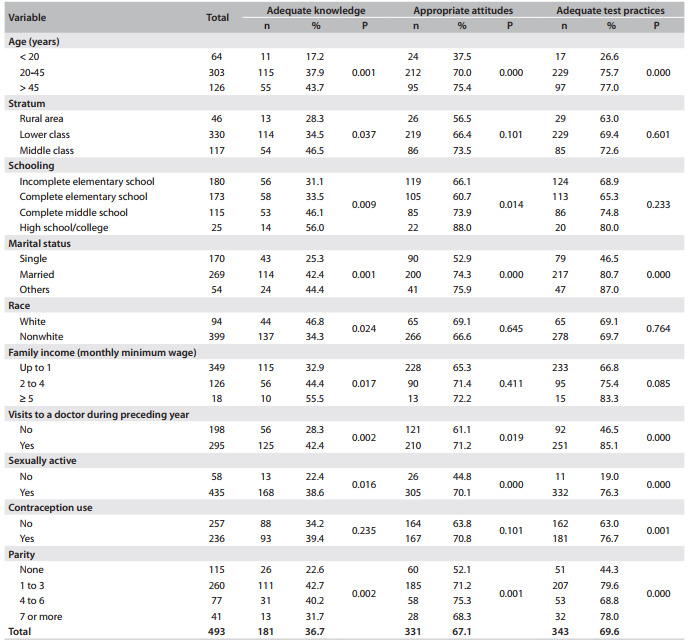
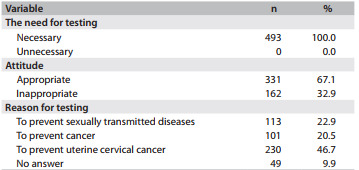
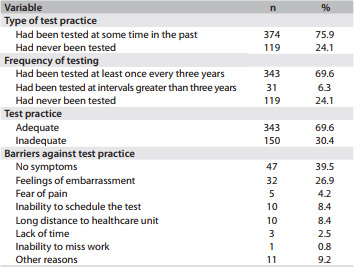
The degrees of adequacy of knowledge, attitudes and practices regarding the Pap test were 36.7%, 67.2% and 69.6%, respectively. Among the main barriers against testing, absence of symptoms and a sense of embarrassment were the most notable.
Women who visit doctors periodically had the most appropriate practices regarding the Pap test, but their knowledge of the procedure was poor. This suggests that these women were not receiving adequate information about the benefits of periodic testing.
巴氏涂片检查已被证明在预防宫颈癌方面有效。然而,国内外文献均表明巴氏涂片检查尚未达到理想的覆盖水平。本研究的目的是评估女性对巴氏涂片检查的知识、态度和行为,并调查这三个因素与女性社会人口学特征之间是否存在关联。
在皮奥伊州弗洛里亚诺进行的横断面描述性研究。
2009年11月至2010年12月期间,对493名女性进行了研究。使用了一份带有预编码问题的问卷,并根据与巴氏涂片检查的相关性对回答进行了分析。
巴氏涂片检查知识、态度和行为的充分程度分别为36.7%、67.2%和69.6%。在阻碍检查的主要因素中,无症状和尴尬感最为显著。
定期看医生的女性对巴氏涂片检查的行为最为恰当,但她们对该检查程序的了解较差。这表明这些女性没有得到关于定期检查益处的充分信息。