• 文献检索
  • 文档翻译
  • 深度研究
  • 学术资讯
  • Suppr Zotero 插件Zotero 插件
  • 邀请有礼
  • 套餐&价格
  • 历史记录
应用&插件
Suppr Zotero 插件Zotero 插件浏览器插件Mac 客户端Windows 客户端微信小程序
定价
高级版会员购买积分包购买API积分包
服务
文献检索文档翻译深度研究API 文档MCP 服务
关于我们
关于 Suppr公司介绍联系我们用户协议隐私条款
关注我们

Suppr 超能文献

核心技术专利:CN118964589B侵权必究
粤ICP备2023148730 号-1Suppr @ 2026

文献检索

告别复杂PubMed语法,用中文像聊天一样搜索,搜遍4000万医学文献。AI智能推荐,让科研检索更轻松。

立即免费搜索

文件翻译

保留排版,准确专业,支持PDF/Word/PPT等文件格式,支持 12+语言互译。

免费翻译文档

深度研究

AI帮你快速写综述,25分钟生成高质量综述,智能提取关键信息,辅助科研写作。

立即免费体验

[南美洲国家初级卫生保健环境中宫颈癌的控制:系统评价 南美洲国家初级卫生保健服务中宫颈癌的控制:系统评价]

[Control of cervical cancer in the primary care setting in South American countries: systematic reviewControl del cáncer cervicouterino en los servicios de atención primaria de salud en los países de América del Sur: revisión sistemática].

作者信息

Cerqueira Raisa Santos, Dos Santos Hebert Luan Pereira Campos, Prado Nilia Maria de Brito Lima, Bittencourt Rebecca Gusmão, Biscarde Daniela Gomes Dos Santos, Dos Santos Adriano Maia

机构信息

Universidade Federal da Bahia Programa de Pós-Graduação em Saúde Coletiva Vitória da Conquista (BA) Brasil Universidade Federal da Bahia, Programa de Pós-Graduação em Saúde Coletiva, Vitória da Conquista (BA), Brasil.

Universidade Federal da Bahia Escola de Enfermagem Salvador (BA) Brasil Universidade Federal da Bahia, Escola de Enfermagem, Salvador (BA), Brasil.

出版信息

Rev Panam Salud Publica. 2022 Aug 18;46:e107. doi: 10.26633/RPSP.2022.107. eCollection 2022.

DOI:10.26633/RPSP.2022.107
PMID:36016837
原文链接:https://pmc.ncbi.nlm.nih.gov/articles/PMC9395576/
Abstract

OBJECTIVE

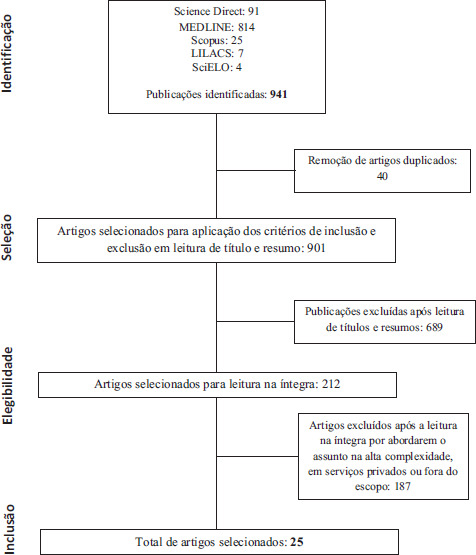
To describe cervical cancer (CC) prevention and control strategies in the primary care setting in South America.

METHOD

Two review steps were performed: review of documents published in governmental websites in Argentina, Bolivia, Brazil, Chile, Colombia, Ecuador, Paraguay, Peru, Uruguay, and Venezuela; and systematic review of the literature available in LILACS, MEDLINE, Scopus, SciELO, and Science Direct databases.

RESULTS

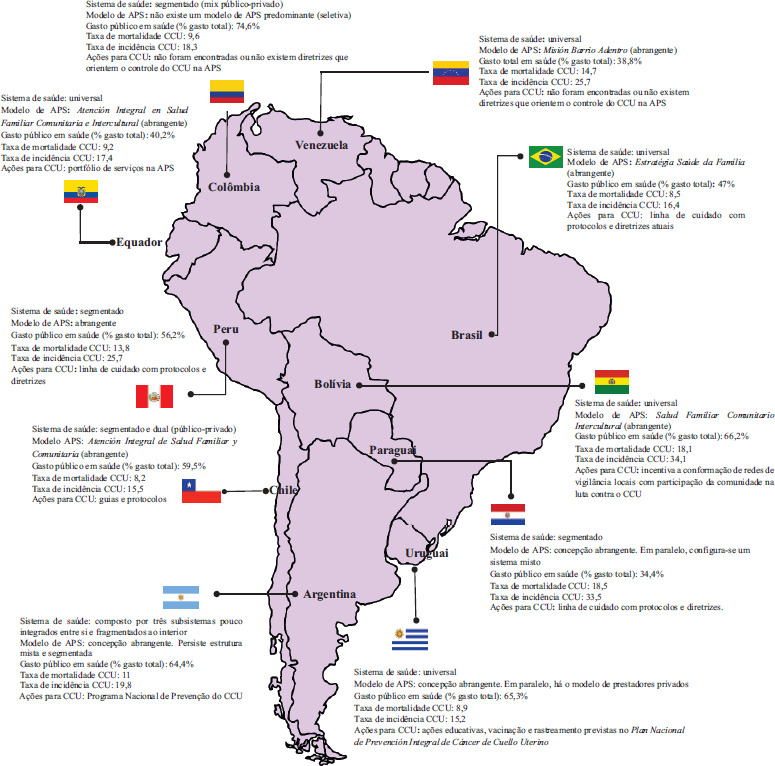
Twenty-one institutional documents (plans, practice guides, and national guidelines) and 25 journal articles were included. All countries had high CC morbidity and mortality rates. Screening in primary healthcare (PHC) was mostly opportunistic, although the institutional documents indicated an intention and strategies for early diagnosis and longitudinal follow-up of suspected and confirmed cases, preferably within the public healthcare system. All countries adopted a broad view of PHC, although the stage of PHC implementation was heterogeneous in different countries, with predominance of selective PHC. Access to screening was more difficult for women from rural or remote areas and for indigenous populations. The unavailability of PHC close to households/communities was an important barrier for CC screening.

CONCLUSIONS

The fragmentation of healthcare systems and the selective provision of services are barriers for the prevention and control of CC in South America. Organized CC screening programs and active search for Papanicolaou testing in primary care are needed. Intercultural practices and intersectional public policies are essential to overcome the inequities in CC control in South American countries.

摘要

目的

描述南美洲初级保健环境下的宫颈癌(CC)预防与控制策略。

方法

进行了两个综述步骤:查阅阿根廷、玻利维亚、巴西、智利、哥伦比亚、厄瓜多尔、巴拉圭、秘鲁、乌拉圭和委内瑞拉政府网站上发布的文件;对拉丁美洲和加勒比地区卫生科学数据库(LILACS)、医学文献数据库(MEDLINE)、Scopus数据库、科学电子图书馆在线(SciELO)和科学Direct数据库中的可用文献进行系统综述。

结果

纳入了21份机构文件(计划、实践指南和国家指南)和25篇期刊文章。所有国家的宫颈癌发病率和死亡率都很高。初级卫生保健(PHC)中的筛查大多是机会性的,尽管机构文件表明了对疑似和确诊病例进行早期诊断和纵向随访的意图和策略,最好是在公共卫生系统内进行。所有国家对初级卫生保健都有广泛的认识,尽管不同国家初级卫生保健的实施阶段各不相同,以选择性初级卫生保健为主。农村或偏远地区的妇女以及土著居民获得筛查的难度更大。家庭/社区附近缺乏初级卫生保健是宫颈癌筛查的一个重要障碍。

结论

卫生保健系统的碎片化和服务的选择性提供是南美洲宫颈癌预防与控制的障碍。需要有组织的宫颈癌筛查计划,并在初级保健中积极开展巴氏试验。跨文化实践和交叉性公共政策对于克服南美国家宫颈癌控制方面的不平等至关重要。
https://cdn.ncbi.nlm.nih.gov/pmc/blobs/42eb/9395576/6d7597666a83/rpsp-46-e107_Figure2.jpg
https://cdn.ncbi.nlm.nih.gov/pmc/blobs/42eb/9395576/506123bd050f/rpsp-46-e107_Figure1.jpg
https://cdn.ncbi.nlm.nih.gov/pmc/blobs/42eb/9395576/6d7597666a83/rpsp-46-e107_Figure2.jpg
https://cdn.ncbi.nlm.nih.gov/pmc/blobs/42eb/9395576/506123bd050f/rpsp-46-e107_Figure1.jpg
https://cdn.ncbi.nlm.nih.gov/pmc/blobs/42eb/9395576/6d7597666a83/rpsp-46-e107_Figure2.jpg

相似文献

1
[Control of cervical cancer in the primary care setting in South American countries: systematic reviewControl del cáncer cervicouterino en los servicios de atención primaria de salud en los países de América del Sur: revisión sistemática].[南美洲国家初级卫生保健环境中宫颈癌的控制:系统评价 南美洲国家初级卫生保健服务中宫颈癌的控制:系统评价]
Rev Panam Salud Publica. 2022 Aug 18;46:e107. doi: 10.26633/RPSP.2022.107. eCollection 2022.
2
[Primary health care for South-American indigenous peoples: an integrative review of the literatureAtención primaria en salud a indígenas de América del Sur: revisión integrativa de la bibliografía].[南美洲原住民的初级卫生保健:文献综合综述 南美洲原住民的初级卫生保健:文献综述]
Rev Panam Salud Publica. 2018 Oct 4;42:e163. doi: 10.26633/RPSP.2018.163. eCollection 2018.
3
Advanced Practice Nursing: A Strategy for Achieving Universal Health Coverage and Universal Access to Health.高级实践护理:实现全民健康覆盖和全民健康服务的一项战略。
Rev Lat Am Enfermagem. 2017 Jan 30;25:e2826. doi: 10.1590/1518-8345.1677.2826.
4
Beyond the black stump: rapid reviews of health research issues affecting regional, rural and remote Australia.超越黑木树:影响澳大利亚地区、农村和偏远地区的健康研究问题的快速综述。
Med J Aust. 2020 Dec;213 Suppl 11:S3-S32.e1. doi: 10.5694/mja2.50881.
5
Systematic literature review of primary and secondary cervical cancer prevention programs in South America.南美洲宫颈癌一级和二级预防项目的系统文献综述。
Rev Panam Salud Publica. 2023 Jul 3;47:e96. doi: 10.26633/RPSP.2023.96. eCollection 2023.
6
[COVID-19 infodemic management strategies in South AmericaEstrategias adoptadas en América del Sur para la gestión de la infodemia relacionada con la COVID-19].[南美洲的新冠疫情信息疫情管理策略:南美洲为管理与新冠疫情相关的信息疫情所采取的策略]
Rev Panam Salud Publica. 2021 May 12;45:e43. doi: 10.26633/RPSP.2021.43. eCollection 2021.
7
Prioritization of strategies to approach the judicialization of health in Latin America and the Caribbean.拉丁美洲和加勒比地区应对卫生司法化问题的策略优先次序
Rev Saude Publica. 2016 Sep 1;50:56. doi: 10.1590/S1518-8787.2016050005728.
8
Not All Discharge Settings Are Created Equal: Thirty-Day Readmission Risk after Elective Colorectal Surgery.并非所有出院环境都相同:择期结直肠手术后 30 天再入院风险。
Dis Colon Rectum. 2020 Sep;63(9):1302-1309. doi: 10.1097/DCR.0000000000001727.
9
[Regulations on expanded access and compassionate use of medicines in South AmericaRegulación de los programas de acceso ampliado y uso compasivo de medicamentos en América del Sur].[南美洲药品扩大可及性与同情用药法规]
Rev Panam Salud Publica. 2019 Jul 8;43:e57. doi: 10.26633/RPSP.2019.57. eCollection 2019.
10
[Toward a model of communications in public health in Latin America and the Caribbean].[迈向拉丁美洲和加勒比地区公共卫生通信模式]
Rev Panam Salud Publica. 2005 Dec;18(6):427-38. doi: 10.1590/s1020-49892005001000006.

引用本文的文献

1
[Cervical cancer screening in Brazil: a coverage analysis using the Brazilian Cancer Information System].[巴西的宫颈癌筛查:使用巴西癌症信息系统进行的覆盖率分析]
Cad Saude Publica. 2025 Aug 22;41(8):e00152224. doi: 10.1590/0102-311XPT152224. eCollection 2025.
2
[Educational strategy for prevention of cervical cancer in Indigenous peoples: a participatory action research experience].[原住民预防宫颈癌的教育策略:一项参与式行动研究经验]
Cad Saude Publica. 2025 Apr 25;41(4):e00170423. doi: 10.1590/0102-311XES170423. eCollection 2025.
3
Service Delivery Redesign for Noncommunicable Disease Management: Assessment of Needs and Solutions Through a Co-Creation Process in Argentina.

本文引用的文献

1
An Intersectional Perspective on the Utilization of Cervical Cancer Screening among Migrants. A Cross-Sectional Analysis of Survey Data from Austria.移民群体中宫颈癌筛查利用情况的交叉性视角:来自奥地利调查数据的横断面分析
Cancers (Basel). 2021 Dec 2;13(23):6082. doi: 10.3390/cancers13236082.
2
Quality of Actions to Control Cervical Cancer in Bahia, Brazil.巴西巴伊亚州控制宫颈癌的行动质量。
Asian Pac J Cancer Prev. 2021 Aug 1;22(8):2343-2349. doi: 10.31557/APJCP.2021.22.8.2343.
3
Elimination of cervical cancer in low- and middle-income countries: Inequality of access and fragile healthcare systems.
非传染性疾病管理的服务提供重新设计:通过阿根廷的共同创造过程评估需求与解决方案
Glob Health Sci Pract. 2024 Dec 20;12(6). doi: 10.9745/GHSP-D-24-00208.
4
Educational interventions for cervical cancer prevention: a scoping review.教育干预措施预防宫颈癌:范围综述。
Rev Bras Enferm. 2023 Nov 27;76(5):e20230018. doi: 10.1590/0034-7167-2023-0018. eCollection 2023.
5
Screening and hospitalization of breast and cervical cancer in Brazil from 2010 to 2022: A time-series study.2010 年至 2022 年巴西乳腺癌和宫颈癌的筛查和住院治疗:时间序列研究。
PLoS One. 2023 Oct 26;18(10):e0278011. doi: 10.1371/journal.pone.0278011. eCollection 2023.
中低收入国家消除宫颈癌:获取机会不平等和脆弱的医疗体系。
Int J Gynaecol Obstet. 2021 Jan;152(1):7-11. doi: 10.1002/ijgo.13458. Epub 2020 Dec 11.
4
Lifetime Prevalence of Cervical Cancer Screening in 55 Low- and Middle-Income Countries.55 个中低收入国家宫颈癌筛查终身流行率。
JAMA. 2020 Oct 20;324(15):1532-1542. doi: 10.1001/jama.2020.16244.
5
Cervical cancer burden in Latin America and the Caribbean: Where are we?拉美和加勒比地区的宫颈癌负担:我们处于什么位置?
Int J Cancer. 2020 Sep 15;147(6):1638-1648. doi: 10.1002/ijc.32956. Epub 2020 Apr 9.
6
Effect of organised cervical cancer screening on cervical cancer mortality in Europe: a systematic review.欧洲有组织的宫颈癌筛查对宫颈癌死亡率的影响:系统评价。
Eur J Cancer. 2020 Mar;127:207-223. doi: 10.1016/j.ejca.2019.12.013. Epub 2020 Jan 21.
7
A descriptive analysis of health practices, barriers to healthcare and the unmet need for cervical cancer screening in the Lower Napo River region of the Peruvian Amazon.秘鲁亚马逊地区下纳波河区域的健康行为、医疗保健障碍及宫颈癌筛查未满足需求的描述性分析。
Womens Health (Lond). 2019 Jan-Dec;15:1745506519890969. doi: 10.1177/1745506519890969.
8
[Healthcare trajectories and obstacles faced by women in a health region in Northeast Brazil].[巴西东北部某健康区域女性所面临的医疗保健轨迹及障碍]
Cad Saude Publica. 2019 Nov 28;35(12):e00004119. doi: 10.1590/0102-31100004119. eCollection 2019.
9
Estimating the public health impact of a national guideline on cervical cancer screening: an audit study of a program in Campinas, Brazil.估算国家宫颈癌筛查指南对公共卫生的影响:巴西坎皮纳斯项目的审计研究。
BMC Public Health. 2019 Nov 8;19(1):1492. doi: 10.1186/s12889-019-7846-2.
10
Optimizing high risk HPV-based primary screening for cervical cancer in low- and middle-income countries: opportunities and challenges.优化低收入和中等收入国家基于高危型人乳头瘤病毒的宫颈癌初筛:机遇与挑战
Minerva Ginecol. 2019 Oct;71(5):365-371. doi: 10.23736/S0026-4784.19.04468-X.