
CXCR4表达与乳腺癌预后:一项系统评价与Meta分析
Expression of CXCR4 and breast cancer prognosis: a systematic review and meta-analysis.
作者信息
Zhang Zhigang, Ni Chao, Chen Wuzhen, Wu Ping, Wang Zhen, Yin Junhua, Huang Jian, Qiu Fuming
机构信息
Cancer Institute (Key Laboratory of Cancer Prevention & Intervention, National Ministry of Education, Provincial Key Laboratory of Molecular Biology in Medical Sciences), The Second Affiliated Hospital, Zhejiang University School of Medicine, Hangzhou 310009, China.
出版信息
BMC Cancer. 2014 Jan 29;14:49. doi: 10.1186/1471-2407-14-49.
BACKGROUND
The chemokine receptor CXCR4 plays a significant role in biological processes, as well as in tumorigenesis and the progression of cancer, especially breast cancer. However, the clinical application of CXCR4 for breast cancer prognosis is still very limited. A meta-analysis based on published studies was performed with the aim of obtaining an accurate evaluation of the relationship between CXCR4 expression and the prognosis of breast cancer.
METHODS
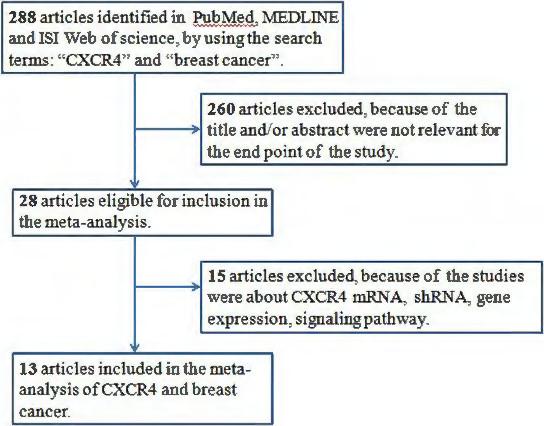
A comprehensive search strategy was used to search relevant literature in PubMed, MEDLINE and the ISI Web of Science. The correlation between CXCR4 expression and clinicopathological features and breast cancer prognosis was analyzed. This meta-analysis was carried out using Review Manager 4.2.
RESULT
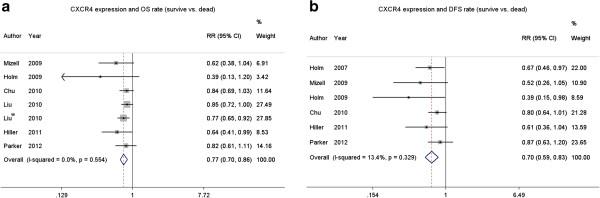
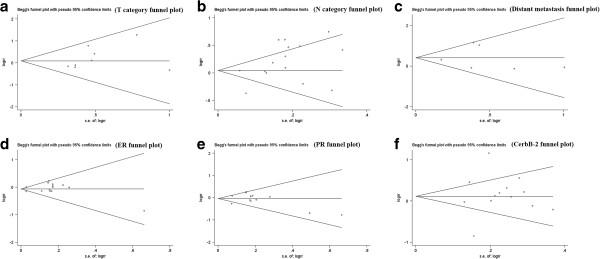
Thirteen eligible studies consisting of 3865 participants were included. We found that breast cancers with CXCR4 expression were associated with lymph node status (pooled RR =1.20, 95% CI: 1.01-1.43, P<0.001) and distant metastasis (pooled RR =1.52, 95% CI: 1.17-1.98, P = 0.125). CXCR4 overexpression was significantly associated with disease free survival (DFS) (RR = 0.77, 95% CI = 0.70-0.86, P = 0.554) and overall survival (OS) (RR = 0.70, 95% CI = 0.59-0.83, P = 0.329). However, there was no significant association between CXCR4 expression and some clinical parameters of breast cancer, such as tumor category, ER status, PR status, or c-erbB-2 status.
CONCLUSION
Our meta-analysis showed that CXCR4 is an efficient prognostic factor for breast cancer. Overexpression of CXCR4 was significantly associated with lymph node status and distant metastasis and indicated poor overall and disease free survival.
背景
趋化因子受体CXCR4在生物过程以及肿瘤发生和癌症进展(尤其是乳腺癌)中发挥着重要作用。然而,CXCR4在乳腺癌预后中的临床应用仍然非常有限。为了准确评估CXCR4表达与乳腺癌预后之间的关系,我们基于已发表的研究进行了一项荟萃分析。
方法
采用全面的检索策略在PubMed、MEDLINE和ISI Web of Science中检索相关文献。分析CXCR4表达与临床病理特征及乳腺癌预后之间的相关性。本荟萃分析使用Review Manager 4.2进行。
结果
纳入了13项符合条件的研究,共3865名参与者。我们发现,CXCR4表达阳性的乳腺癌与淋巴结状态(合并RR = 1.20,95%CI:1.01 - 1.43,P < 0.001)和远处转移(合并RR = 1.52,95%CI:1.17 - 1.98,P = 0.125)相关。CXCR4过表达与无病生存期(DFS)(RR = 0.77,95%CI = 0.70 - 0.86,P = 0.554)和总生存期(OS)(RR = 0.70,95%CI = 0.59 - 0.83,P = 0.329)显著相关。然而,CXCR4表达与乳腺癌的一些临床参数,如肿瘤类别、雌激素受体(ER)状态、孕激素受体(PR)状态或c-erbB-2状态之间无显著关联。
结论
我们的荟萃分析表明,CXCR4是乳腺癌的一个有效预后因素。CXCR4过表达与淋巴结状态和远处转移显著相关,提示总生存期和无病生存期较差。


 Zotero 插件